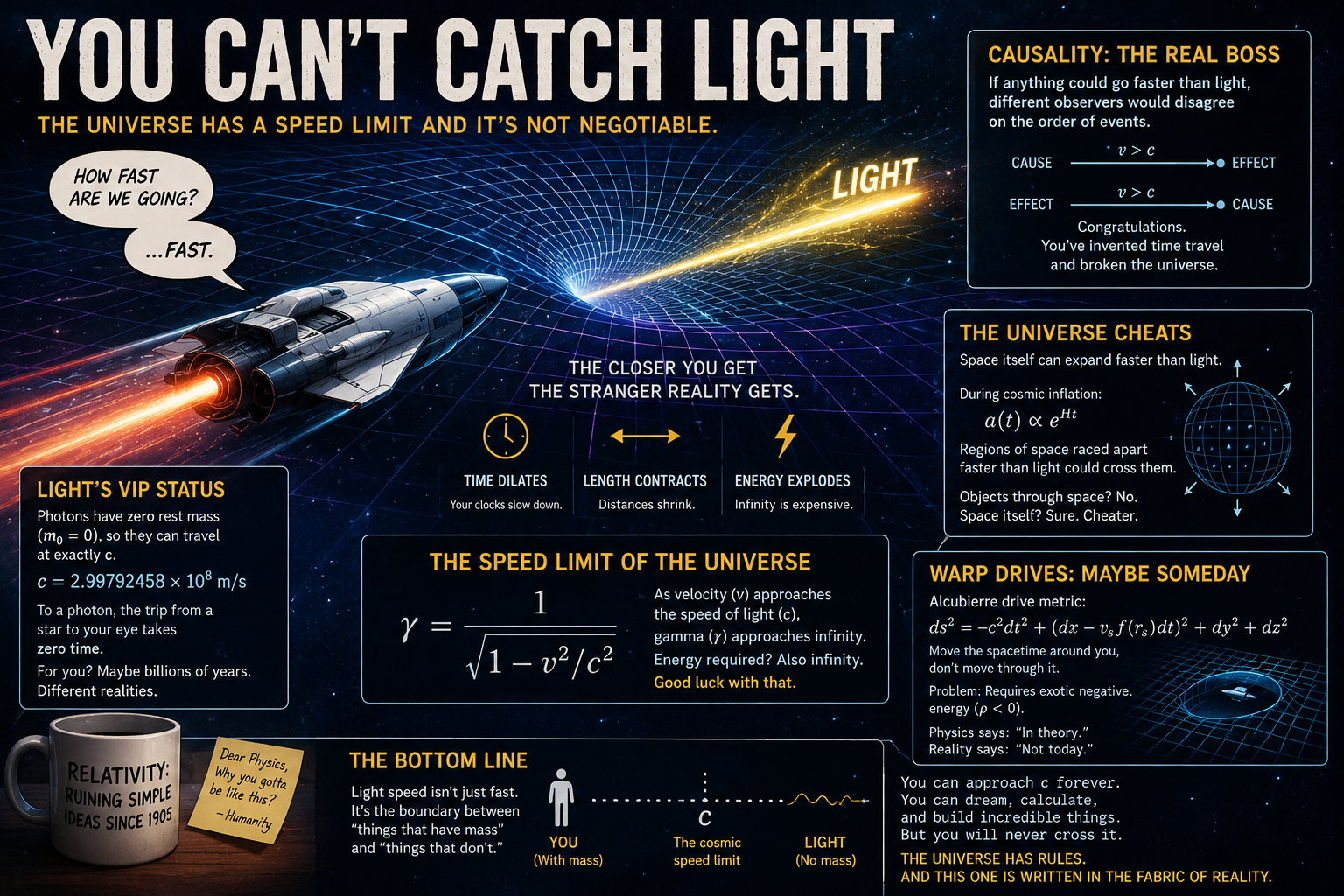
Why You Will Never Reach the Speed of Light — No Matter How Petty, Rich, or Technologically Advanced We Become
Humanity has an unhealthy relationship with limits.
Every time nature says “absolutely not,” civilization collectively responds like a drunk engineer at 2 a.m.:
“Okay… but what if we rotate it slightly?”
Mountains? Climbed.
The atmosphere? Escaped.
The atom? Split.
The Moon? Visited six times, then ghosted for fifty years like a toxic ex.
So naturally, the moment physicists discovered the speed of light was supposedly the ultimate limit of reality, humanity’s first reaction was not acceptance.
It was suspicion.
Because historically, “impossible” has mostly meant:
“We have not funded the right psychopath yet.”
But the speed of light is different.
This is not an engineering problem.
This is spacetime itself telling matter to stay in its lane.
And the truly offensive part is that the deeper the mathematics gets, the more the universe doubles down on the insult.
Not only can you not reach the speed of light — reality itself begins distorting to stop you from trying.
Time slows.
Distances shrink.
Energy requirements diverge toward infinity.
Causality starts threatening legal action.
The universe basically turns into an OSHA investigator for physics.
Let us establish the scale of the problem first.
The speed of light in vacuum is:
c = 2.99792458 × 10^8 m/s
That is approximately:
300,000 km/s
Or:
1.08 × 10^9 km/h
Light travels from Earth to the Moon in:
t = d/v
Using:
d ≈ 3.84 × 10^8 m
We get:
t ≈ (3.84 × 10^8)/(2.998 × 10^8)
t ≈ 1.28 seconds
Meaning if the Sun exploded right now — which would admittedly ruin everyone’s Thursday — Earth would continue orbiting normally for roughly 8 minutes and 20 seconds before we noticed.
Gravity itself propagates at light speed.
Even spacetime refuses to send information faster.
Now here is where Newtonian physics collapses emotionally.
In classical mechanics, kinetic energy is:
KE = 1/2 mv²
Simple. Elegant. Comforting.
Double the velocity and energy rises quadratically.
Human brains love this equation because it behaves reasonably.
Relativity looked at reasonable behavior and said:
“Absolutely not.”
At relativistic speeds, the correct expression becomes:
E = γmc²
Where:
γ = 1 / √(1 − v²/c²)
This innocent-looking denominator is one of the most violent pieces of mathematics in physics.
Because as:
v → c
Then:
1 − v²/c² → 0
Which means:
γ → ∞
And therefore:
E → ∞
Not “very large.”
Not “impractical.”
Infinite.
Physics literally inserts infinity into the invoice.
Let us quantify how disrespectful this becomes.
Suppose you have a spacecraft with mass:
m = 10^5 kg
About the size of a modest crewed interplanetary vehicle.
At:
v = 0.5c
The Lorentz factor becomes:
γ = 1 / √(1 − 0.25)
γ ≈ 1.1547
Manageable.
Now let us try:
v = 0.99c
Then:
γ = 1 / √(1 − 0.9801)
γ ≈ 7.09
Already horrifying.
At:
v = 0.999999c
We get:
γ ≈ 707
Your energy demand has now entered “small nation-state GDP” territory.
At:
v = 0.999999999999c
γ ≈ 707106
At this point your propulsion engineer is no longer solving equations.
They are negotiating directly with God.
Now here is where relativity becomes deeply strange.
As velocity increases, time dilation occurs according to:
Δt’ = γΔt
Meaning moving clocks tick slower relative to stationary observers.
Suppose astronauts travel at:
v = 0.99995c
For 5 years ship-time.
With:
γ ≈ 100
Earth experiences:
Δt = γΔt’
Δt = 100 × 5
Δt = 500 years
You leave Earth and return to discover your bank account still somehow insufficient to buy a house in Northern Virginia.
Relativity is cruel, but not unrealistic.
But the truly disturbing part is what happens to light itself.
Photons have:
m₀ = 0
Zero rest mass.
This is why they are allowed to travel at exactly:
v = c
In special relativity, the spacetime interval is:
s² = c²t² − x² − y² − z²
For light:
s² = 0
This is called a null interval.
Meaning photons do not experience proper time.
Mathematically:
dτ = 0
To a photon, emission and absorption occur instantaneously.
A photon emitted from a galaxy 10 billion light-years away does not “experience” a 10-billion-year journey.
From its frame — though photon frames are technically ill-defined — the trip effectively has zero elapsed time.
Which means light is not merely moving very fast.
Light occupies a fundamentally different relationship with spacetime itself.
Matter lives inside time.
Light skims across the edge of it.
Now let us discuss why faster-than-light travel breaks reality.
Suppose information travels faster than light.
Relativity says simultaneity is frame-dependent.
The Lorentz transformation is:
t’ = γ(t − vx/c²)
Notice something horrifying.
If:
vx > c²t
Then:
t’ < 0
Meaning an observer can measure an event occurring before its cause.
Congratulations.
You have invented temporal nonsense.
The universe now resembles a group chat where replies arrive before the original message.
Causality collapses.
Physics effectively becomes Twitter.
And yet the universe itself appears capable of violating light-speed separation under certain conditions.
During cosmic inflation after the Big Bang, spacetime expanded exponentially:
a(t) ∝ e^(Ht)
Where:
- a(t) is the scale factor
• H is the Hubble parameter
Regions of spacetime receded from one another effectively faster than light because spacetime itself expanded.
This distinction matters enormously.
Special relativity forbids objects moving through spacetime faster than light locally.
It does not forbid spacetime itself from expanding.
This loophole inspired the Alcubierre drive.
The metric is:
ds² = −c²dt² + (dx − vₛf(rₛ)dt)² + dy² + dz²
Which effectively compresses spacetime ahead of a spacecraft and expands it behind.
You do not move through space faster than light.
You drag spacetime itself like a cosmic moving walkway.
Unfortunately the required stress-energy tensor appears to require exotic negative energy densities:
ρ < 0
Which is physics’ way of saying:
“The math works. The universe may still file a restraining order.”
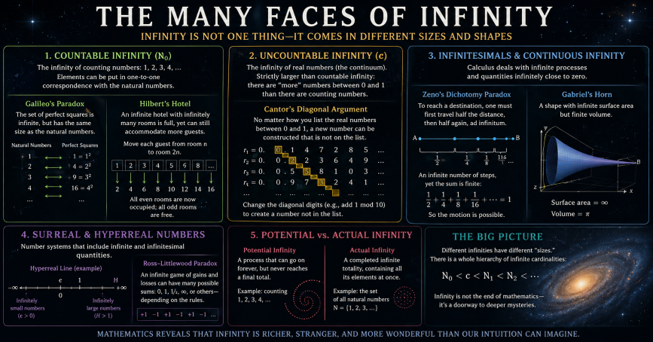
And this is where the comparison to infinity becomes unavoidable.
The speed of light behaves mathematically like an asymptote.
You can approach it forever:
0.9c
0.99c
0.999c
0.999999999c
But never fully arrive as a massive object.
Infinity behaves similarly.
You can endlessly approach:
lim x → ∞
Without ever operationally “reaching” infinity itself.
Light speed is therefore less like a destination and more like a geometric boundary condition embedded into spacetime topology.
A horizon.
Not technological.
Ontological.
And that may be the most humbling discovery humanity has ever made.
Because for the first time in our species’ history, we may have encountered something that is not difficult…
…but fundamentally prohibited by the architecture of reality itself.
Which of course means humanity will absolutely spend the next thousand years trying to argue with it anyway.