I have often wondered whether I’d want to know the exact date of my death.
Not vaguely. Not “you’ll live a long fulfilled life surrounded by loved ones.” I mean the exact moment. Tuesday. 4:17 PM. Taken out by airport sushi while pretending turbulence over Nebraska is “probably normal.”
Most people assume death is the great existential mystery. Personally, I think birth is far more disturbing.
Death at least has branding. Entire religions, philosophies, and wellness influencers have dedicated themselves to explaining it. Death gets orchestral music, poetry, candlelight vigils, and dramatic rain at funerals.
Birth, meanwhile, is absolute chaos.
One moment you do not exist. No memories. No language. No anxiety. No student loans. No annual cybersecurity training modules reminding you not to click suspicious links from “TotallyRealBank.ru.”
Nothing.
Then suddenly you are here. Conscious. Breathing. Expected to understand taxes by age twenty-five and maintain proper eye contact during meetings.
That transition alone should concern us far more than it does.
Because nobody remembers anything before birth. And despite humanity’s enormous confidence about literally everything, nobody actually knows what happens after death either. We’ve built civilizations around theories, sure, but at the end of the day every human being arrives from mystery and exits into mystery.
That’s an insane operating model for a species this arrogant.
We speak confidently about the laws of the universe, but the two most important transitions in human existence remain completely inaccessible to direct observation. We remember nothing before arrival and report back very inconsistently after departure.
Honestly, the entire thing feels like a startup that scaled too quickly.
And somewhere inside all of this is the question I cannot stop thinking about: are we even bounded by the limits of time the way we think we are?
Physics tells us nothing can move faster than light.
c ≈ 3.0 × 10⁸ m/s
Einstein effectively looked at the universe and said, “This is the speed limit. Nobody is outrunning photons.”
Fair enough.
But consciousness complicates things. Assuming there is something before birth or after death, how long does transition take? A billion years? Seconds? Is there travel involved? Waiting? Or does time itself stop mattering outside biological existence?
Relativity already tells us time is flexible.
Δt’ = Δt / √(1-v²/c²)
Move fast enough and time slows. Gravity bends it. Near black holes it nearly breaks. Physics itself quietly suggests time may not be the fixed universal system humans assume it is.
Which means asking “how long does it take to get here?” before birth may actually be the wrong question.
Maybe “before” only exists inside life itself.
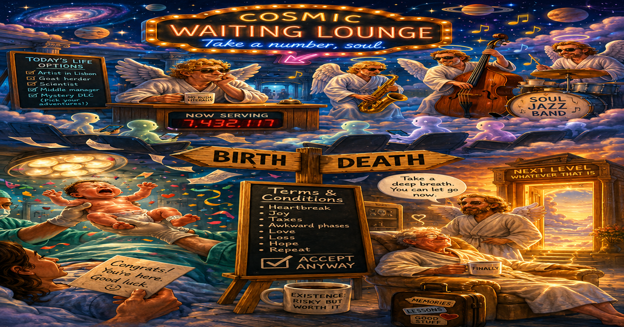
And that thought led me into one of the strangest recurring ideas I’ve ever had: what if there’s a waiting room before birth?
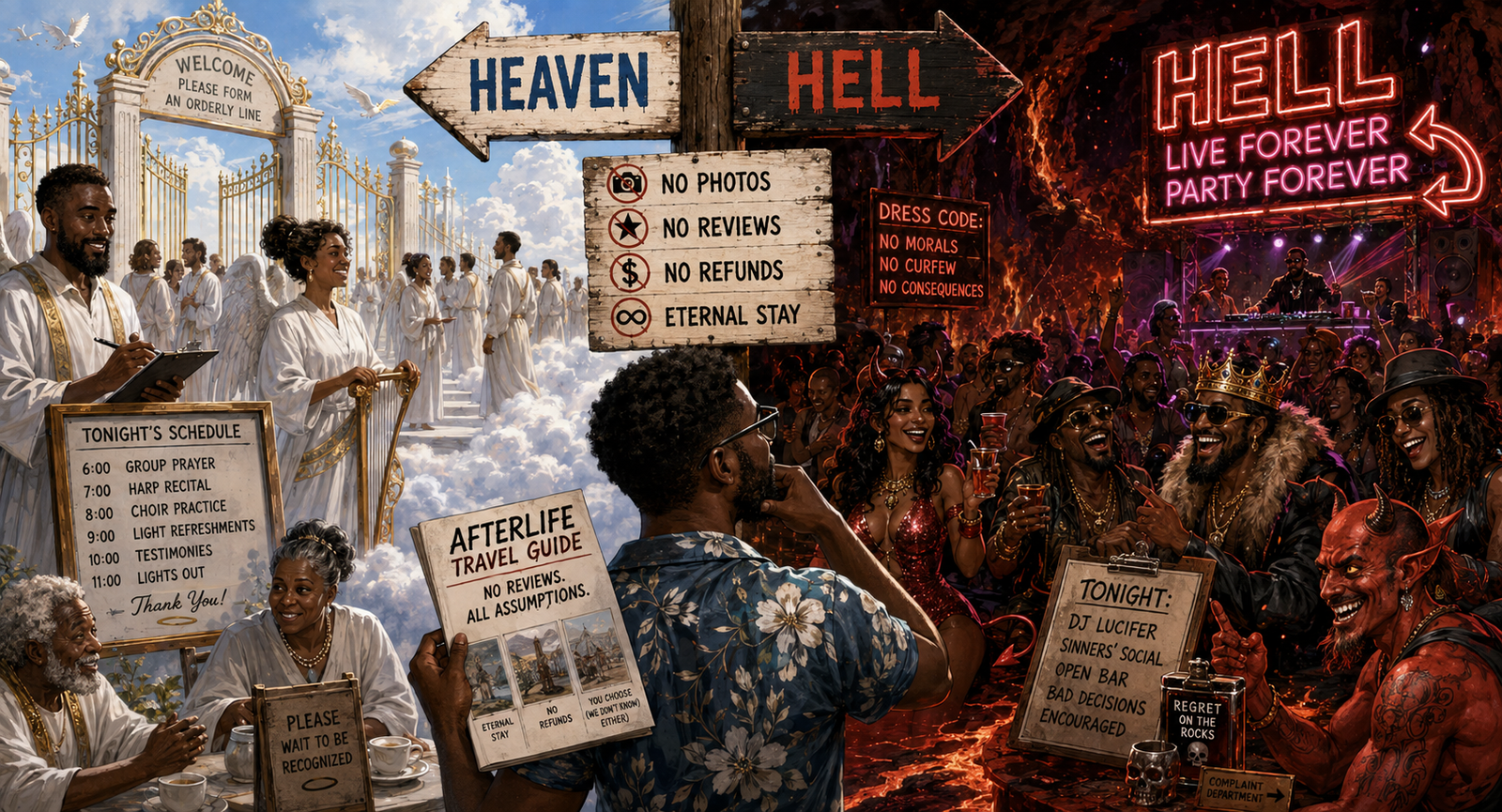
Not heaven. Not clouds and harps. Honestly, if eternity includes harp music, that already sounds exhausting. I mean a place outside of measurable time. A holding area for consciousness before assignment into biological existence.
Picture an infinite room with no visible walls because walls imply space and space may not exist there yet. No clocks. No language. Just awareness suspended in something softer than silence.
And somehow you are there.
Not current-you. Not your name, nationality, career, or carefully curated social media personality designed to look emotionally balanced. Just the core thing underneath all of that.
Maybe there are others too. Consciousnesses waiting their turn.
And somewhere in this impossible place is Orientation.
A cosmic briefing nobody fully remembers afterward.
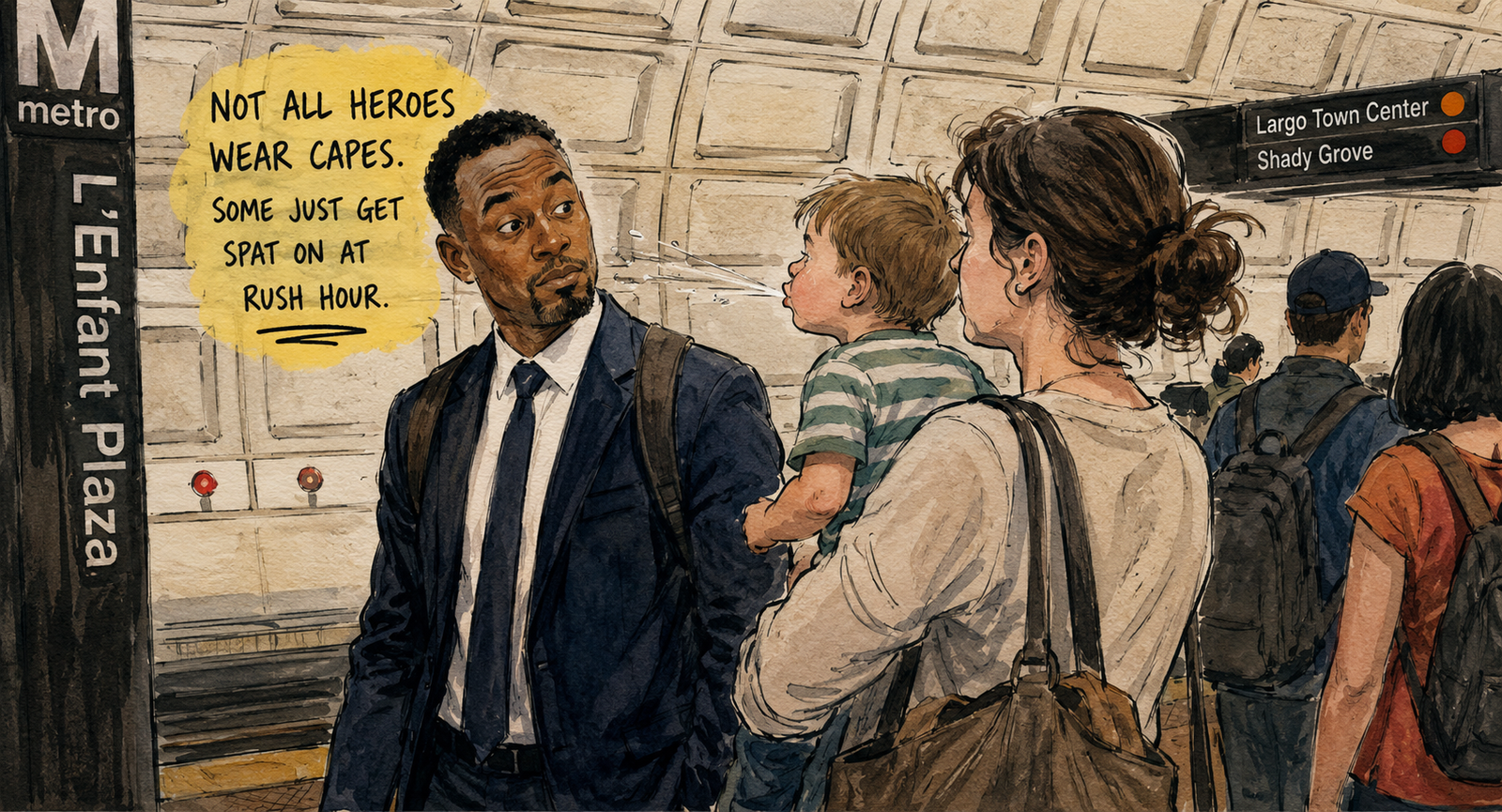
“Welcome everyone. Today’s available experiences include emotionally repressed middle manager, exhausted single parent, billionaire with suspiciously dead eyes, goat herder in Mongolia, and one deeply confused commuter in Washington, D.C. who will spend significant portions of adulthood questioning existence during train delays.”
And somehow souls still volunteer.
That’s the part that fascinates me.
Because if there really is a waiting room before life, then either we were catastrophically misled about Earth or whatever exists outside life is so incomprehensibly empty that even performance reviews and lower back pain looked interesting by comparison.
Maybe there’s even a disclaimer nobody reads.
“WARNING: Human existence may include heartbreak, grief, taxes, awkward adolescence, existential dread, loss, hope, random moments of beauty, and several humiliating memories replayed internally until death.”
And humanity collectively clicks Accept Terms & Conditions anyway.
Honestly, that tracks.
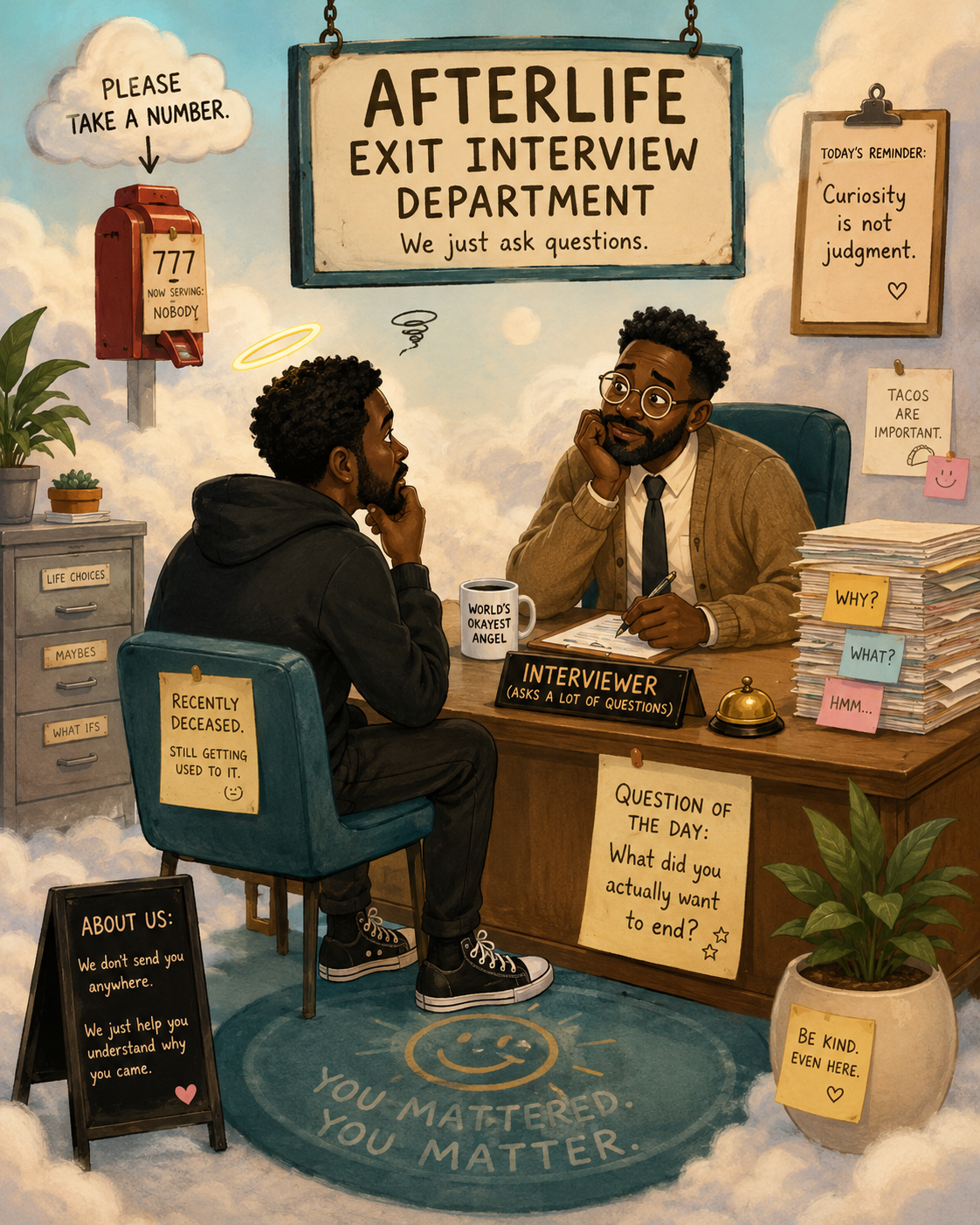
But then I started wondering whether death has its own waiting room too.
And strangely, I don’t imagine it as terrifying anymore.
Not because I suddenly became enlightened. I still panic when doctors say things like “we should keep an eye on that.” I just wonder whether death might feel less like punishment and more like finally arriving somewhere after an unbelievably long flight.
Imagine arriving there still stressed about deadlines that no longer matter. Still mentally replaying arguments from fifteen years earlier. Still worried about emails.
Meanwhile whatever runs the place looks at you the way nurses look at patients trying to leave the hospital while still attached to IV lines.
“Sir… you can let go of the quarterly metrics now.”
Maybe that place is quiet.
Not empty-quiet.
Safe-quiet.
The kind of silence humans almost never experience because modern civilization is essentially a nonstop attack on the nervous system. Notifications. Traffic. Advertising. Doomscrolling. Group chats that begin lovingly and eventually devolve into psychological warfare over dinner reservations.
Maybe death feels peaceful not because people necessarily see paradise, but because for the first time since birth, the machinery stops.
No performance.
No comparison.
No optimization.
No pretending.
Just stillness.
Of course, this entire theory could be nonsense. Consciousness may simply emerge from sufficiently complex neural activity and disappear the moment the system shuts down, the same way music stops when you unplug a speaker.
But honestly, that explanation is equally absurd.
Matter somehow became self-aware long enough to question itself. The universe produced creatures capable of grieving their own impermanence while simultaneously arguing online about pineapple on pizza and pretending meetings could have been emails.
That’s objectively hilarious.
And maybe that’s the real miracle—not immortality, not certainty, not cosmic answers.
Just the fact that for a brief period of time, the universe arranged atoms into something capable of asking questions at all.
We celebrate birth because someone arrived.
We mourn death because someone mattered.
Maybe that’s enough.