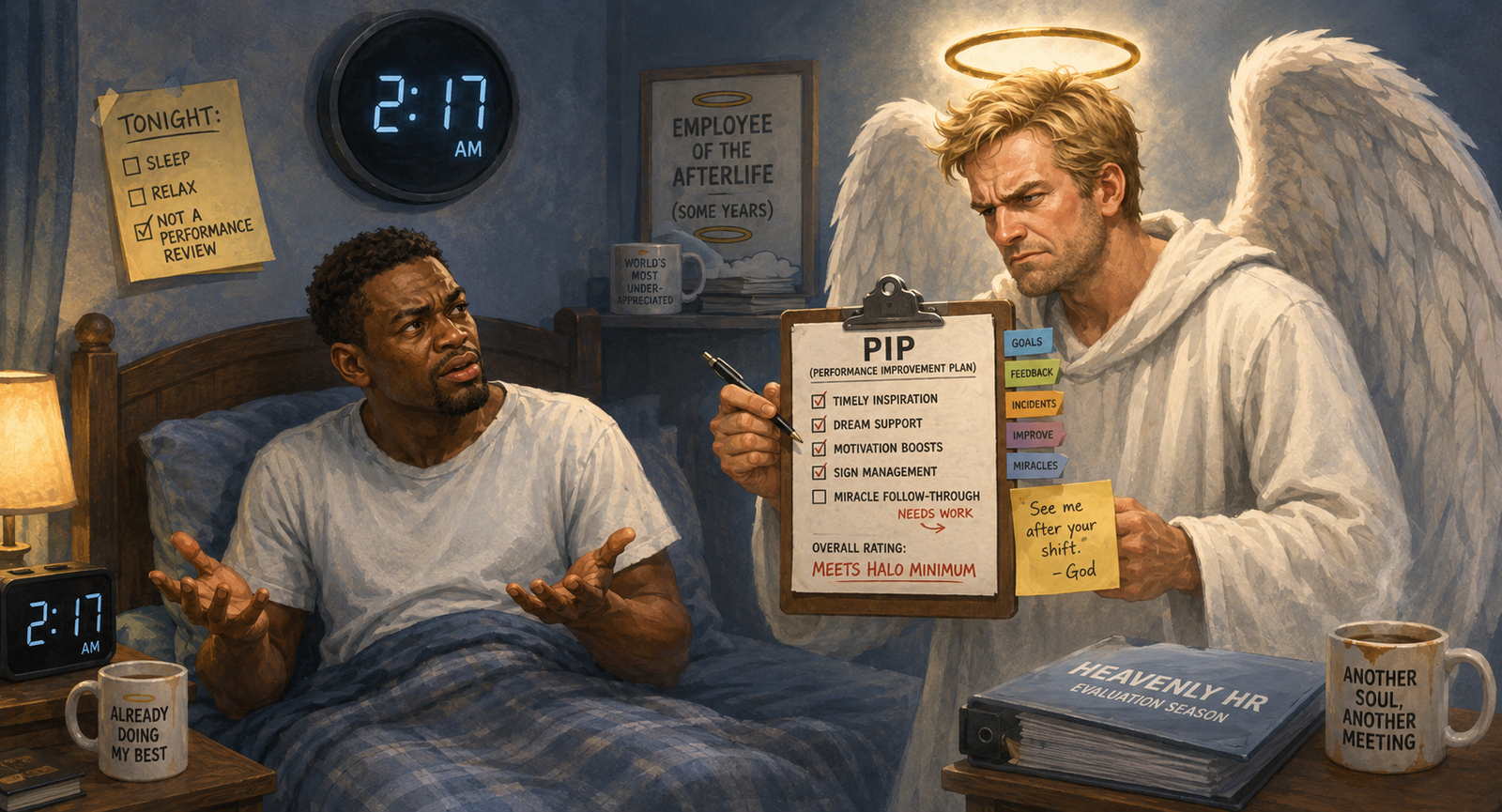
Yesterday, over tea with a friend at work, we wandered into one of those conversations that begins casually and then realizes, too late, that it has walked into a sacred room without removing its shoes. We were talking about suicide, not as spectacle, not as planning, and not as some grim intellectual hobby, but as one of the most difficult human questions: why do some people stay when, from the outside, they appear to have every reason to go, while others leave when, from the outside, they appear to have every reason to stay? It is one of those questions that humiliates ordinary explanations. Money does not settle it. Status does not settle it. Love does not always settle it. Religion does not always settle it either. The human interior is not a courtroom where evidence is neatly entered and a verdict follows. Sometimes the person who has everything feels dispossessed. Sometimes the person who has almost nothing remains tethered to life by a child, a promise, a habit, a fear, a joke, a song, a memory, or the stubborn suspicion that the story is not yet over.
I made the argument that, as I get older, religion feels less sufficient to address the questions and longings I have developed. That was not an attack on God. It was not a rejection of faith as such. It was a confession that the inherited answers that once carried weight now sometimes feel too small for the scale of the questions. When one is young, religion can arrive as architecture: walls, doors, rules, prohibitions, rituals, certainties. As one ages, suffers, grieves, fails, survives, and watches the world break people in both ordinary and spectacular ways, religion often has to become something else. It has to become weather. It has to become silence. It has to become presence without explanation. The problem is that many of us were handed religion as an answer key, not as a language for surviving unanswered questions.
What I did not say to my friend was that this was not an abstract conversation for me. There was a private variable sitting underneath the tea, underneath the words, underneath the polite intellectual exchange. The closest person I have ever had in my life recently died, and grief has a way of making every philosophical question suddenly stop being academic. It is one thing to discuss meaning when life is merely irritating. It is another thing to discuss meaning when someone who helped anchor your internal world is no longer reachable. The death of someone that close does not simply make you sad. It reorganizes the furniture inside you. The rooms are still there, but every chair is facing the wrong direction.
The word that comes closest is listless. Not dramatic. Not theatrical. Not even always visibly depressed. Just listless, as if the engine of ordinary attachment has been left running but the vehicle no longer knows where it is supposed to go. You still answer emails. You still make tea. You still attend meetings. You still respond when spoken to. You still perform the recognizable gestures of being alive in public. But privately, something has lost voltage. The world continues asking for deliverables while your interior life is standing beside a fresh grave trying to understand how someone so central can become unreachable and yet remain everywhere.
That is the strange cruelty of grief. The dead do not fully leave. They become distributed. They live in your gestures, your reflexes, your jokes, your silences, your sudden anger at minor inconveniences, your inability to explain why a normal Wednesday feels like a collapsed building. A person dies once in the world, then repeatedly in you. You reach for them mentally and remember again. You imagine telling them something and remember again. You see something they would have laughed at and remember again. Death becomes less like an event and more like an operating system update you never agreed to install.
So when I said religion no longer felt sufficient, I was not speaking from a seminar room. I was speaking from that strange after-place where prayer still exists, but its function has changed. Prayer no longer feels like asking for intervention. It feels more like leaving a voicemail in a universe that may or may not return calls. Faith no longer feels like certainty. It feels like standing in the dark with one hand on the wall, not because you know the room, but because the alternative is to pretend you are not in the dark at all.
My friend’s response was sharper than I expected. He said, in essence, that it was hubris for me to conclude that I understood divine truth well enough to decide that all available meaning had been exhausted. His point was not that religion had already answered me. His point was that I was arguing from a small piece of what is possible and mistaking that small piece for the whole. He was not defending easy faith. He was attacking premature certainty. In the moment, I resisted that framing because nobody likes to be called arrogant when they are trying to be honest about pain. But afterward, I realized that he had exposed the weakness in my argument. I had moved too quickly from “religion no longer feels sufficient to me” to something dangerously close to “therefore the remaining case for staying has been adequately examined.” Those are not the same claim.
The first claim is legitimate. The second claim is epistemologically unstable. To say that religion no longer satisfies the questions one is carrying is an honest report from the interior. To say that one has therefore exhausted the claims of God, duty, love, time, obligation, mystery, and future meaning is a conclusion no finite person can responsibly certify. The failure was not in questioning religion. The failure was in treating present spiritual exhaustion as if it were total knowledge. Despair is often persuasive because it speaks with the tone of finality. It does not say, “I am a weather system passing through you.” It says, “I am the truth.” That is why it is so dangerous. It converts a condition into a verdict.
This is where Albert Camus enters the tea shop, probably overdressed, smoking metaphorically, and preparing to ruin everyone’s afternoon in the most elegant way possible. Camus begins from the absurd, the collision between the human hunger for meaning and the universe’s refusal to provide a clear memo. Humans want the cosmos to explain itself. The cosmos, with spectacular bureaucratic inefficiency, does not reply. We ask why suffering happens, why love dies, why the innocent are crushed, why the wicked flourish, why grief has no respect for calendars, and why the people we need most can disappear before we are done needing them. The universe answers with wind, traffic, medical paperwork, and someone asking whether we have completed the form in triplicate.
Camus is useful because he refuses both cheap hope and cheap despair. He does not say the world is obviously meaningful in the way religious optimists sometimes want to claim. He also does not say that meaninglessness settles the matter. His absurd hero does not win because the universe finally explains itself. He wins because he refuses to let the universe’s silence dictate the entire human response. In the myth of Sisyphus, the condemned man pushes the rock up the hill, watches it roll back down, and then pushes it again. On paper, this is a terrible performance review. No productivity metric survives it. No consultant would recommend it. The rock has no deliverable, no exit ramp, no quarterly milestone, no measurable return on investment. And yet Camus finds dignity precisely there, in the conscious refusal to surrender one’s humanity merely because the task is absurd.
There is a strange humor in that if one is not too pious about it. Sisyphus is basically the patron saint of Monday morning inboxes. He is everyone who has cleared email only to watch twelve more messages arrive. He is everyone who has cleaned the house while living with a child. He is every government employee who has watched a process reform create three additional processes. He is every grieving person who wakes up, survives the day, goes to bed, wakes up, and discovers that the rock is waiting again at the bottom of the hill with the nerve to look familiar.
But Camus does not make the absurd cute. He makes it honest. The absurd is not a motivational poster. It is the recognition that human beings want the world to be morally legible, and the world often refuses. Religion tries to answer that refusal by locating meaning beyond visible reality. Absurdism answers by saying that even if the universe does not disclose meaning, the human act of refusing collapse still matters. In religious language, one might say God knows the meaning even when we do not. In Camus’ language, one might say meaning is not found like buried treasure; it is enacted through revolt, freedom, and passion. The religious person says, “I do not know enough to declare the story empty.” The absurdist says, “Even if the story is empty, my refusal to surrender becomes part of the story.” Oddly enough, these positions are not as far apart as they first appear.
The religious imagination and the absurdist imagination meet at the same cliff, though they describe the landscape differently. Religion says the unknown may conceal purpose. Absurdism says the unknown may conceal nothing, but we are still responsible for how we stand before it. Religion tells us not to mistake silence for absence. Absurdism tells us not to mistake silence for permission to become less human. Religion says the final meaning may belong to God. Absurdism says the immediate meaning belongs to our revolt against meaninglessness. One kneels. The other stands with its hands in its pockets, suspicious of kneeling. But both resist the same enemy: the arrogance of final despair.
That is why my friend’s challenge has stayed with me. He was not asking me to pretend religion still worked in the old way. He was asking me not to promote my present anguish into metaphysical authority. Grief narrows the aperture. Depression narrows it further. Exhaustion narrows it again. The mind under strain becomes a very confident local government. It starts issuing permits it has no constitutional authority to issue. It declares certain roads closed. It condemns buildings that may only need repair. It treats future possibility as if it had been properly audited and found insolvent. But the audit is compromised. The inspector is grieving. The report should not be treated as final.
This is where the outside view of suicide becomes so inadequate. People often ask why someone would stay or go as if life were a ledger. On one side are assets: family, career, education, money, faith, reputation, opportunity. On the other side are liabilities: grief, shame, illness, loneliness, trauma, failure, exhaustion. If the assets exceed the liabilities, the person should stay. If the liabilities exceed the assets, outsiders think they understand why the person left. But the human soul does not operate like a balance sheet. A person may be loved and still feel unreachable. A person may be admired and still feel unseen. A person may believe in God and still feel abandoned inside the very faith that once sustained them. A person may possess a life others would envy and still experience that life as a room with no air.
That is why religion is both powerful and paradoxical. It can be a barrier against self-destruction, but it can also become a field of struggle. At its best, religion says: your life is not merely private property; you belong to something larger than your current pain; do not make an irreversible decision from inside a temporary enclosure of despair. At its worst, religion says: your pain is evidence of weak faith; your questions are rebellion; your suffering is shameful; your despair should be hidden from the community that claims to love you. In the first form, religion protects life. In the second form, religion can intensify isolation.
The paradox goes even deeper. The unknown can block suicide, but the unknown can also remove the block, depending on how one understands one’s relationship with God. If the unknown is approached with humility, it says: you do not know enough to conclude that your story has no remaining meaning. You do not know what tomorrow may disclose. You do not know what your child, your friend, your future self, your work, your unfinished obligation, or your still-forming wisdom may require of you. You do not know whether the silence of God is absence, concealment, waiting, mercy, or simply the limit of human perception. In that frame, mystery restrains finality.
But the unknown can also be interpreted differently. A suffering person may say: if God is merciful, perhaps God understands why I am tired. If divine compassion exceeds human doctrine, perhaps the old prohibitions are not as absolute as I was taught. If nobody truly knows what lies beyond death, perhaps fear should not be the thing that keeps me here. In that frame, mystery no longer restrains. It releases. The same unknown that one person experiences as a sacred barrier, another experiences as a merciful opening. This is why religion cannot be treated as a simple suicide-prevention mechanism. Faith is not a switch. It is an ecosystem. Its effect depends on doctrine, community, temperament, suffering, theology, family history, mental health, grief, and the kind of God a person believes is waiting in the silence.
This is also why “religion prevents suicide” is too simple. A more accurate statement is that some dimensions of religion and spirituality may be protective, while others may become risk-amplifying when they intensify shame, alienation, or spiritual struggle. Moral opposition to suicide, intrinsic belief, community belonging, ritual, prayer, and a sense of divine purpose can help some people remain anchored. But religious struggle, especially the collapse of ultimate meaning, can become its own form of pain. A person can be religious and still be spiritually homeless. A person can attend worship and still feel existentially abandoned. A person can believe in God and still be angry that belief has not made life more bearable.
That is the part religious communities often mishandle. They assume that doubt is the opposite of faith. But for many adults, doubt is not the opposite of faith; it is the cost of having taken faith seriously enough to bring real suffering into the room. A childish faith may survive because it has not been tested. A mature faith may survive only by losing the need to explain everything. There is a difference between rejecting God and rejecting inadequate language about God. There is a difference between losing faith and losing the version of faith that was too brittle to survive grief. There is a difference between spiritual arrogance and spiritual exhaustion.
Grief makes this distinction brutally practical. After a major loss, religion’s promises can begin to sound both necessary and offensive. Necessary because one wants desperately to believe that love has not been annihilated. Offensive because the language of comfort can feel too clean for the violence of absence. “They are in a better place” may be true within a faith framework, but it can still feel like emotional trespassing when what you want is not a better place but one more conversation. “God has a plan” may be doctrinally coherent, but grief is not always ready to admire the plan. Sometimes grief wants to cross-examine the planner.
This is where Camus becomes unexpectedly helpful again. He gives permission to admit that the arrangement feels absurd. Not fake-absurd, not internet-absurd, but metaphysically absurd. A person can be central to your life and then suddenly become unavailable to the world. Love can remain fully alive in the one who survives while having no obvious destination. The phone number remains, but the person does not. The memory remains, but the body does not. The jokes remain, but the laugh does not. The love remains, but its address has been revoked. If that is not absurd, the word has no meaning.
And yet the absurd does not eliminate responsibility. That is Camus’ hard gift. He does not rescue us from the rock. He asks what kind of person we become while pushing it. Religion might say that the rock is part of a divine mystery. Camus might say the rock is just a rock, which is rude but clarifying. Either way, the human question remains: what now? Not what is the final explanation. Not what doctrine neatly resolves the ache. Not what slogan can make this tolerable. What now? What does love require when the person loved is gone? What does duty require when motivation has thinned? What does dignity require when meaning has become intermittent?
My friend accused me, indirectly, of arrogance. I now think the more precise word is certainty. The danger was not that I asked whether religion remained sufficient. That question is fair. The danger was believing that my inability to feel the sufficiency of religion meant I had adequately measured the full scope of divine possibility. That is a mistake. The fact that I cannot see the road does not prove there is no road. The fact that an old map no longer works does not prove there is no terrain. The fact that inherited doctrine no longer quiets the ache does not prove there is no God, no purpose, no obligation, no future, and no remaining claim upon my life.
The strategic correction is to separate sufficiency from finality. Religion may be insufficient as an emotional sedative. It may be insufficient as an intellectual explanation. It may be insufficient as a cultural inheritance. It may be insufficient as a set of childhood answers carried unchanged into adulthood. But insufficiency is not absence. It may mean the faith one inherited must be enlarged, interrogated, refined, or rebuilt. It may mean that God is no longer encountered as certainty but as restraint. Not restraint in the punitive sense, but restraint in the epistemic sense: do not conclude too much from the narrowness of this hour.
That is where I now find the most serious religious argument for staying. It is not fear of punishment. It is not social embarrassment. It is not the sentimental claim that everything will be fine. It is the discipline of humility before the unknown. The argument is this: I do not know enough to make despair sovereign. I do not know enough to declare my usefulness ended. I do not know enough to say that love has no future claim on me. I do not know enough to decide that the pain of this present season is more truthful than every possible tomorrow. I do not know enough to treat silence as abandonment. I do not know enough to mistake exhaustion for revelation.
Camus would likely remove the religious language and keep the discipline. He might say: do not give the absurd more power than it deserves. Do not let the silence of the universe become an instruction manual. Do not confuse the absence of a cosmic explanation with the absence of human obligation. Push the rock, not because the rock makes sense, but because your revolt against meaninglessness is itself a form of meaning. Wake up. Make the tea. Answer the child. Write the sentence. Bury the dead. Carry the love. Laugh when the joke is genuinely funny, even if part of you feels guilty for laughing. The absurd does not abolish laughter. In fact, laughter may be one of the most subversive responses to it.
That may be the bridge between faith and absurdism. Religion says there may be a divine purpose beyond what I can perceive. Absurdism says that even without visible purpose, I can still choose a posture of revolt, tenderness, responsibility, and lucidity. Both approaches can oppose the arrogance of despair. Both can say: your current pain is real, but it is not omniscient. Both can say: the silence is not enough evidence for finality. Both can say: continue, not because the case is closed, but because the case is not closed.
This does not make religious struggle easy. It does not make suffering romantic. It does not turn grief into a sermon illustration. In fact, it should make us more careful with people who are suffering. When someone says religion is no longer sufficient, the worst response is to shame them back into silence. The better response is to ask what kind of religion has failed them. Was it doctrine without tenderness? Community without honesty? Ritual without presence? Prohibition without companionship? Certainty without mystery? Sometimes the person is not rejecting God. Sometimes they are rejecting a religious framework that had no room for adult anguish.
The same is true outside religion. Secular people also live by forms of faith, even if they do not call them that. They may stay for love, responsibility, beauty, unfinished work, moral duty, curiosity, defiance, or the possibility that their future self deserves a vote. Every person who chooses to remain without certainty is practicing some form of hope. Not optimism. Optimism is often too cheerful to be trusted. Hope is more austere. Hope is not the belief that tomorrow will be good. Hope is the refusal to let today issue the final ruling.
That may be the point I missed over tea. I was arguing about whether religion still gave me answers. My friend was arguing that I had no authority to convert unanswered questions into final conclusions. He was right. The better argument is not that religion has failed. The better argument is that religion becomes paradoxical when it matures: it wounds and heals, binds and releases, frightens and comforts, silences and speaks. Its mystery can be used cruelly by people who want to shut down suffering, but its mystery can also save us from the arrogance of despair. The unknown can feel like a void. It can also function as a guardrail.
Perhaps divine purpose is not always experienced as a clear assignment. Perhaps sometimes it is experienced only as an interruption: not yet. Do not close the book yet. Do not assume the silence means nothing is being written. Do not confuse the collapse of old answers with the absence of all answers. Do not let pain claim the authority of God.
Perhaps Camus would phrase it differently. He might say: the rock is real, the hill is real, the exhaustion is real, and the universe may never issue a satisfactory explanation. Push anyway. Not because pushing is glamorous. Not because the rock is secretly fun. Not because grief will become noble if described properly. Push because the refusal to surrender one’s humanity to absurdity is one of the last freedoms available to us. Push because the dead we love are not honored by our disappearance from the world they once helped us inhabit. Push because love, even when it loses its immediate object, may still have work to do through us.
That is not a neat conclusion. It is not a bumper sticker. It is not enough for every night. But it is something. And sometimes, in the serious mathematics of remaining, something is not small. Something is the whole structure holding.
If this subject is not theoretical for you, please do not carry it alone. In the United States, call or text 988 for the Suicide & Crisis Lifeline, or go to the nearest emergency department if there is immediate danger. This essay is a reflection on meaning, religion, grief, and human endurance. It is not a substitute for care, companionship, treatment, or intervention when the question becomes urgent.