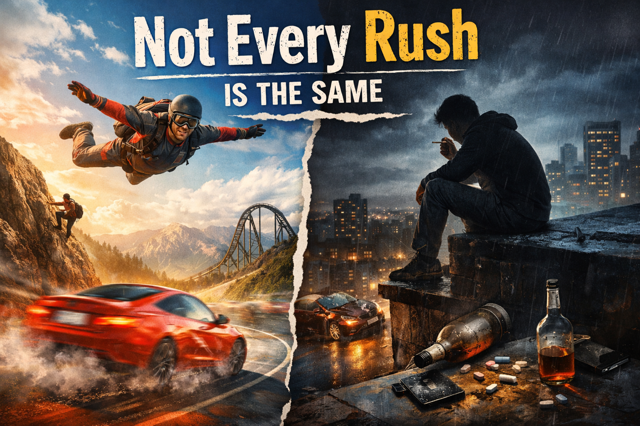
Human beings have a remarkable talent for taking very different forms of suffering, recklessness, pleasure, and mild psychological collapse and tossing them into one lazy category like we are sorting laundry.
Risky behavior.
There. Done. Excellent work, everyone.
But not every rush is the same. There is a difference between wanting an adrenaline hit and having a quietly deteriorating relationship with your own safety. Those things can look similar if you are observing from across the room, across the internet, or across brunch while pretending to listen to your friend’s story about her sound bath retreat. But internally, they are often worlds apart.
One person is trying to feel alive.
Another person is trying to feel anything other than what they are currently feeling.
And another, more troubling possibility, is that they do not particularly care what happens either way.
That is not the same genre of experience. It is just been flattened into one because society enjoys simplicity almost as much as it enjoys being wrong.
We tend to romanticize certain forms of danger when they are packaged attractively. If someone climbs a mountain, jumps out of a plane, free-dives into dark water, or straps themselves to some machine clearly designed by a man who hated peace, we call them bold. Adventurous. Fearless. Alive. We make documentaries about them. We sell them moisture-wicking clothing. We let them start podcasts.
But let someone drift into risk for darker reasons and suddenly everybody gets very clumsy. Now the language changes. Now everyone starts speaking in nervous euphemisms, as though precision itself might make things worse. Now people act as if all danger is basically the same unless someone literally stands on a table and announces, like a Victorian ghost, that they are in distress.
Unfortunately, that is not how most distress works.
Sometimes it looks cinematic. Often it looks administrative.
Sometimes it is not a grand death wish. It is just a growing indifference. A loosening. A private shrug in the direction of one’s own well-being. Not exactly “I want to die,” but maybe “I no longer have the energy to protect myself with the seriousness I should.” Which, to be clear, is not exactly reassuring either.
That is the distinction people keep missing.
A genuine adrenaline rush usually says: I want more life. More intensity. More sensation. More challenge. More proof that I am here in this body and it works and I can push it and survive and maybe feel a little godlike for forty-five seconds. It is not necessarily healthy in every form, but it is usually oriented toward aliveness. The thrill-seeker wants the drop, the speed, the terror, the clarity, and then, ideally, the safe return home where they can become unbearable at dinner.
The point is not obliteration. The point is the edge.
The self-destructive version is different. It is murkier. Less photogenic. Less cooperative with branding. It may wear the clothes of recklessness, but the inner script is darker. The act is no longer about feeling vividly alive. It is about escape, numbness, punishment, interruption, or that eerie state where survival has ceased to feel especially urgent. Sometimes the person is not seeking excitement at all. They are seeking relief. Or silence. Or impact. Or a break in the static.
That is why two people can do what appears to be the exact same dangerous thing for completely different reasons.
One person drives too fast because they love control, precision, power, speed, and the fantasy that they are in a film no one else was talented enough to audition for.
Another person drives too fast because some exhausted, buried part of them has stopped caring enough to brake for themselves the way they would brake for others.
Those are not the same conditions.
One person drinks because it is a party.
Another drinks because consciousness has become overcrowded and they would like to vacate the premises for a while.
One person overtrains because they love competition, discipline, and watching their body do difficult things.
Another pushes themselves into pain because the line between self-improvement and self-punishment has quietly collapsed somewhere behind the ribs.
Again: same behavior, different weather.
This is why the phrase “adrenaline junkie” is often too neat to be useful. Sometimes it is accurate. Sometimes it is just a socially acceptable alias for distress with good posture. Sometimes it is the polished corporate rebrand for a person whose nervous system has been eating drywall for years. Sometimes it is what happens when pain borrows the language of adventure because that is easier for everyone to tolerate.
Society is far more comfortable with danger when danger looks ambitious.
Work yourself into illness, emotional depletion, insomnia, and a blood pressure reading that could trigger a small chapel service, and people will call you committed.
Drive yourself past the point of sanity in the name of achievement, and someone will say you have high standards.
Laugh off destructive behavior in a witty tone and people will assume you are self-aware instead of possibly unwell.
There is a lot one can hide under the umbrella of “I’m just intense.”
Intensity is one of the last respectable disguises left.
And that is part of what makes this conversation so useful, especially if you want to make serious things easier to discuss without turning the whole room into a grief seminar. Humor helps because humor can hold a truth without forcing everyone to stare directly at it under fluorescent lights.
So let us say it plainly.
Not every dangerous habit is a cry for help.
But not every dangerous habit is a love letter to life either.
Sometimes people really do want the rush. They want the mountain, the plunge, the challenge, the performance, the high-wire moment when the body and mind suddenly agree on something for once. They want to feel sharpened. Heightened. Awake. Good for them. May their insurance premiums remain merciful.
But sometimes the so-called rush is not really a rush at all. Sometimes it is a person trying to outrun deadness. Or rage. Or humiliation. Or despair. Or the kind of numbness that makes even your own body feel like office furniture. In those moments, danger is not exciting because it is dangerous. It is appealing because it interrupts something worse.
That is a brutal distinction, but it is a useful one.
Because the real question is not simply, “Was this risky?”
The real question is, “What was the risk doing for you?”
Was it enlarging life?
Was it proving competence?
Was it giving you joy?
Was it waking you up?
Or was it functioning like a private little act of self-erasure with better public relations?
That is where the truth usually lives.
The aftermath tells on people too. A real rush tends to leave some version of brightness behind. Relief. Excitement. Presence. A ridiculous grin. The body saying, yes, that was terrifying, but we are HERE. There is often a feeling of expansion to it. Even the fear feels alive.
The darker version tends to leave something colder. Shame. Flatness. Exhaustion. A strange emptiness. Maybe even disappointment that the act did not solve whatever it was supposed to solve. Because of course it did not. If the real problem lives in the psyche, the nervous system, the heart, or that private chamber where a person keeps their unbearable thoughts, then danger is rarely a cure. At most it is a loud interruption.
Sometimes people do not want the thrill. They want the interruption.
That line alone explains more behavior than most self-help language ever will.
And the tricky part is that many people have probably visited both neighborhoods at different times in life. There are seasons when you want challenge in the healthiest sense. You want to test yourself. Stretch yourself. Feel strong. Feel vivid. Feel the clean animal fact of being alive. Then there are other seasons, darker ones, where your choices become suspiciously casual. Where “I’m just having fun” starts sounding less like truth and more like a press release issued by an unstable government.
That is where honesty matters.
Not theatrical honesty. Not “let me turn my wounds into content” honesty. Just honest honesty. The private kind.
What am I actually looking for when I do this?
Am I trying to feel more alive, or just less trapped?
Do I prepare to survive, or do I leave things sloppy because some part of me no longer values my own safety properly?
If this went badly, would I be horrified or weirdly resigned?
That last question is not cheerful, but it is clarifying.
Because that is the real divide.
Thrill-seeking usually has a return built into it. Even when it flirts with chaos, it still imagines a homecoming. It wants the story afterward. The self-destructive impulse is more careless with the ending. It may not consciously want death, but it has started negotiating with damage. It has started speaking the language of harm in a low voice.
That is not the same thing as adventure.
It just sometimes borrows adventure’s wardrobe.
Which is why I think we should stop treating all edge-seeking as one charming personality quirk. Sometimes it is joy. Sometimes it is bravado. Sometimes it is pain in expensive shoes. Sometimes it is depression with good lighting. Sometimes it is a nervous system so overstretched that danger feels like relief because at least relief, unlike peace, still knows how to make an entrance.
And that is what people miss.
The behavior may rhyme.
The motives do not.
Some rushes are a toast to being alive.
Some are a dare thrown at your own existence.
From far away, both can look like courage. Both can look wild, sexy, dramatic, intense, unbothered, impressive. But up close, one is reaching toward life with greedy hands.
The other is beginning, quietly and perhaps without fully admitting it, to loosen its grip.
And that is not the same rush at all.