A fun, science-influenced blog post inspired by a seven-year-old asking the kind of question adults should ask more often
Children ask questions with zero concern for whether the question will ruin your afternoon. That is one of their best qualities. One minute you are minding your business. The next, a seven-year-old looks up at you with the calm of a senior astrophysicist and asks, “What happens if the Sun vanishes?” At that point, you have two options. You can either say, “Let’s not think about that,” or you can lean all the way in and let orbital mechanics destroy the vibe.
So let us do the responsible thing and lean in.
First, the Sun does not get to disappear dramatically and immediately change our day. Physics is annoyingly procedural about these things. Light from the Sun takes about 8 minutes and 19 seconds to reach Earth. The Sun’s gravitational influence also changes at the speed of light, not instantaneously. So if the Sun vanished at exactly 12:00:00 p.m., Earth would continue receiving sunlight and continue orbiting as usual until about 12:08:19 p.m. For eight very disrespectful minutes, people would still be answering emails, eating yogurt, paying bills, and making five-year plans, completely unaware that the solar system had already suffered a catastrophic leadership vacancy.
The other planets would get the memo on a delay too. Mercury would notice first in a little over 3 minutes because Mercury lives too close to the action. Venus would notice in just under 6 minutes. Earth gets the bad news at 8 minutes 19 seconds. Mars notices after roughly 12 and a half minutes. Jupiter waits about 43 minutes. Saturn takes over an hour. Uranus needs nearly 2 hours and 40 minutes. Neptune, naturally, is more than 4 hours late to the crisis meeting. Even the apocalypse has rollout timing.
You can estimate that timing with a very simple equation, and I am putting it here in plain text so WordPress does not decide to become emotional about formatting later:
t_notice = r / c
If r is measured in astronomical units (AU), then:
t_notice ≈ 499 * a seconds where a = distance from the Sun in AU
That means for Earth the number is:
t_notice ≈ 499 * 1 = 499 seconds ≈ 8 minutes 19 seconds
Then the clock runs out.
The sky would not slowly dim like a sentimental sunset in a prestige film. It would simply fail. One moment it is day. The next, it is a kind of darkness that feels administratively incorrect. The Moon would go dark too, because moonlight is borrowed sunlight. No Sun, no moon glow, no silver poetry, just instant cosmic budget cuts.
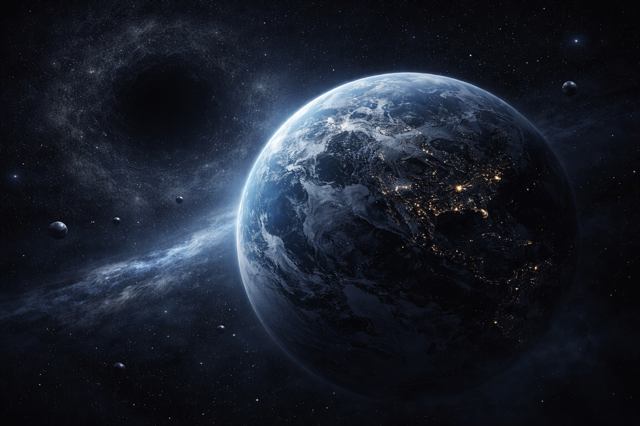
At the exact same moment, Earth would stop orbiting the Sun. People often imagine that Earth would immediately plunge somewhere or be yanked violently backward. Not quite. Earth is already moving through space fast. Orbit is just what happens when forward motion is continuously bent by the Sun’s gravity. Remove the Sun and the curve disappears. Earth keeps moving forward, but now in a straight-line path tangent to its old orbit. We would not fall. We would be released. Which sounds philosophical until you realize it is terrible.
v = sqrt(G * M_sun / r)
where G = gravitational constant
M_sun = mass of the Sun
r = Earth-Sun distance
The important part is not the symbolism. The important part is that without M_sun in the picture, there is nothing left to bend Earth’s path around the Sun. We become a rogue planet. Not a cool rebel planet. A deeply unemployed one.
Now comes the question every child asks and every adult dreads: do we all die immediately? Surprisingly, no. Catastrophically? Yes. Cinematically? Not quite. Earth has thermal inertia. The oceans, atmosphere, and ground all store heat. So the planet does not turn into an ice marble in ten minutes. It cools hard, but in stages.
C * dT/dt = F_geo - sigma * T^4
where C = effective heat capacity of the Earth system
F_geo = geothermal heat flow from Earth’s interior
sigma * T^4 = radiative heat loss
That equation is just a tidy way of saying: once sunlight drops to zero, Earth starts living off savings and a very modest geothermal side hustle. Unfortunately, the planet has been accustomed to a star-sized income and is not prepared for austerity.
The short timeline is ugly enough on its own. In the first few days, average surface temperatures would plunge. Many estimates put the early cooling rate at roughly 20 degrees Celsius per day at first. Within 2 to 3 days, much of the planet would be below freezing. Photosynthesis stops immediately. Agriculture would collapse almost immediately. Plants are not known for their resilience to total solar deletion. Solar panels would become decorative installations. Human beings would discover, in real time, that the Sun was never “background scenery.” It was infrastructure with excellent attendance. Humanity would discover that “we’ll pivot” is not, in fact, a thermodynamic strategy.
Within about a week, much of the surface ocean would begin icing over in earnest. Within about a year, Earth’s average surface temperature could fall below 200 kelvin, which is about minus 73 degrees Celsius or minus 100 degrees Fahrenheit. The deepest oceans, however, would take far longer to freeze completely. Some estimates put that on the order of a thousand years. Earth is large enough to die slowly in the basement even after the upper floors become uninhabitable.
And now we get to the part that made my seven-year-old look personally vindicated: some life would outlast us by a great deal.
Most familiar life depends on sunlight either directly or indirectly. No sunlight means no photosynthesis, and no photosynthesis means the elegant surface arrangement collapses fast. But some organisms on Earth already live in places where the Sun has never been invited. Deep-sea hydrothermal vent ecosystems run on chemosynthesis. Microbes use chemical energy from compounds like hydrogen sulfide or methane, and entire food webs build upward from that. Tube worms, clams, and microbial communities down there are basically saying, “That is unfortunate about your star, but operations remain stable in this sector.”
So would those deep creatures notice right away? Not in the same way surface life would. They do not rely on daylight. They do not need a sunrise. They are already living in darkness, pressure, and chemistry. They are, in a very real sense, the least surprised organisms on Earth. In other words, they already live like they never trusted the Sun in the first place. There is something rude about that level of preparedness.
Now, would they live forever? Probably not on a Sunless Earth. This is where people, including me on a dramatic day, can get carried away. The deep ocean still depends on Earth’s internal heat budget, and if the planet keeps cooling, even those refuges eventually face a harder future. “A very long time compared with us” is well supported. “Perpetuity” is a little too ambitious unless you are running for office in the microbial kingdom.
But that is exactly where the thought experiment becomes more interesting than a standard apocalypse story. Maybe the real question is not “Would Earth be doomed without the Sun?” It would. The more interesting question is whether we have been asking the wrong question about life in the universe the whole time.
We love asking whether a planet is in the “habitable zone,” which is science language for “close enough to a star that water might stay liquid at the surface.” That is a useful question, but it is also a very surface-dweller question. It assumes life has to live under a sky, in the light, on top of a planet, preferably with nice weather and good public relations. Earth itself already tells us that is not the only model. Life can hide underground. Life can live under ice. Life can run on chemistry instead of sunshine. Life, in other words, may be far more cunning than our search images.
That matters because astronomers think there may be staggering numbers of rogue planets drifting through the galaxy, possibly even trillions in the Milky Way alone. If some of those worlds have thick atmospheres, internal heat, buried oceans, tidal heating from moons, or chemically active interiors, then the universe may be full of dark, cold planets whose interesting biology is buried deep under the surface where our instincts are not looking. Not postcard life. Not green-hill-under-blue-sky life. Hidden, weird, under-the-floorboards life. Which raises the uncomfortable possibility that the universe is full of hidden biospheres minding their business under ice while we keep asking whether aliens have lawns and sunsets.
And yes, eventually the atmosphere would start doing stranger things too. People love saying “oxygen would freeze in the sky,” which is technically possible in a very late-stage, deeply miserable version of events. But that does not happen in the opening act. Oxygen condenses and freezes only at much lower temperatures than Earth would reach in the first days or even the first year. So if you are making a dramatic chart for this scenario, put “frozen oxygen sky” well after “everyone regrets underestimating the Sun.”
There is something oddly comforting in all this. Not the part where humanity gets turned into a cautionary tale by thermodynamics. That part lacks charm. I mean the reminder that life is both fragile and stubborn. Fragile on the surface, where warmth and light make complexity easy. Stubborn in the deep, where chemistry keeps the lights on long after the lights are gone.
So when my seven-year-old asked what happens if the Sun vanishes, the honest answer was this: for eight minutes, nothing. Then everything. The sky goes dark. Earth stops orbiting and drifts into deep space. The planet freezes. Surface life collapses. A few deep weirdos keep going longer than the rest of us. And somewhere in all of that is a useful lesson: the universe may be far less concerned with sunlight than we are. Also, children should not be allowed to ask better astrobiology questions than most adults before breakfast. It is humbling.