Mind Notes
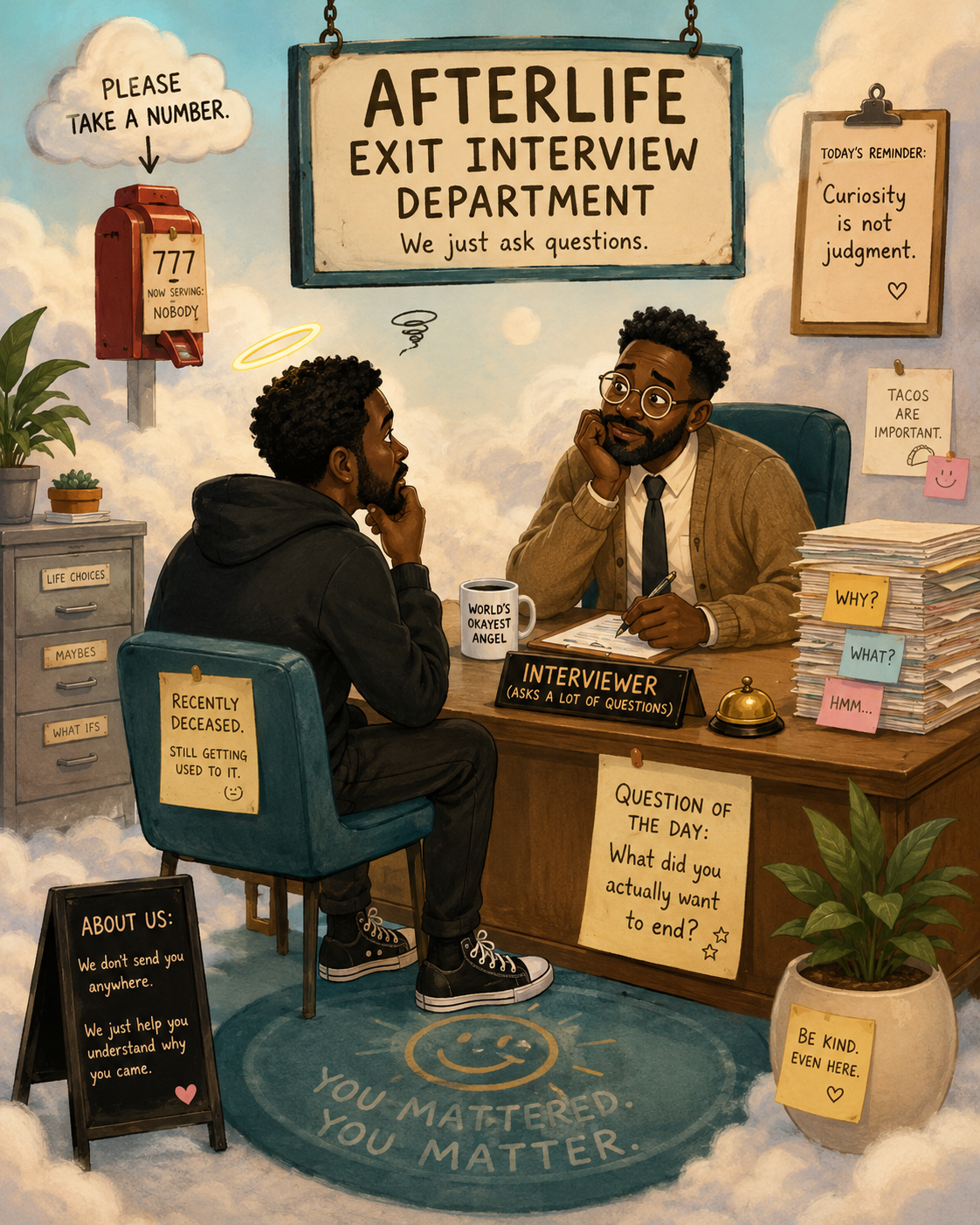
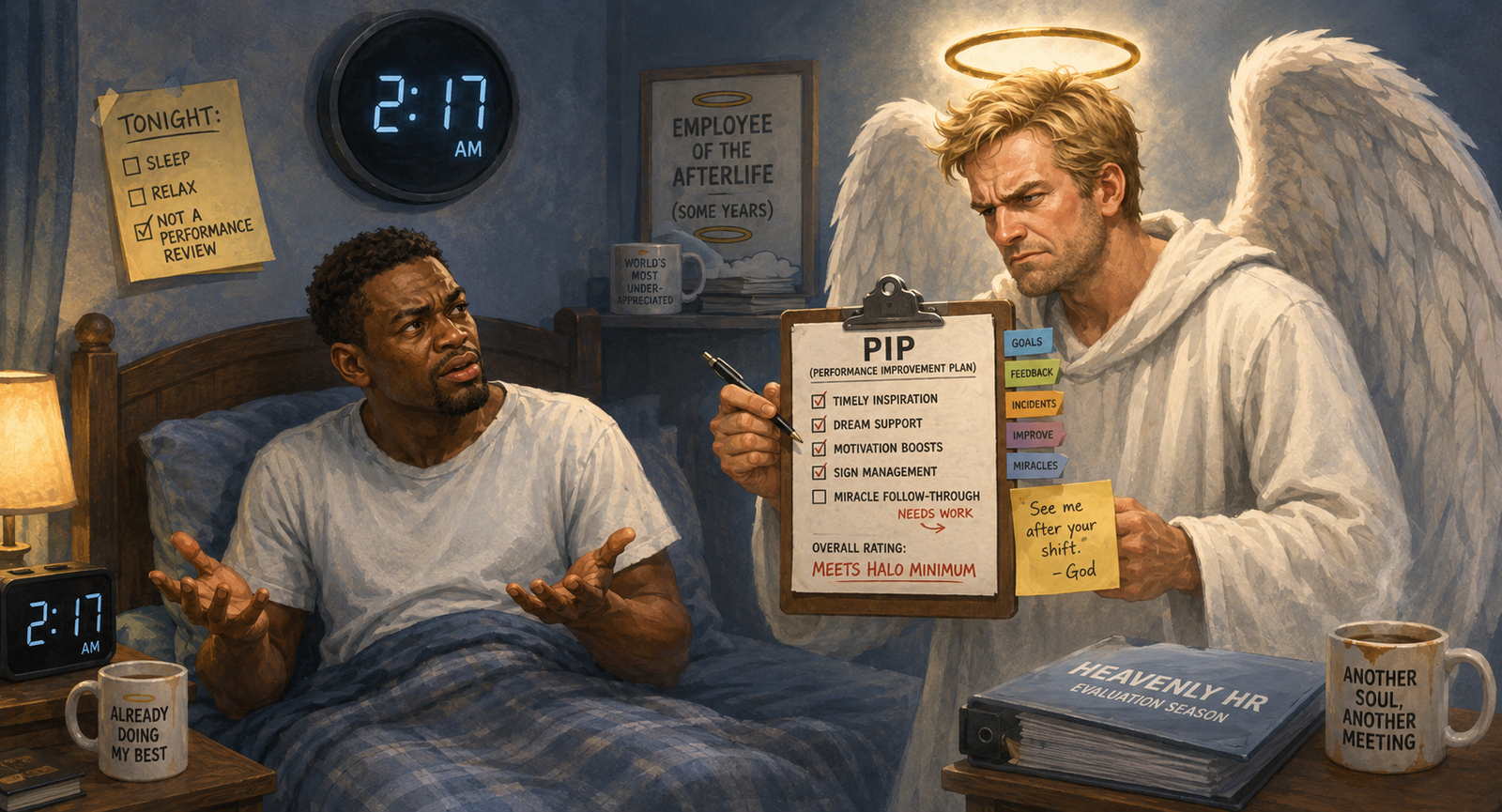
I had assumed that once you survive an existential crisis involving your guardian angel, a clipboard, several questionable afterlife policies, and a surprisingly complicated reincarnation menu, the universe would give you some space. Not necessarily a parade. I was not expecting a choir. But perhaps seventy-two hours without supernatural administrative involvement seemed reasonable. Apparently, I had misunderstood the terms of my continued existence, because three weeks later I woke at approximately 2:17 in the morning to find the same guardian angel sitting in the chair beside my bed with his arms folded, his wings compressed behind him, and an expression suggesting he had just discovered I had been using company funds to buy llamas. “You,” he said. I pulled the covers higher. “No.” He nodded once. “Yes.” I reminded him that we had already done this, which he immediately rejected on technical grounds. “We did not ‘do this.’ We conducted an emergency retention intervention.” I pointed out that his intervention had included telling me to return to life because his performance evaluation was coming up. He bristled. “That was one factor.” It had, in fact, been the first factor. He called that “contextually relevant,” which is the sort of phrase people use when they know you are right but still control the meeting.
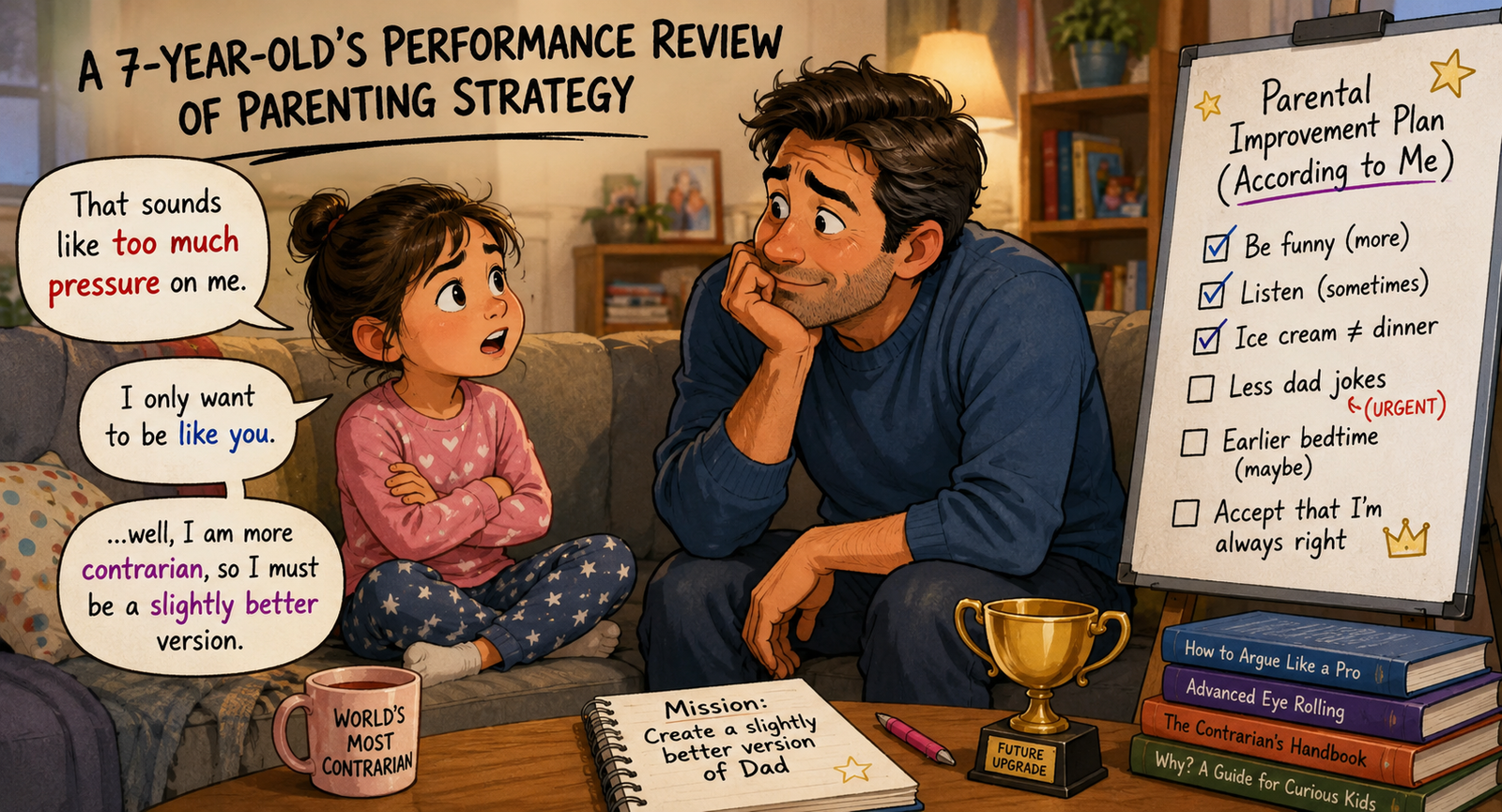
He reached down beside the chair and lifted the clipboard. My stomach sank immediately. There is nothing inherently threatening about a clipboard, but once a clipboard has appeared in both your mortal and spiritual problems, you begin to understand that paperwork may be the true force governing the universe. “Follow-up review,” he said. I protested that he could not possibly need a follow-up review, but apparently my case had been designated “high-touch.” I asked whether that meant I had somehow been enrolled in a premium celestial service tier. It did not. “Your continued stewardship requires enhanced monitoring,” he explained. I asked what enhanced monitoring actually meant. “Me.” I told him he had already been monitoring me. “Enhanced me,” he replied. That sounded significantly worse. Then he sighed, flipped to another page, and announced the real reason for the visit: because of deficiencies identified during his evaluation, he had been placed on a Performance Improvement Plan. I sat up so quickly I almost injured myself, which would have been an extremely on-brand development. “You got put on a PIP?” He stiffened. “It is called a Celestial Developmental Alignment Framework.” I laughed. “That is a PIP.” He said it was not. I asked whether it had specific goals, timelines, milestones, and scheduled check-ins with his supervisor. By the time I got to the supervisor part, he had become very interested in a point on the wall. “That is a PIP,” I said again. “It is developmental,” he muttered, which is also what earthly managers say shortly before someone’s email access stops working.
Naturally, I wanted details. He did not want to provide any. This disagreement lasted roughly twelve seconds because, unlike me, he had a performance metric tied to transparent stakeholder engagement. Finally, with the reluctance of a man reading his own disciplinary letter aloud at dinner, he agreed to share the objectives. The first was to demonstrate improved proactive intervention prior to subject destabilization. Reasonable enough. The second was to strengthen communication techniques during high-stress mortal interactions. I smiled because we both knew exactly what that referred to. During our last encounter, his opening line to a person actively contemplating death had been, “You have got to be kidding me.” He insisted this had established urgency. I told him it had primarily established that my guardian angel was having a worse evening than I was. He moved briskly to objective three: reduce visible frustration when the subject exhibits repetitive maladaptive behavior. That one was obviously about me. He claimed it was phrased generically. I asked what behaviors qualified. He turned the clipboard around, and there it was: an extensive list with tabs.
The first tab was labeled “Avoidable Emotional Complications,” which already felt judgmental. Under it were items such as revisiting conversations that had already ended, imagining arguments that had not occurred, rehearsing responses to hypothetical criticism, checking messages whose contents had not changed since the previous twelve checks, and assigning profound emotional significance to punctuation. I objected immediately. Punctuation matters. He disagreed. I reminded him that “Okay,” “Okay!”, “Okayyy,” “K,” and “Okay.” represent five completely different levels of diplomatic stability. He stared at me. “The message said ‘Okay.’” I asked whether there had been a period. He said yes. I spread my hands. “You see?” He did not. This may be the fundamental difference between humans and angels: angels appear to believe punctuation serves grammar, while humans understand that one full stop can initiate a three-hour forensic analysis of an otherwise ordinary relationship.
The next category was “Unnecessary Self-Created Complications.” Apparently, one evening I had stayed awake until 3:37 in the morning because I was anxious about being tired the next day. He had documented this as a closed-loop failure. I objected that this happened to people all the time. He calmly explained that I had created the exact condition I feared while attempting to prevent the possibility of that condition occurring. When he said it that way, it sounded stupid. He said it had been stupid. I reminded him that his developmental framework required improved communication techniques. He paused, recalibrated, and said, “I recognize that your decision-making process had opportunities for optimization.” Better. Then he added, “I still mean stupid.” Fair enough. There was no reason for both of us to pretend heaven had suddenly become tactful.
Then he reached the food and hydration section, which I considered an invasion of privacy until he reminded me that privacy was never really the product when one had a guardian angel. He had apparently noticed that I repeatedly wait until I am extremely hungry and then act surprised when my mood deteriorates. I told him that felt excessively personal. He replied that for me, nutrition had now become a documented risk factor. Worse, he had notes on hydration. “You own multiple water bottles,” he said. I agreed. “Decorative ownership is not hydration.” I told him I drink water. He replied that I drink coffee near water. Apparently that does not count biologically, spiritually, or administratively. Then he wrote something down. When I demanded to know what it was, he said, “Resistance to hydration coaching.” I told him he could not put that in my permanent record. “There is no temporary record,” he said. That sentence produced a brief but profound concern about the scope of celestial data retention. I asked how much heaven actually keeps. “All of it,” he said. I made the catastrophic mistake of asking whether that included browser history. For the first time all evening, he smiled. Not kindly. “We are not discussing browser history.” I decided immediately that mystery can be a mercy.
The most troubling part of the review came when he informed me that, due to new boundaries imposed by management, he was no longer permitted to intervene in what were officially classified as “low-consequence stupidity events.” This was alarming because I had no idea such a category existed. He provided examples. The previous afternoon I had spent eleven minutes searching for an object that had been directly in front of me the entire time. I argued that this happened to everyone. He agreed, which was apparently why guardian angels had stopped wasting resources on it. Then there was the refrigerator incident. According to him, I had opened the refrigerator three times within a twenty-minute period hoping that new food would appear. I explained that I had been reassessing the inventory. “You knew the inventory.” I told him that sometimes options reveal themselves after reflection. “They did not.” I reminded him he could not know that. “I was there.” This is one of the drawbacks of debating an immortal witness. They have excellent documentation.
Then came an event I still dispute. He alleged that the previous Thursday I had walked around my own home using the flashlight on my phone while searching for my phone. I told him this could not possibly be true. He said it lasted forty-one seconds and was timestamped. I argued that I must have been tired. “You were holding the phone.” I thought about this. “Then clearly I found it.” He closed his eyes. It was around then that I understood why even eternal beings might eventually develop stress-related symptoms. Guardian angels may spend entire centuries watching competent adults enter rooms and immediately forget why they went there, then stand in the middle of the room staring at furniture as though furniture has the answer.
At some point I asked how many actual disasters he had prevented. He told me to define disaster. I said anything genuinely serious. He counted several vehicle incidents, one bout of food poisoning, a poorly secured shelving unit, two falling objects, an electrical issue, several interpersonal situations that were “trending toward consequences disproportionate to their entertainment value,” and something involving a treadmill. I immediately asked about the treadmill. He told me we had agreed never to discuss it. I did not remember agreeing to this. “You were unconscious for part of the negotiation,” he said. I decided some archival materials should remain sealed. He then moved to what he described as my “persistent conflict with inanimate systems.” I objected because I do not fight with objects. He reminded me that I had recently yelled at a printer. I explained that the printer knew what it was doing. He told me it had a paper jam. I said I had pressed print once and nothing happened. He informed me that I had actually pressed print fourteen times, which resulted in fourteen copies once the obstruction cleared. This proved nothing except that the machine had been withholding service deliberately.
The microwave file was even worse. Apparently, I had entered two minutes, left the room, returned eight minutes later, and accused the microwave of making my food cold. I told him I had forgotten the food was there. He nodded. Then, according to his notes, I reheated the food, forgot it again, and repeated the sequence twice. He closed the file and asked whether I now understood why management considered his portfolio elevated-complexity. I told him he was making me sound unstable. He responded that I was broadly consistent with the species, which somehow made everything worse. Perhaps that is the most comforting and insulting truth available to any adult: many of the things we privately regard as evidence that we are uniquely failing at life are apparently standard human operating conditions. Everyone walks into rooms and loses the plot. Everyone rereads a message and finds fresh insult on the seventh pass. Everyone has argued with a password requirement. Everyone has stood in front of a self-checkout machine and been accused of placing an unexpected item in the bagging area immediately after being instructed to place the item in the bagging area. Maybe guardian angels are not primarily protecting us from flaming catastrophes. Maybe half their workload consists of standing nearby whispering, “Do not engage. It is a kiosk.”
Eventually, because curiosity continues to sabotage my peace, I asked whether guardian angels ever traded assignments. He became suspicious immediately. “Why?” I told him I was just curious. He accused me of implying that he had requested reassignment. I pointed out that I had merely asked whether transfers existed. His defensive posture answered the question. “Oh my God,” I said. “You tried to transfer me.” He denied this in the specific manner of someone confirming it. “I explored resource alignment options.” That was a transfer request. Apparently there had been discussions. I asked how many departments had declined. Silence. Then I asked whether there had been a meeting. More silence. By that point I could practically see the agenda. Somewhere in eternity, a group of immortal beings had gathered around a table to discuss whether any of them wanted responsibility for me. I asked whether anyone had volunteered. Gabriel apparently had communications responsibilities. Michael had a security mandate. Raphael was over capacity. One cherub had expressed preliminary interest, which briefly raised my spirits until I learned that the cherub had misunderstood the assignment and thought they were discussing bird watching. My celestial market value was below bird watching.
The angel checked the time and announced that we needed to finish. I reminded him that, technically speaking, he had nowhere else to go. He replied that this was irrelevant because he still had deliverables. I asked to whom. He gave me the look. Right. Senior angel. I asked what would happen next. He said he would continue monitoring me and undergo a thirty-day review under the Celestial Developmental Alignment Framework. I asked whether I could help his case by behaving better. He laughed. Not smiled. Laughed loudly, for several seconds, with enough force that I found the response personally hurtful. I insisted that I was capable of responsible behavior. He reminded me that the previous day I had attempted to open a package with a steak knife because the scissors were downstairs. I defended this by explaining that I needed the package immediately. He checked his notes. “It contained socks.” New socks, I told him. That mattered. He pointed at me and said this was exactly the kind of low-consequence stupidity he was no longer permitted to prevent. Apparently personal responsibility now included surviving your own impatience around hosiery.
He stood to leave, then paused and said his supervisor had recommended that he practice positive reinforcement. The words themselves seemed physically uncomfortable for him. After several seconds, he managed to say that I had demonstrated “acceptable continuity” since our previous intervention. I told him this might be the worst compliment I had ever received. He tried again. “You have continued participating in life despite recurring frustration.” Better. Then, because he could not help himself, he added that I had maintained basic functioning and occasionally demonstrated judgment. I objected to “occasionally.” He said he could not falsify records. Finally, after several failed attempts at praise, he looked down at the clipboard, then back at me, and said, “You are still here.” That was the first thing he said all evening that neither of us could improve.
Still here. Not transformed. Not cured by revelation. Not permanently optimistic. Not floating through the world with a new understanding of purpose and a soft halo around every inconvenience. Just still here, navigating the absurd machinery of ordinary life while occasionally arguing with electronics and reading emotional subtext into punctuation. Maybe that is enough for some days. Not every day has to be meaningful. Some days can simply be completed. You can survive Wednesday without understanding Wednesday. You can have a terrible morning and an acceptable sandwich by lunch. You can be profoundly uncertain about the future and still remember there is laundry in the dryer. You can spend an hour contemplating the terrifying enormity of existence and then discover frozen groceries have been sitting in the trunk. Human beings contain multitudes, but an embarrassing percentage of those multitudes are errands.
The angel started to fade, and I wished him luck with the evaluation. He thanked me, which was unexpectedly sincere. I told him I hoped he got off the PIP. He immediately corrected me: it was not a PIP. It was a Celestial Developmental Alignment Framework. Completely different. Night and day. I agreed with all the seriousness I could manage, then offered to tell his supervisor that I had observed meaningful improvement in stakeholder engagement. His expression softened. “You would do that?” Absolutely, I said, assuming there was a feedback survey. The irritation returned instantly, which frankly restored the natural order of things.
He vanished. I lay back down. About two minutes later, I realized I had forgotten the only question that truly mattered: whether the angels reviewing him knew about the treadmill. From somewhere in the darkness came his voice. “Yes.” I froze. There was a pause, then he added, “And stop thinking so loudly.” I pulled the covers over my head. Somewhere beyond the visible universe, my guardian angel was on a Performance Improvement Plan, heaven was operating a bureaucracy nobody had warned us about, and apparently my thoughts were generating unnecessary administrative traffic. For reasons I cannot fully explain, I found that reassuring. At minimum, it suggested neither of us was getting rid of the other anytime soon.
If you are contemplating suicide, this is the one part of the story that is not a joke: tell someone immediately. Tell them the ugly version, the inconvenient version, the version you have been editing down so nobody worries. Contact a mental health professional, crisis service, emergency department, or emergency services if you are in immediate danger; in the United States, call or text 988.
Do not sit around waiting for a shaft of light, a choir, or some overworked celestial employee to materialize beside your bed with a clipboard and an attitude. Get help from the living while you are still among them. Your guardian angel may exist, but for all you know he is already on a PIP, behind on his case notes, arguing with Heavenly HR, and absolutely furious that you have scheduled another unsanctioned existential escalation during evaluation season.
A Note About Mind Notes
Mind Notes is my attempt to take some of the hardest things people carry quietly—depression, suicidal thoughts, loneliness, grief, anxiety, and the strange private negotiations we have with our own minds—and drag them into the light without turning them into a lecture. These subjects are real, prevalent, and often terrifying precisely because they can feel impossible to say out loud. Humor does not make them less serious; sometimes it simply makes them less frightening to approach. If we can laugh at the absurdity surrounding the darkness, perhaps we can talk about the darkness itself with a little less shame and a little more honesty. The joke is never the person who is struggling. The joke is the bizarre machinery of being human while trying to survive your own thoughts.
I write about these subjects from lived experience. I have struggled with suicidal ideation, and it remains something I understand personally rather than academically or from a safe distance. That does not make me a clinician, and these essays are not intended to minimize suicide, depression, or anyone else’s experience. They are an attempt to share some of the ways I have learned to live alongside difficult thoughts—especially humor, perspective, absurdity, and talking about what many of us learn to hide. What helps me may not help you in exactly the same way, but perhaps it can help you find or build your own ways of getting through the difficult hours. Most importantly, I want Mind Notes to make one thing clear: having these thoughts is nothing to be ashamed of, and asking for help is not something that requires an apology.
Depression is real. Suicide is final. Mind Notes is not therapy, medical advice, or a substitute for professional care. If something here feels uncomfortably familiar, tell someone. Say the awkward thing. Say the embarrassing thing. Say the thing you have been carefully editing so nobody realizes how bad it has become. If you are thinking about suicide or believe you may be in immediate danger, seek help now; in the United States, call or text 988 or go to the nearest emergency department. There is no prize for carrying it beautifully. The objective is to still be here long enough to laugh at something ridiculous tomorrow.