Mind Notes
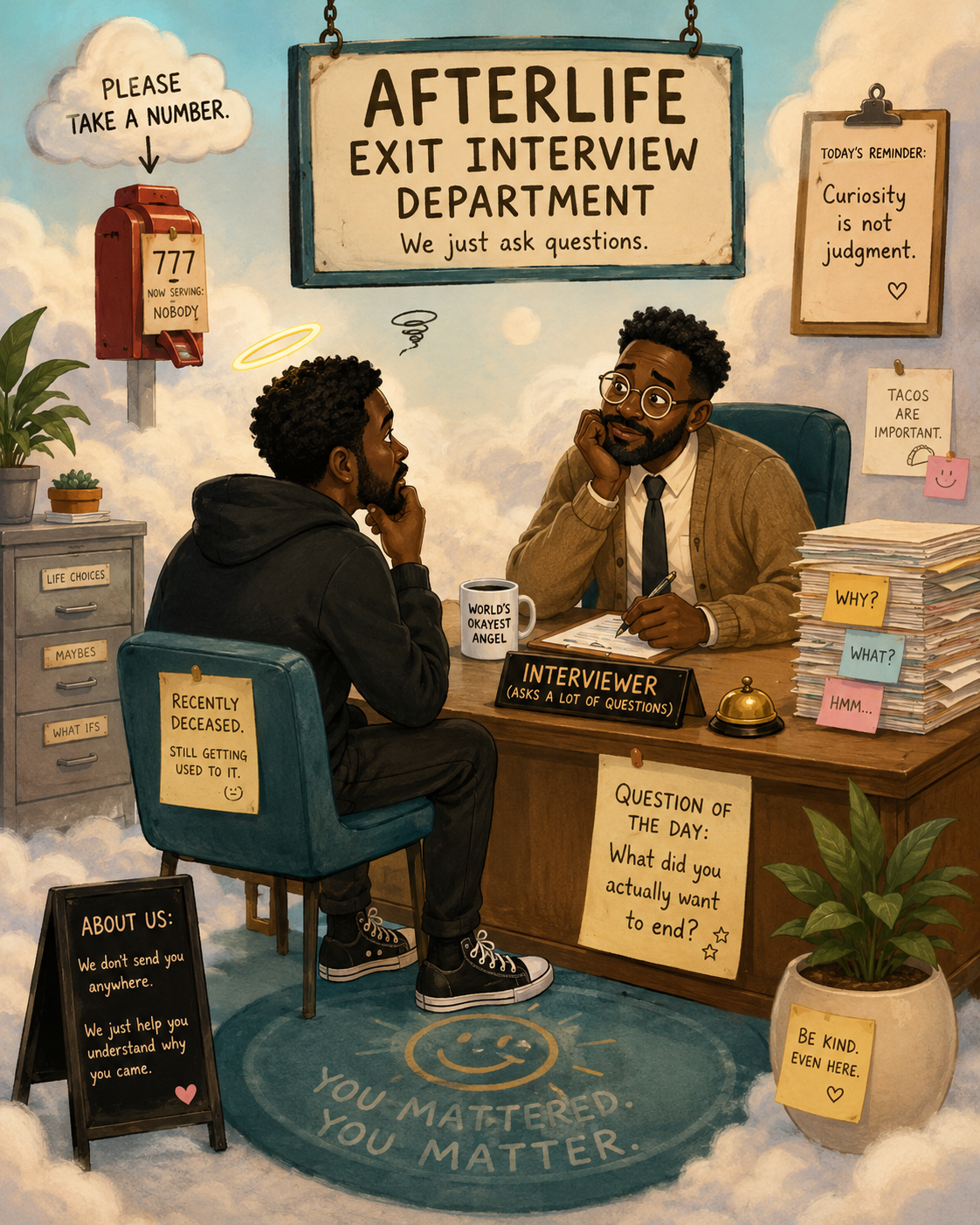
The first thing I noticed about being dead was how aggressively unimpressive it was. No tunnel. No white light. No choir warming up somewhere behind the clouds. Nobody’s grandmother standing at the gates looking twenty-seven again. There was no booming voice announcing that my file had been located, no montage of my childhood, and, perhaps most disappointingly, absolutely no indication that anyone had reviewed the extensive literature promising me that death would involve floating peacefully toward something luminous. Instead, I was sitting in a chair. Across from me was a desk. On the desk was a folder. Behind the desk sat someone I could not quite describe afterward, which I suppose should have been my first indication that something unusual was happening. The room looked less like heaven and more like the administrative office of a government agency that had recently failed an inspection. Beige walls. Fluorescent lighting. Two chairs, one of which was apparently assigned to the deceased. I looked down at myself and discovered that I still had hands, which seemed administratively unnecessary, and then looked back at the person behind the desk. They opened the folder, glanced at the first page, looked at me and said, “So. Why did you do it?”
There are questions you imagine will require complicated answers until somebody actually asks them. Then you discover that all the magnificent explanations you constructed inside your head have somehow failed to report for duty. I had spent months answering this question without anyone asking it. I answered it in the shower. I answered it while driving. I answered it at three in the morning while staring at the ceiling. I answered it at work while pretending to read emails. I had built entire closing arguments around it. Life had become exhausting. People would eventually move on. Everyone would be better without the burden of worrying about me. Nothing was going to change. I had tried. I had waited. I had endured. I was tired of enduring. Somewhere along the way, these thoughts stopped behaving like thoughts and became evidence. Evidence became conclusions. Conclusions became certainty. By the time I arrived in this strange beige office after apparently dying, I should have been able to deliver a flawless presentation with charts, appendices, footnotes, and perhaps a short question-and-answer period afterward. Instead, I stared at the person behind the desk and said, “I was tired.”
“Tired of what?”
“Everything.”
They looked down at the folder.
“That is not an answer.”
“It was enough of an answer yesterday.”
“And how did that work out?”
I stared at them. “Am I being judged?”
“No.”
“Because this feels remarkably judgmental.”
“I asked a question.”
“I answered it.”
“You supplied a category. ‘Everything’ is not particularly useful for analytical purposes.”
I almost laughed, which seemed inappropriate considering I was dead. “Analytical purposes?”
“You made a permanent decision. We are attempting to understand the problem it was intended to solve.”
That irritated me more than it should have. “I didn’t know there would be an exit interview.”
“There is always paperwork.”
“Of course there is.”
They turned a page. “Let’s try again. What were you tired of?”
This time I actually thought about it. Not the rehearsed answer. Not the dramatic version that had occupied my head for months. The actual answer. I was tired of waking up already exhausted. I was tired of people asking how I was doing and hearing myself say “good” before I had even decided whether that was true. I was tired of carrying sadness that had no obvious source and therefore seemed impossible to justify. I was tired of being loved and somehow still feeling alone. I was tired of disappointing people. I was tired of performing normalcy so convincingly that people occasionally complimented me on it. A few weeks earlier, someone had stopped me in a hallway and said, “You look great. Whatever you’re doing, keep doing it.” I had smiled, thanked them, walked to my car after work, closed the door and sat in the parking garage for almost forty minutes because I could not summon whatever version of myself would be required when I got home. That was the strange part: I could still answer emails, make jokes, attend meetings, remember birthdays, ask other people how they were doing and appear interested in their answers. From the outside, the machinery was operational. Nobody could see that some evenings I sat in the driveway negotiating with myself over the simple act of opening the front door. Most of all, I was tired of waking up every morning and discovering that I had to be myself again.
The person behind the desk listened without interrupting.
When I finished, they asked, “Which one did you want to end?”
“All of them.”
“That was not the question.”
I sighed. “You really enjoy saying that.”
“It saves time.”
“I apparently have plenty.”
They didn’t smile. “Which one did you want to end?”
I thought again. “The pain.”
They wrote something down.
“What?”
“Nothing.”
“You wrote something.”
“Yes.”
“What did you write?”
“That you wanted the pain to end.”
“Yes.”
“Then why did you end your life?”
I stared at them.
For the first time since arriving, the room became completely silent.
It is strange how a question can sound ridiculous until you realize you do not have an answer for it. “Because they were the same thing.”
“Were they?”
“At the time.”
“That isn’t what I asked.”
“You weren’t there.”
“No.”
“You don’t know what it felt like.”
“No.”
“You don’t know how long I had been fighting.”
“No.”
“You don’t know what I tried.”
“No.”
“You don’t know how many times I woke up and told myself to make it through one more day.”
“No.”
“So don’t sit there and reduce it to some clever distinction between my pain and my life.”
They closed the folder.
“I am not reducing anything.”
“Sounds like it.”
“I am asking whether the thing you wanted to stop and the thing you stopped were actually the same thing.”
“And I am telling you that distinction is much easier to make from your side of the desk.”
For once, they said nothing.
I leaned forward. “You keep asking questions as if I was sitting there with a menu of rational alternatives and simply selected the wrong one. You ask what tomorrow might have contained. Fine. Maybe tomorrow contained something wonderful. Maybe next year did too. But you weren’t the one who had to survive until tomorrow.”
The person looked at me for a long moment.
“No,” they said. “I wasn’t.”
That was it. No clever reversal. No hidden philosophical trap. No line from the folder that demolished my argument. Just an acknowledgment.
Somehow that made the next question harder.
“If the pain could have ended without your life ending,” they asked, “would you have taken that option?”
“Yes.”
The answer came so quickly that I hated it.
They looked at me.
“What?”
“You answered immediately.”
“So?”
“Nothing.”
“You keep doing that.”
“Doing what?”
“Making silence feel accusatory.”
“I am simply allowing you to hear your own answers.”
“Well, stop.”
They reopened the folder.
I wanted to argue. More than that, I wanted to win. There was something offensive about discovering that death apparently did not exempt you from defending your reasoning. I had expected, if there was anything after death at all, that there would at least be some recognition of how difficult it had been. Maybe that was what I wanted from this mysterious person: validation. I wanted them to review the evidence, lean back in the chair and say, Yes. That was terrible. Under those circumstances, your decision makes perfect sense. Instead they kept separating things I had spent years combining. Pain from life. Loneliness from permanence. Exhaustion from hopelessness. The present from the future. Inside my head those things had fused into a single enormous conclusion: This will never change. Sitting across from someone who refused either to condemn that conclusion or automatically endorse it was surprisingly infuriating.
“You also said nothing was going to change,” they said.
“It wasn’t.”
“How did you know?”
“Experience.”
“Experience of the future?”
I rolled my eyes. “Obviously not.”
“Then what happens next Thursday?”
“What?”
“Next Thursday.”
“I don’t know.”
“Next year?”
“I don’t know.”
“Then how much of the future did you actually observe before deciding what all of it contained?”
I folded my arms. “You can do this with anything. Nobody knows the future.”
“Correct.”
“That doesn’t mean everything magically gets better.”
“I did not say it would.”
“Maybe things would have gotten worse.”
“Yes.”
“Much worse.”
“Yes.”
“Then what exactly is your point?”
They looked directly at me. “That you treated uncertainty as evidence for the outcome you feared most.”
That one landed differently.
There is a peculiar authority to hopelessness that nobody talks about enough. Despair can make extraordinary claims about things it cannot possibly know. It can tell you that nobody will ever love you differently, that your family will eventually be better without you, that your career will never recover, that grief will never loosen its grip, that treatment will never work, that tomorrow will simply be today wearing different clothes. And because despair speaks in your own voice, it does not sound like speculation. It sounds like intelligence. It sounds like pattern recognition. It sounds like someone who has finally stopped lying to themselves. I had never considered that perhaps my mind had been making predictions with enormous confidence using a dataset consisting almost entirely of terrible days.
The person behind the desk interrupted my thoughts. “Who did you leave?”
“I don’t want to talk about that.”
“It is in the file.”
“Then you don’t need me.”
“I want your version.”
“No.”
They waited.
“Stop doing the silence thing.”
They continued doing the silence thing.
I finally named them. The people I loved. The people I had convinced myself would eventually recover. The people whose future grief I had calculated on their behalf without consulting any of them. I explained that I had believed my continued existence imposed a burden on them. I explained that worrying about me was exhausting. I explained that they deserved freedom from the constant possibility that something might happen.
“And now?” the person asked.
“Now what?”
“Are they free from it?”
I didn’t answer.
“Or did you transfer it?”
That was the first question that made me angry enough to stand. “You said this wasn’t judgment.”
“It isn’t.”
“Then what is it?”
“An examination.”
“Of what?”
“Your certainty.”
I sat back down.
They flipped another page. “You wrote that nobody understood.”
“They didn’t.”
“Did you tell them?”
“Some of them.”
“Everything?”
“No.”
“Why?”
“They wouldn’t understand.”
“How did you determine that?”
“I knew them.”
“That is not the same as telling them.”
“You have clearly never attempted to explain depression to someone who thinks sadness can be repaired with exercise and gratitude.”
“That sounds frustrating.”
“You have no idea.”
“No. But I notice you are capable of describing it quite precisely now.”
I almost told them to go to hell before remembering that, depending on where this office was located, they might already have home-field advantage.
They continued. “What do you miss?”
“Nothing.”
“Nothing?”
“I just died.”
“Yes.”
“Give me a minute.”
“I believe that is what we are doing.”
I looked around the beige room. “I don’t know. People.”
“Anything else?”
“No.”
They waited.
“Coffee,” I said eventually.
They wrote it down.
“You cannot possibly be writing coffee.”
“I am.”
“Delete that.”
“I don’t believe these forms permit deletion.”
“I’m dead and my permanent record is going to say coffee?”
“You selected it.”
“I didn’t select it. You interrogated me until I panicked.”
“Anything else?”
I thought about mornings. Music in the car. Rain against windows. The first cold day after a brutal summer. Laughing at something inappropriate when you were absolutely not supposed to laugh. A particular restaurant. Clean sheets. A favorite chair. The sound of someone you love walking through the front door. Getting a text from a friend you had not heard from in months. Complaining about meetings. Canceling plans and experiencing the immediate spiritual renewal that follows.
“Tacos,” I said.
They wrote that down too.
“This is humiliating.”
“You appear to have developed several attachments to existence.”
“I did not kill myself because I disliked tacos.”
“I understand.”
“Or coffee.”
“Noted.”
“You are making this sound ridiculous.”
“No. I am establishing that wanting your suffering to stop did not necessarily mean you wanted every component of being alive to stop with it.”
That shut me up again.
Eventually I asked the question I had been avoiding.
“So what happens now?”
The person closed the folder.
“I don’t know.”
“What do you mean you don’t know? You work here.”
“I did not say that.”
“You have a desk.”
“That proves remarkably little.”
“Am I going somewhere?”
No answer.
“Heaven?”
Nothing.
“Hell?”
Nothing.
“Reincarnation?”
Still nothing.
“This is an extraordinarily poorly managed afterlife.”
Then they asked, “Do you regret it?”
I opened my mouth and discovered that the obvious answer would not come. Yes felt dishonest. No felt impossible. Regret suggested that I had suddenly discovered life was wonderful, and I hadn’t. The things that hurt still hurt when I remembered them. The loneliness had been real. The exhaustion had been real. The nights when staying alive felt less like courage and more like administrative maintenance had been real. I could not retroactively turn suffering into a misunderstanding simply because I was now sitting in a strange room discussing coffee with an unidentified bureaucrat. But something had changed. Not the facts. The certainty.
“I don’t know,” I said.
They waited.
“I wish…”
I stopped.
“What?”
“I wish I had waited.”
The beeping started quietly.
I looked around.
“What is that?”
The person did not answer.
The beeping grew louder.
“Is that for me?”
Nothing.
The room seemed to move farther away without actually moving. The desk blurred around the edges. The folder disappeared first, then the walls, then the chair beneath me. I heard the beeping again, louder now, irritatingly familiar, and somewhere inside the confusion I realized I knew that sound.
My alarm.
I opened my eyes.
Dark bedroom. Ceiling. Sheets tangled around my legs. My shirt soaked through with sweat. Heart beating so hard I could feel it in my throat. My phone was vibrating angrily on the nightstand, performing the same thankless duty it performed every morning: informing me that despite my objections, another day had begun.
I turned it off and lay there.
For several seconds I did not understand what had happened. I looked toward the corner of the room expecting the desk to be there. I could almost see the folder. The beige walls. The irritating person waiting for another answer. Then the bedroom slowly reassembled itself around me.
No office.
No interview.
No folder.
I was alive.
And for one ugly, confusing instant, I wasn’t relieved.
I had been prepared for something to be over. Whatever else death had meant inside the dream, it had at least meant that I would not have to get up and continue. Now the alarm was off, morning was waiting, and every problem I had carried into sleep appeared to have survived the night with me. I closed my eyes again, not because I wanted to die, but because being alive suddenly felt like discovering that a flight you thought had been canceled was merely delayed and you were still expected at the gate.
Then another feeling arrived.
Not joy.
Not gratitude.
Curiosity.
That was all.
The question from the dream would not leave me alone.
What did you actually want to end?
I sat on the edge of the bed.
Not my life.
That answer frightened me because I was not completely certain it was true. But I was certain enough to examine it.
Maybe I wanted the pain to stop. Maybe I wanted the exhaustion to stop. Maybe I wanted one particular problem to stop masquerading as my entire existence. Maybe I wanted permission to stop performing, stop pretending, stop carrying something alone, stop being the version of myself I thought everybody required. Maybe “I don’t want to live anymore” had been doing too much work as a sentence. Perhaps buried inside it were several smaller sentences that sounded almost identical when everything became dark: I don’t want to live like this anymore. I don’t want to hurt like this anymore. I don’t know how to fix this. I cannot imagine doing this forever. I need something to change.
Those are serious sentences.
They are not the same sentence.
I made coffee. Apparently that mattered. I sat there holding the cup and thought about the strange bureaucracy my sleeping mind had invented, about the folder containing all my supposedly airtight arguments, and about how quickly some of them had become less certain when another voice simply kept asking questions.
The problems were still there. I was still there too.
Maybe that is one of the quiet dangers of despair. It does not always lie about how bad today is. Sometimes today really is awful. Sometimes the job really is unbearable, the grief really is crushing, the relationship really has failed, the loneliness really does hurt, and getting through another day genuinely feels like work. The trick is subtler. Despair takes today’s evidence and quietly extends it across every tomorrow you have not lived yet. It converts pain into permanence, exhaustion into prophecy, and uncertainty into a verdict. Then it hands you the verdict in your own handwriting.
I still did not know what next Thursday would look like.
Neither, apparently, did the part of my mind that had been so certain there was no reason to see it.
So I did not solve the rest of my life that morning. I did something considerably less impressive.
I stayed.
Maybe sometimes that is enough. Not a revelation. Not a five-year plan. Not a beautiful explanation for suffering. Just enough uncertainty to postpone an irreversible conclusion and enough honesty to tell another person what you actually want to end.
Because you do not have to solve the rest of your life today.
But perhaps you shouldn’t cancel it either.
A note from Mind Notes: This essay is a fictional exploration of suicidal thinking, not crisis guidance. If thoughts of suicide are becoming immediate or you are concerned that you may act on them, seek immediate support from a trusted person, qualified mental-health professional, emergency service, or crisis service where you live. You do not need to settle the rest of your life before asking someone to help you through the present moment.