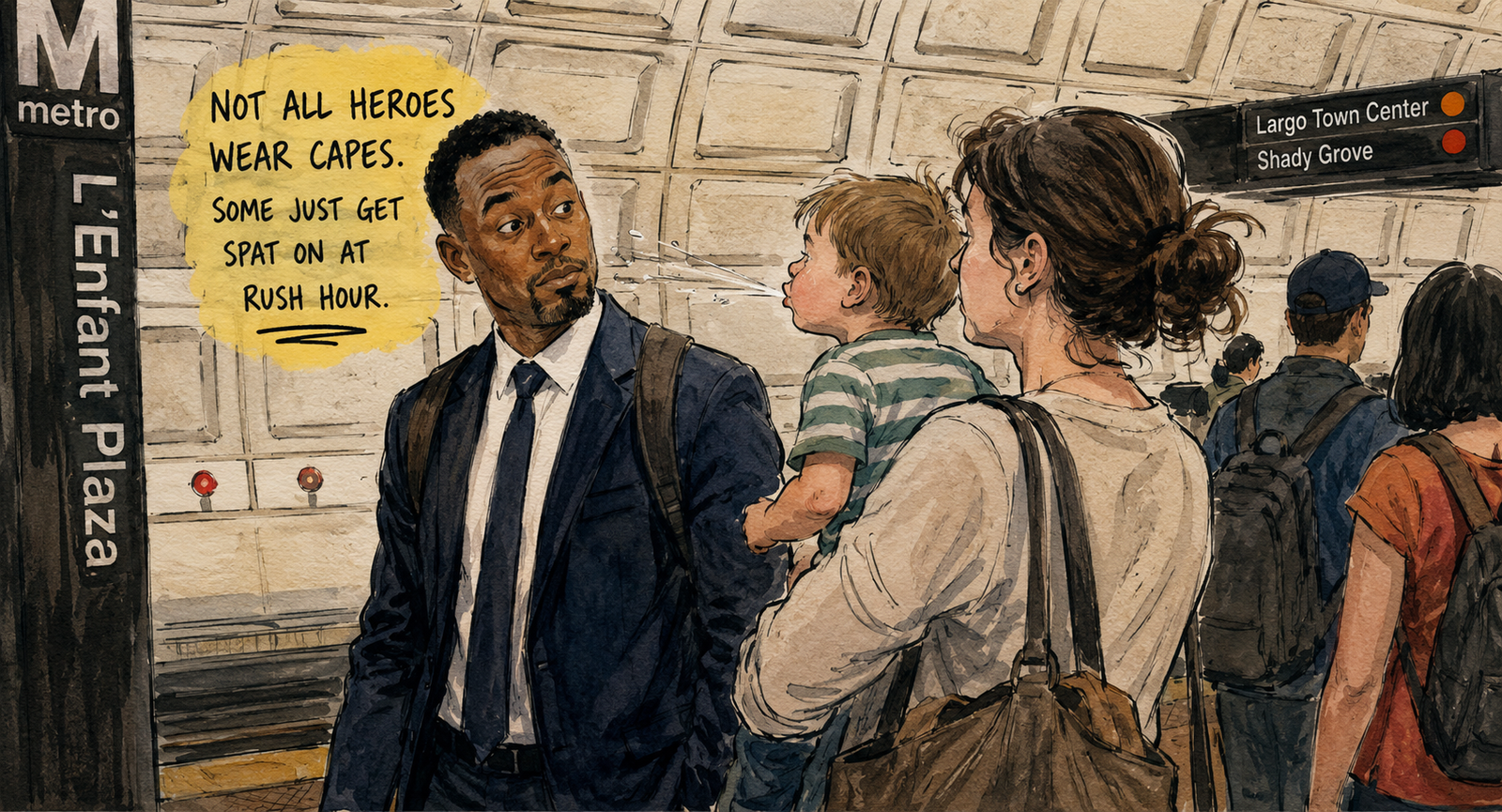
There are days when public transportation feels less like a transit system and more like a poorly funded sociology experiment with wheels, fluorescent lighting, and just enough delay to make everyone reconsider their life choices. This particular evening, however, the Metro outdid itself. It did not merely transport passengers from one station to another. It delivered narrative structure. It gave us tension, character development, moral ambiguity, sudden reversal, and a climax so unexpected that even the train operator probably felt the ancestral winds shift somewhere between stops. Karma, apparently tired of working remotely, had decided to come into the office.
As previously established in the ongoing civic documentary known as summer break, teenagers have been released back into the wild with unlimited Metro access, questionable judgment, and the confidence of people whose brains are still under municipal construction. School is out, supervision is uneven, and the trains have become moving lounges for young people testing the boundaries of romance, volume control, deodorant, and the general patience of the adult population. They do not walk onto the train so much as arrive, like a weather event with sneakers. Some bring music. Some bring snacks. Some bring the energy of future defendants in minor public-nuisance hearings. This evening’s featured guests were a young couple who had clearly decided that five Metro stops was the appropriate length of time for a full romantic summit.
Now, one does not want to sound like the self-appointed village elder of the Blue Line, but there is a difference between affection and turning a public train into a low-budget teen romance filmed without permits. A kiss here and there is nothing. Young love is young love. Everyone was once ridiculous in public, even those of us who now pretend we were born fully employed, irritated, and carrying reusable grocery bags. But this couple was not merely making out. They were conducting field research. They were testing the structural limits of Metro seating, the moral endurance of strangers, and the acoustics of adolescent decision-making. After five stops, the rest of us had become unwilling shareholders in their emotional startup.
Naturally, the adult response was avoidance. Nobody wanted to be the person who said something, because saying something on the Metro requires a personality type best described as “prepared to appear on local news.” So people did what trained Metro veterans do. They looked at phones. They studied imaginary objects in the distance. They inspected advertisements for dental implants with sudden philosophical intensity. I put on my headphones and stared into nothing, which is one of the last remaining survival skills of civilized society. It is a delicate art, the Metro stare. You must look awake but unavailable, aware but not involved, present but spiritually out of jurisdiction.
Then she boarded.
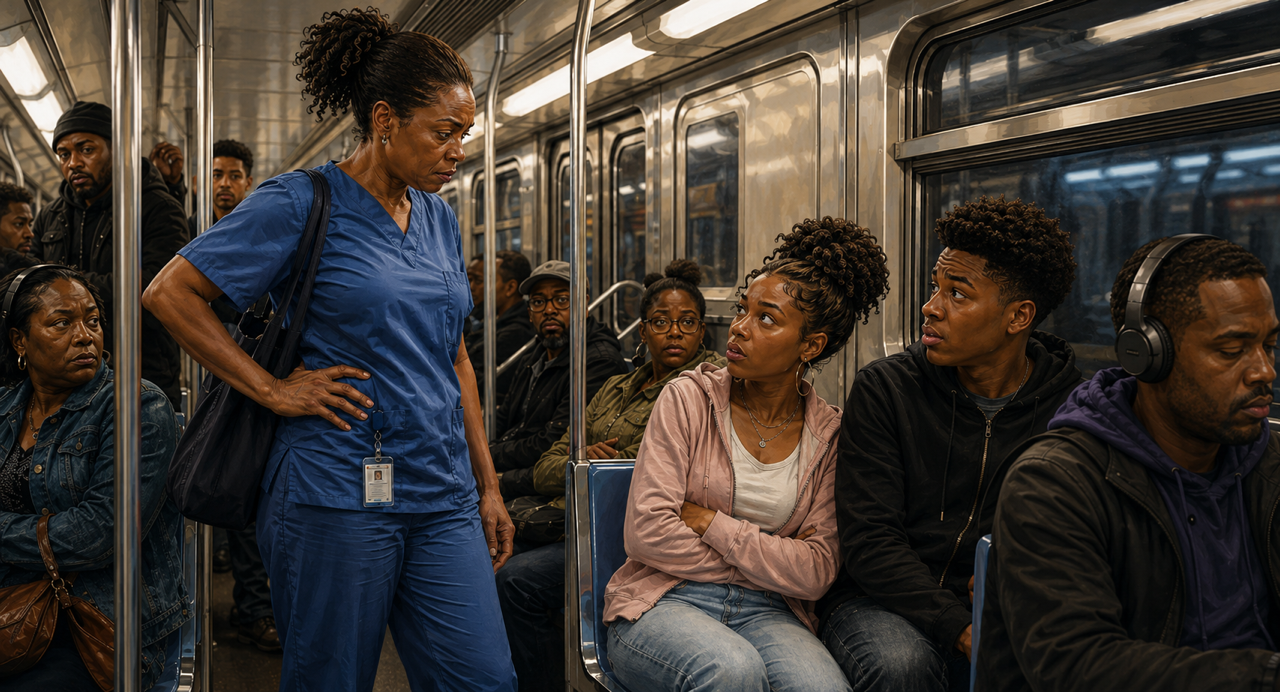
At first, she looked like any other exhausted adult finishing a shift somewhere in the medical ecosystem. Scrubs, practical shoes, face set to that familiar expression worn by people who have spent all day dealing with blood pressure, insurance forms, appointment delays, and human beings who arrive late but demand immediate attention. She had the aura of a woman who had already been tested by the public and was no longer accepting new challenges. If she worked in a clinic, urgent care, dental office, or any place where people say “I just have one quick question” before ruining the next forty minutes, then she had already served her country that day. She stepped onto the train like someone whose last nerve was not missing but had submitted resignation paperwork.
And then she saw them.
There are moments in life when the atmosphere changes before anyone speaks. A child hears their full government name from another room. A husband sees his wife discover the Amazon box he said was “just something small.” A waiter approaches a table where one person has decided the entire bill must be audited. This was one of those moments. The woman looked across the train, saw the young couple, and her face did something remarkable. It did not register surprise first. It registered confirmation. This was not discovery. This was evidence. Somewhere in her soul, a file opened, tabs were reviewed, prior incidents were entered into the record, and the prosecution rose to its feet.
Turns out, young miss romance scholar was her daughter.
What followed was not so much a confrontation as a hostile corporate takeover of the entire train car. The woman moved with the speed of a parent who had spent years saying “I am not playing with you” and had finally reached the fiscal quarter where enforcement became necessary. She descended on that girl with the righteous fury of a mother who had done laundry, paid phone bills, bought snacks she never got to eat, and somehow still had to discover her daughter auditioning for Bad Decisions: The Metro Edition in front of strangers. The daughter’s face collapsed instantly from romantic confidence into child-of-this-house panic. It was a remarkable transformation. One moment she was Juliet of the Red Line; the next she was somebody’s baby who had forgotten that mothers have GPS powered by suspicion and ancestral technology.
Now, before anyone sharpens their comment-section knives, let us be clear. Nobody is advocating child abuse. Nobody is drafting public policy in favor of Metro-based corporal punishment. Nobody is saying a public beating solves teenage sexuality, poor boundaries, impulsivity, peer pressure, supervision gaps, or whatever deeper family conversation probably needs to happen after everyone gets home and the adrenaline wears off. In any serious sense, that kind of public humiliation may not correct the behavior at all. It may only teach the child to be more strategic, which is how half the adult population developed operational security before they developed wisdom. But for one brief, morally complicated, socially unacceptable, undeniably cinematic second, parenting won the day. Not therapy. Not restorative dialogue. Not a community-based intervention model. Parenting walked onto the train in scrubs and said, “Today, consequences will be delivered locally.”
The entire car froze in that special public-transportation silence where everyone is pretending not to watch while watching with the intensity of federal investigators. The phones remained down, because even the reckless understood that recording this woman might convert them from audience members into co-defendants. The aunties in spirit approved silently. The tired workers looked relieved that somebody else had taken the lead on civilization. The younger passengers recalculated their own conduct. Even the train seemed to behave better for a few minutes. It stopped with more dignity. The doors opened with respect. Somewhere in the distance, I believe the spirit of every parent who has ever said “Do not embarrass me outside” stood up and saluted.
The boyfriend, meanwhile, entered one of the most impossible strategic positions available to teenage males. What exactly was he supposed to do? Intervene? Absolutely not, unless his life insurance was current and his mother had approved the beneficiary. Defend the girl? From her own mother? That is not romance; that is accelerated funeral planning. Run? That would be cowardly, but also medically advisable. Apologize? To whom? The mother? The daughter? The train? God? Offer a handshake and say, “Ma’am, I respect your household structure”? There is no script for that moment. He just sat there, trapped between love, fear, and the dawning realization that physical affection comes with jurisdictional risk.
One does wonder how the girlfriend processed his performance. From an adult perspective, he made the only sensible choice, which was to remain alive and reduce movement. From a teenage perspective, however, who knows? Teenagers operate on a moral economy built from vibes, screenshots, peer review, and dramatic accusations that begin with “So you were just going to sit there?” It is entirely possible that later she will ask why he did not do anything, as if “your mother looked capable of folding me into my own hoodie” is not a legally sufficient answer. Perhaps he lost man points. Perhaps he gained survival points. Perhaps, years from now, he will tell people that was the exact moment he learned the difference between affection and liability.
The deeper lesson, if one insists on squeezing meaning from the Metro’s traveling circus, is that public life has a way of reminding everyone that private choices are never as private as we imagine. Teenagers think they are invisible because the world has not yet charged them enough fees. Adults know better. Adults know that every public act enters a shared ecosystem, where strangers become witnesses, witnesses become unwilling commentators, and eventually someone’s mother gets on at the next stop wearing scrubs and the face of divine audit. The Metro does not care about your narrative arc. It will place your romantic subplot beside a federal employee with a migraine, a nurse coming off shift, a man eating fries with no shame, and a parent whose patience expired three stations ago.
By the time the dust settled, the daughter had been relocated from romance back into family governance, the boy had reconsidered every life choice that led him to that seat, and the rest of us had received the kind of civic entertainment people usually have to pay Ticketmaster fees to witness. My headphones stayed on, but spiritually I removed them. There was nothing left to hear anyway. Karma had spoken clearly, publicly, and in comfortable medical footwear. The train continued forward, because Metro always does, carrying the embarrassed, the exhausted, the guilty, the relieved, and the quietly entertained toward their separate destinations. Somewhere between stops, young love learned that summer break has limits, mothers have range, and sometimes the universe does not send a sign. Sometimes it sends your mother on the same train.