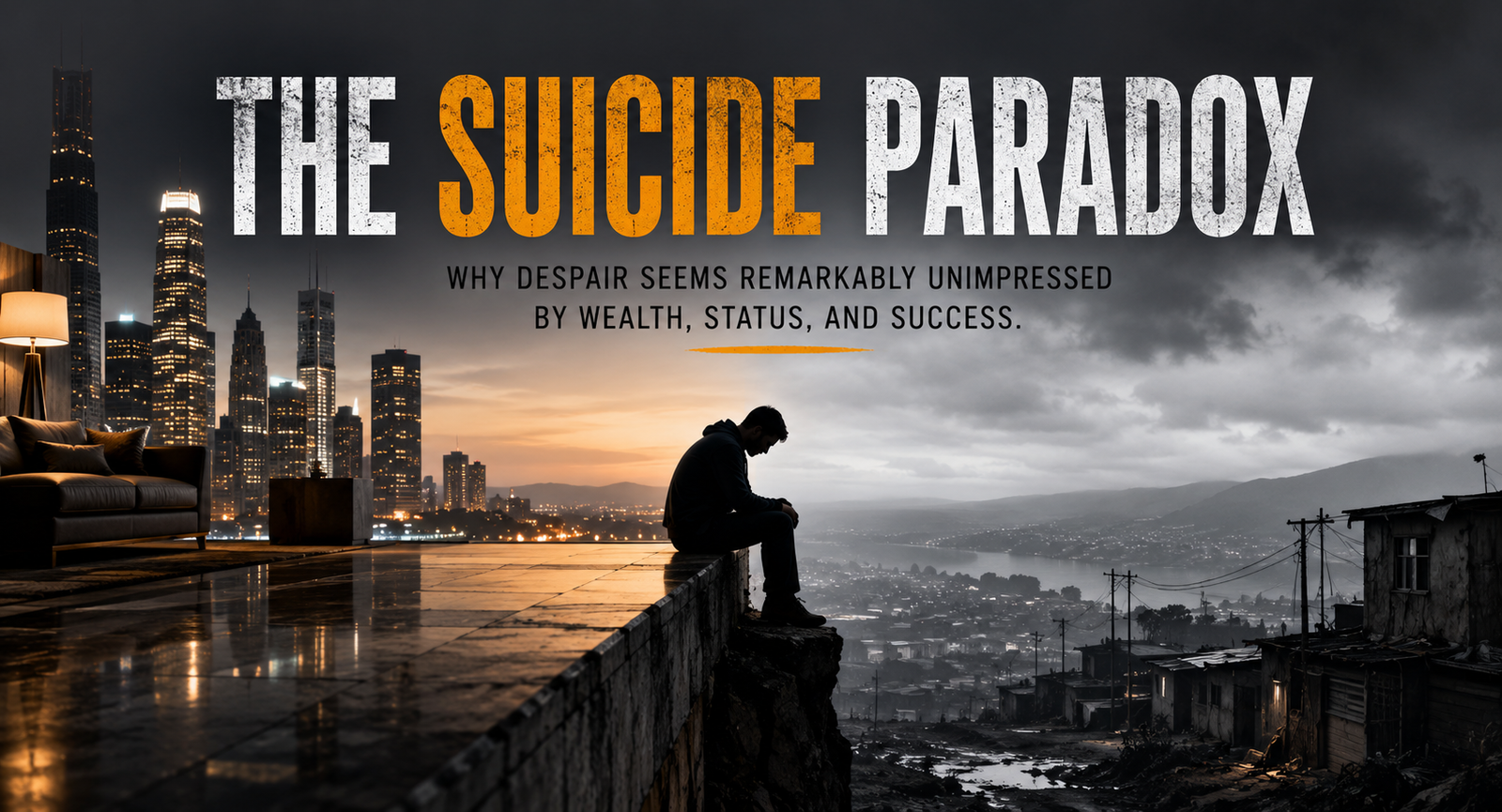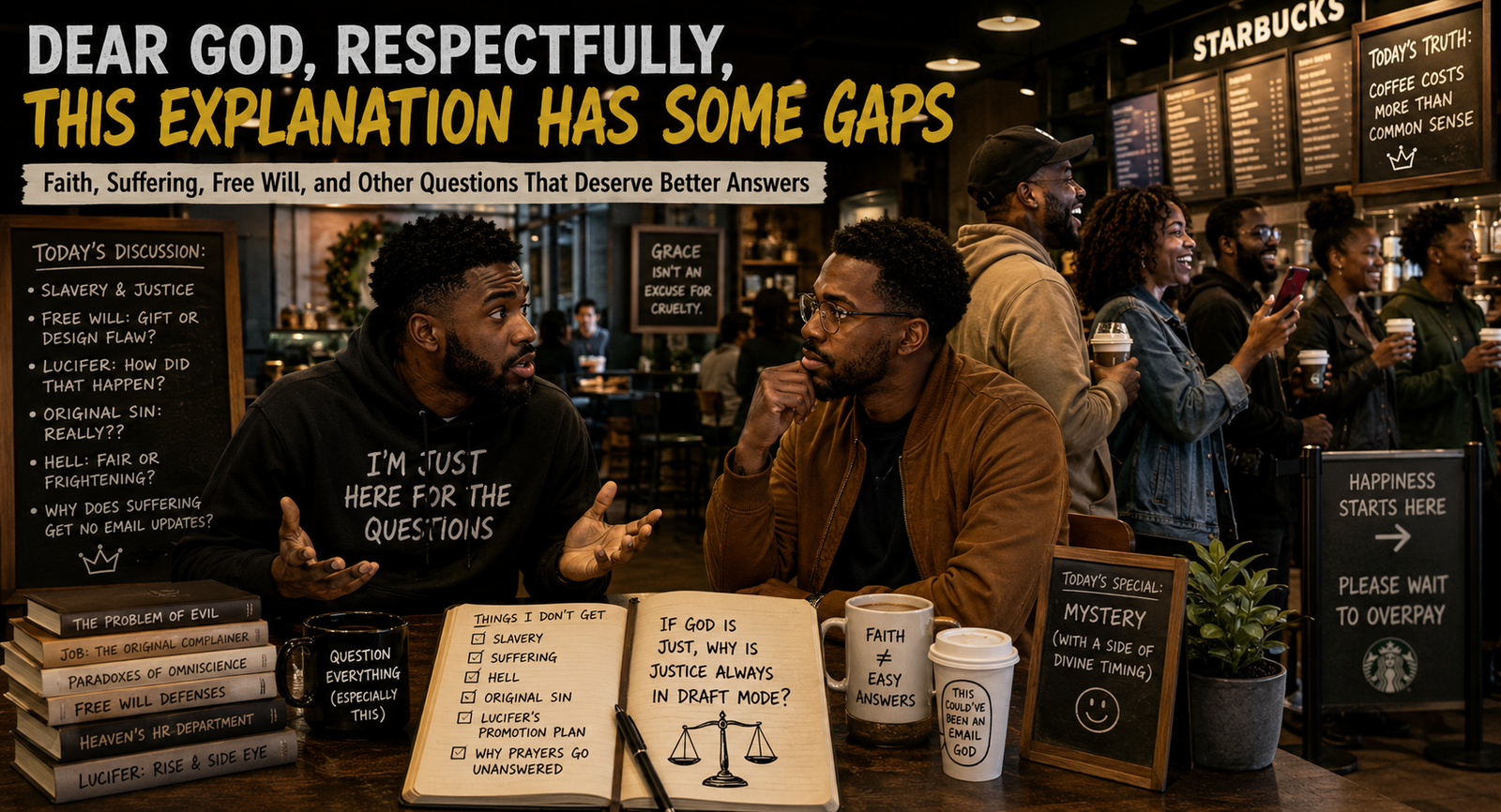
After my earlier conversation about suicide, religion, despair, and the arrogance of certainty, I found myself sitting with a second, more difficult argument. The first essay asked whether it is arrogant for a suffering person to conclude that all meaning has been exhausted simply because religion no longer feels sufficient. That argument still stands. Pain is real, but pain is not omniscient. Despair is persuasive, but despair is not God. Exhaustion can sound like revelation, but sometimes it is only exhaustion wearing a judge’s robe and banging a very dramatic gavel. Still, the more I thought about it, the more I realized there is a counterargument that deserves its own room, its own chair, and possibly its own legal counsel. Because if we are going to warn the suffering person against claiming too much certainty, we must also warn theology against doing the same.
The counterargument begins with a brutal example. Imagine a person born into slavery, raised in cruelty, owned by a master, denied freedom, dignity, safety, education, bodily autonomy, family security, and the basic right to wake up without someone else’s violence deciding the terms of the day. Now imagine telling that person to be hopeful because God is just, the arc of history bends toward freedom, heaven will balance the books, or some future generation may one day sing songs about liberation. One can almost hear the enslaved person respond, quite reasonably, “That is lovely, but I was hoping to witness the redemption personally, preferably before my spine gives out and my oppressor dies peacefully in bed surrounded by grandchildren.” That is not cynicism. That is moral clarity.
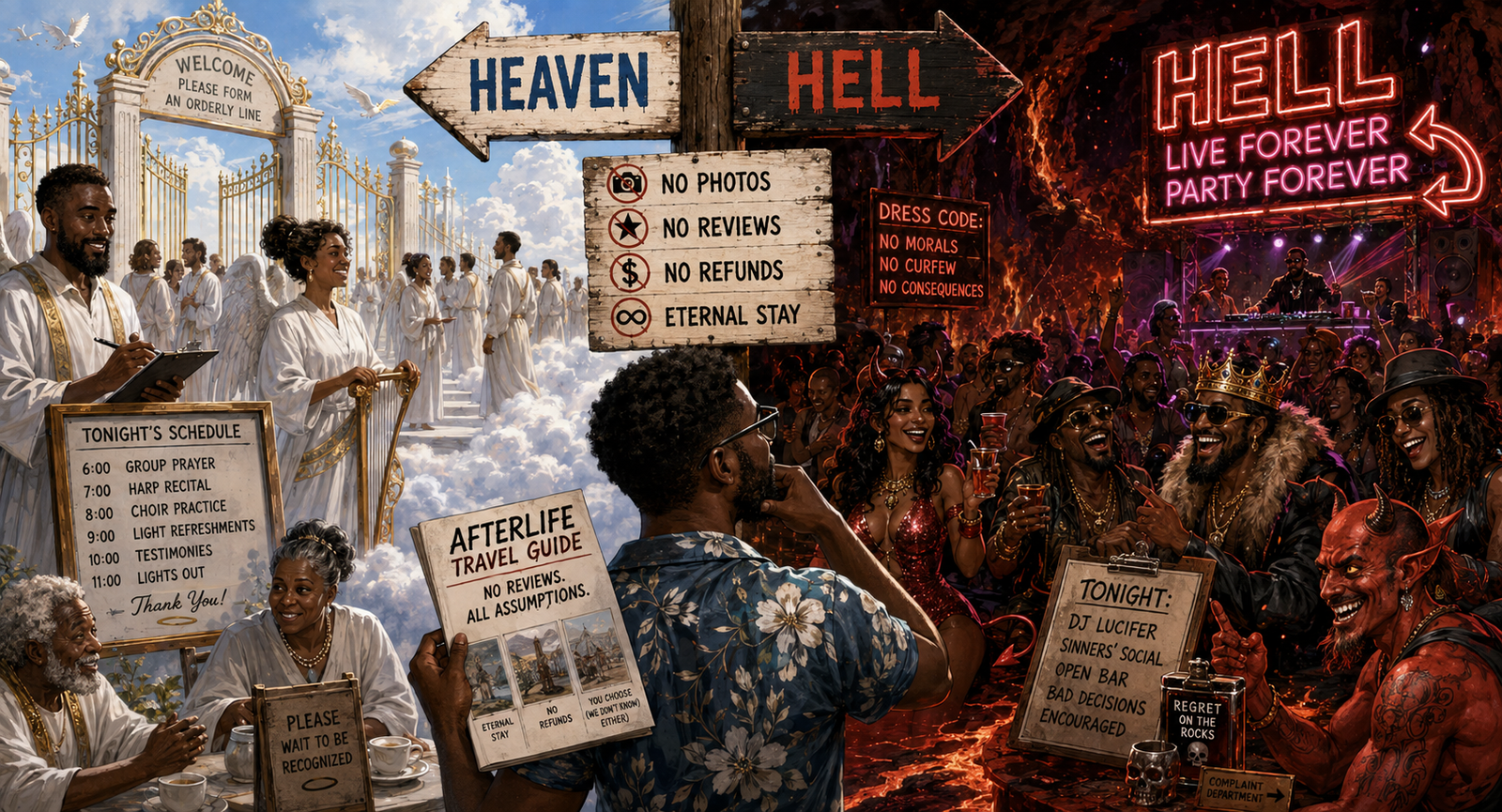
This is where some religious explanations begin to sound less like comfort and more like celestial customer service. “Thank you for calling the Department of Divine Justice. Your suffering is very important to us. Please remain faithful. Your estimated wait time is: mystery.” Mystery may be true, but mystery can also become infuriating when it is used as a hold-music version of theology. The victim is not asking for a footnote in a cosmic dissertation. The victim is asking why the just and loving God who allegedly sees everything also sees the master’s house, the whip, the locked door, the stolen life, the children born into terror, and does not immediately balance the scale in a way the sufferer can witness. That question cannot be dismissed as lack of faith. It is one of the most faithful questions a person can ask, because it takes divine justice seriously enough to demand evidence.
This is the problem with easy hope. Hope is beautiful when it rises from inside the suffering person as defiance, endurance, or stubborn attachment to life. Hope becomes morally suspicious when outsiders impose it on the sufferer because the sufferer’s despair makes them uncomfortable. A person under cruelty has no obligation to perform optimism so the rest of us can keep our theology tidy. If someone is chained to the floor, the first religious duty is not to explain the metaphysics of chains. The first duty is to break the chain. The second duty is to make sure the person gets water, food, safety, witnesses, restitution, and the right to speak without being told their tone is insufficiently grateful. Reflection can come later, and only if the survivor wants to conduct the seminar.
This is why the slavery example is so devastating to abstract theodicy. Theodicy is the branch of theology that tries to explain how a good, loving, powerful God can permit evil. In theory, this is a noble project. In practice, it can become a very polished machine for making victims feel as if their pain has been administratively processed by heaven. The classic answers usually arrive in familiar formation: free will, divine patience, soul-making, future judgment, mystery, redemption beyond death, and the possibility that God sees the whole picture while we only see one frame. Some of those answers may contain truth. But truth handled badly can still injure. A hammer is useful. It is less useful when applied directly to someone’s forehead.
The free will answer says human beings are free, and therefore the master’s cruelty belongs to the master, not to God. That makes sense up to a point. A world of genuine freedom must include the possibility of genuine evil, otherwise humans are not moral agents but spiritual appliances. But the enslaved person may still ask, “Fine, the master chose evil. Why was I left under his choice for my whole life?” Free will explains the existence of the oppressor’s agency. It does not fully explain the victim’s abandonment under that agency. It tells us why the master could raise the whip. It does not fully explain why heaven did not break his arm.
Divine patience is another difficult answer. We are told God gives sinners time to repent, that judgment is not immediate because mercy is long-suffering. That sounds generous when one is the sinner. It sounds considerably less charming when one is the person being sinned against. Patience toward Pharaoh can feel like negligence toward Israel. Patience toward the abuser can feel like abandonment of the abused. Patience toward the tyrant can feel like a theological luxury financed by the bodies of the oppressed. If divine mercy toward the guilty requires extended exposure of the innocent to harm, the innocent have standing to question the terms of the arrangement.
Then there is future judgment, which says that even if justice does not arrive in this life, God will eventually judge all things. I understand why this matters. Without some final accounting, history becomes a crime scene where the evidence is buried with the victims. But future judgment does not erase the wound of delayed deliverance. The suffering person is not wrong to want justice with witnesses. There is a difference between being told, “One day, God will balance the books,” and being allowed to see the fraudulent accountant handcuffed before your own eyes. Deferred justice may still be justice in a cosmic sense, but emotionally and morally, it is not the same as liberation in time.
This is also where the fear of hell becomes complicated. If God is all-knowing, then God knows what I will do before I do it. If God created me, placed me in a certain body, family, century, culture, psychology, trauma history, and set of conditions, and if God already knows the final outcome of my life, then why should I be afraid of hell as if the outcome were a surprise inspection? The classic reply is that God’s foreknowledge does not cause my action. Knowing is not the same as forcing. If I know the sun will rise tomorrow, I did not bully the sun into rising. That is a respectable philosophical distinction, but it does not solve the whole problem. God is not merely a weather observer. God is the creator of the system in which the weather occurs.
This is where the debate becomes less like Sunday school and more like constitutional law with incense. If God knows the outcome and creates the person anyway, how does responsibility work? If God gives choice, then human beings are accountable. But if God knows the choice before creation, and if God designs the world in which that choice becomes actual, then God’s relationship to the outcome is not neutral. The divine position changes depending on how much sovereignty one assigns to God. If God controls everything, human freedom becomes difficult to defend. If humans are radically free, God’s control becomes less absolute. If God knows everything but does not cause everything, we still must ask why God creates a world whose catastrophes are known in advance. Every answer solves one problem and immediately creates a new committee of problems waiting outside the door with badges.
Lucifer makes the whole thing even stranger. According to the tradition, Lucifer was created good, close to God, radiant, powerful, and among the angels. Then rebellion emerges. But how does revolt arise in a supposedly pure being living in proximity to divine glory? Most of us rebel because we think management is incompetent, the policy is stupid, the promotion system is rigged, or the person in charge has mistaken volume for leadership. Mutiny usually has a psychology. People revolt because they believe they can do better, deserve more, have been wronged, or cannot tolerate the structure above them. So what exactly happened in the angelic realm? Did Lucifer look around heaven, review the organizational chart, and conclude that the current executive governance model needed disruption? Did pride appear out of nowhere? Did freedom generate self-exaltation simply because freedom always contains that risk? If so, then rebellion was not a software bug. It was a known vulnerability in the operating system.
That brings us to the uncomfortable question: if God knew Lucifer would revolt, why create him? The traditional answer is that a world with free creatures capable of love is better than a world of programmed obedience. This answer has force. Love without freedom is not love; it is compliance with better lighting. But it also has a cost, and the cost is paid by creatures who did not attend the design meeting. If the freedom of angels and humans creates the possibility of rebellion, sin, violence, slavery, genocide, despair, and inherited ruin, then it is fair to ask whether the created beings who suffer under those consequences are being asked to underwrite the grandeur of freedom with their bodies.
Original sin raises the stakes further. Why am I responsible for the first sin if, in theory, the system worked according to design? If Adam and Eve were created by God, placed in a garden by God, given freedom by God, exposed to temptation in a reality God permitted, and if God knew the outcome, then what exactly are later generations inheriting? In some traditions, the answer sounds like inherited guilt. In others, it is more like inherited damage, mortality, corruption, or estrangement. The distinction matters. I can understand being born into consequences I did not choose. That is history. That is empire. That is racism. That is family trauma. That is national debt, bad infrastructure, and office printers that jam because someone before you loaded the paper like a criminal. But inherited consequences are not the same as personal guilt. If religion tells me I am born into a damaged order, I can understand that. If it tells me I am personally culpable for a primordial act committed before I existed, I am going to need a much longer meeting.
The more defensible version is that we are not individually guilty of the first rupture, but we are born into its weather. That makes sense of human life. Nobody enters the world on neutral ground. We inherit languages, wounds, privileges, fears, debts, stories, family systems, national myths, historical crimes, and unresolved grief. We are born into houses already on fire and then judged, at least partly, by how we carry water. That is tragic, but recognizable. The trouble begins when inherited condition becomes personal blame. A wounded world is one thing. A moral invoice issued to people who were not present at the original transaction is another.
This is why theology must be careful with suffering. A doctrine can be technically defensible and still pastorally disastrous. A priest, pastor, imam, rabbi, elder, theologian, or well-meaning friend may say something true in the abstract and still say it at the wrong time, in the wrong tone, to the wrong person, from the wrong side of the wound. There are truths that should not be delivered until one has first sat down, shut up, and listened. The Book of Job remains powerful partly because Job’s friends become progressively less useful the more they explain. At first, they sit with him in silence, which is their finest hour. Then they begin theologizing, and the whole enterprise declines sharply from there. Many religious communities would improve immediately if they treated Job’s friends as a cautionary tale rather than a training model.
The deeper issue is that suffering creates two opposite dangers. One danger is the arrogance of despair, which says, “Because I cannot see meaning, there is none.” That is dangerous because pain narrows perception and then pretends it has widened it. But the other danger is the arrogance of easy theodicy, which says, “Because I can imagine a divine meaning, your suffering is accounted for.” That is also dangerous because it lets the observer explain pain without entering it. The first arrogance belongs to the sufferer when suffering becomes absolute certainty. The second arrogance belongs to the comfortable when theology becomes a protective screen against the scandal of another person’s wound.
The unknown must therefore do double duty. It should restrain the sufferer from making despair sovereign, but it should also restrain the theologian from making suffering neat. Mystery cannot be used only in one direction. If mystery means the suffering person does not know enough to declare life meaningless, then mystery also means the religious observer does not know enough to declare the suffering meaningful. The same humility required of despair must be required of doctrine. Otherwise, mystery becomes a rigged courtroom where only the victim is cross-examined.
This is where a more honest faith would begin. It would say to the suffering person: you are not required to pretend this makes sense. You are not required to call cruelty “growth.” You are not required to be grateful for pain because someone else found a sermon in it. You are not required to defend God on command like a nervous public affairs officer after a scandal. You are allowed to ask why. You are allowed to accuse. You are allowed to say that delayed justice feels like no justice from where you are standing. You are allowed to want redemption you can see, not merely redemption footnoted in eternity.
A serious faith should be able to survive being interrogated by the wounded. If God is just, then God does not need fragile public relations. If God is loving, then God should not require the broken to flatter heaven before they are allowed to be heard. If God is sovereign, then God can withstand human anger. If God created the moral universe, then God can surely handle a deposition from one of its casualties. The Psalms understand this better than many modern believers. They are full of complaint, accusation, confusion, rage, bargaining, grief, longing, and occasionally the kind of emotional volatility that would make a church usher shift uncomfortably near the back row. Yet there they are, canonized. Apparently, heaven has already admitted lament into evidence.
That may be the missing category. Lament is not unbelief. Lament is faith refusing to become propaganda. It is the language of people who still address God but refuse to lie about the conditions. Lament does not say, “Everything is fine.” Lament says, “If You are who You say You are, then look at this.” It is prayer with a subpoena attached. It is worship after the music has stopped. It is what remains when easy praise can no longer carry the weight of the actual world.
This matters for suicide, because many people do not lose the will to live only because they lack reasons. Sometimes they lose access to reasons. Sometimes they cannot feel the claims that still exist. Sometimes grief, trauma, depression, shame, spiritual struggle, or exhaustion blocks the internal signal. In that state, a bad religious answer can make things worse by adding guilt to agony. “Have more faith” is not an intervention. “God has a plan” is not always comfort. “Everything happens for a reason” may be theologically intended as reassurance, but to someone in acute pain it can sound like the universe has excellent paperwork and terrible ethics.
A better response is less polished and more human. It may sound like: “I do not know why this happened. I will not insult you by pretending I do. I will sit here. I will listen. I will help carry the next hour. I will not let you confuse this hour with the whole future. I will not use God to silence you. I will not use your pain to win an argument.” That kind of response does not solve the theological problem of evil, but it may keep a human being company while the problem remains unsolved. Sometimes companionship is the only theology that does not collapse under scrutiny.
So where does that leave the original argument? The earlier essay said that no suffering person should let despair claim total authority. This follow-on adds that no religious person should let theology claim total authority over another person’s suffering. Both are true. The suffering person does not know enough to conclude that the story is over. The comfortable observer does not know enough to conclude that the story makes sense. Between those two limits is a more honest, more humble, and more morally serious space.
In that space, the enslaved person has the right to ask where God is. The grieving person has the right to ask why love can be so powerful and still lose access to the beloved. The person wrestling with hell has the right to ask how judgment works in a world God fully knows. The person wrestling with free will has the right to ask whether freedom is a gift, a burden, or a liability with excellent branding. The person wrestling with Lucifer has the right to ask how rebellion entered heaven’s bloodstream. The person wrestling with original sin has the right to ask why they were born into consequences they did not choose. None of these questions are arrogance. They are the price of taking God, justice, freedom, and suffering seriously.
The answer may not be available in a clean form. That is frustrating, because human beings prefer answers that can fit on mugs, bumper stickers, and inspirational wall art sold at suspiciously high prices. But the serious things rarely fit. Faith may not resolve the argument. It may only keep the argument open without letting despair close it prematurely. That is less satisfying than certainty, but perhaps more honest. Faith may not be the silencing of the case against God. Faith may be the refusal to stop speaking to God even when the case remains open.
And maybe that is where hope becomes morally acceptable again. Not as cheerfulness. Not as denial. Not as a demand placed on the crushed. Hope becomes acceptable when it is humble, defiant, and non-coercive. Hope says: this is not okay, and I will not pretend it is. Hope says: justice delayed is a wound, not a slogan. Hope says: the victim deserves more than abstract consolation. Hope says: I do not know enough to close the case against life, but I also do not know enough to excuse the cruelty done inside it. Hope says: if God is just, then God must be more serious about justice than my theology has yet managed to explain.
That is not a neat conclusion. It is certainly not the kind of conclusion that makes everyone comfortable at tea. But maybe some conversations should not make us comfortable. Maybe the best conversations leave us with better questions, fewer slogans, and a slightly reduced willingness to explain another person’s suffering from a safe distance. If the first essay was about the arrogance of despair, this one is about the arrogance of easy answers. Between them sits the only position I currently trust: humility before the unknown, solidarity with the suffering, and a refusal to let either pain or doctrine become a tyrant.
If this subject is not theoretical for you, please do not carry it alone. In the United States, call or text 988 for the Suicide & Crisis Lifeline, or go to the nearest emergency department if there is immediate danger. This essay is a reflection on suffering, theology, grief, justice, and human endurance. It is not a substitute for care, companionship, treatment, or intervention when the question becomes urgent.