You can always tell when tourist season has arrived in Washington.
The official indicators are things like hotel occupancy rates, museum attendance, and cherry blossom forecasts.
The real indicator is that Metro platforms suddenly start looking like the first fifteen minutes of a disaster movie.
Locals move with purpose. We know where we’re going. We know which train we need. We know exactly how much disappointment to expect from public transportation and have calibrated our emotions accordingly.
Tourists move differently.
They stop without warning.
They walk six people wide.
They stare at station maps like archaeologists who have just uncovered a sacred text.
They somehow manage to stand directly in front of the one thing everyone else needs to see.
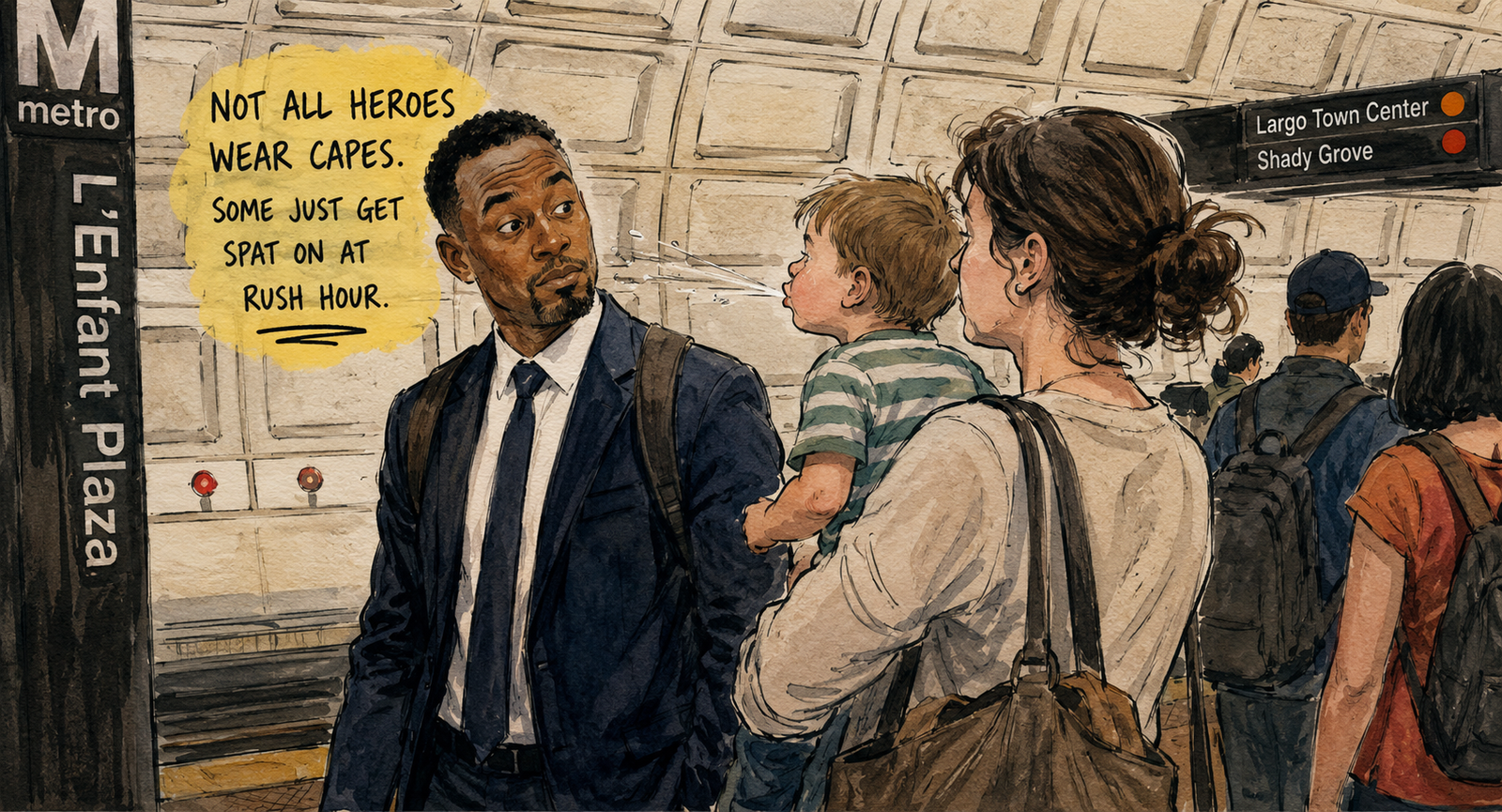
L’Enfant Plaza during rush hour is usually controlled chaos. Last week it was just chaos.
The platform was packed. Every bench was occupied. Every pillar had someone leaning against it. The air carried that familiar blend of impatience, exhaustion, and whatever scent emerges when several thousand federal employees collectively realize they still have thirty years until retirement.
I found a small place to sit and settled into my preferred Metro activity: observing strangers while pretending not to.
That’s when I noticed a family approaching.
Mom was carrying a little boy. Dad appeared to be carrying enough luggage to survive a minor government collapse. Together they were weaving through commuters with the confidence of people who had absolutely no idea where they were but had decided uncertainty was somebody else’s problem.
The little boy looked about four years old. Maybe younger.
Old enough to walk.
Young enough to still believe licking random objects is a legitimate lifestyle choice.
As they passed, the child locked eyes with a Black gentleman standing nearby.
The gentleman wasn’t doing anything.
He wasn’t speaking.
He wasn’t looking at anyone.
He wasn’t making strange gestures.
He wasn’t wearing anything unusual.
He was simply standing there waiting for the train, which ranks among the least offensive activities available in modern society.
Then the child spat on him.
Not accidentally.
Not because he coughed.
Not because he sneezed.
Not because he was choking on a Goldfish cracker.
This child looked at a complete stranger and launched a precision-guided saliva strike.
The attack was swift.
The execution was flawless.
The confidence was frankly impressive.
The little man committed an act of biological warfare and immediately moved on with his day.
I froze.
The gentleman froze.
Half the platform froze.
Even the arriving train seemed to hesitate.
For a brief moment, everyone was united by a single thought:
“Did that just happen?”
Now here’s where things became fascinating.
The mother’s first response was not:
“Oh my God, I’m so sorry.”
Nor was it:
“Apologize to that gentleman right now.”
Nor was it:
“We do not spit on strangers because we are not llamas.”
Instead, she immediately looked at the child and asked:
“Honey, are you okay?”
I nearly fell off the bench.
Was he okay?
Was he okay?
Ma’am, unless I missed something, your son is currently winning.
The only injured party in this situation appears to be standing three feet away questioning every life choice that led him to this exact spot on the platform.
Yet somehow the post-incident wellness check was directed toward the perpetrator.
I’ve noticed this trend in modern parenting.
Sometimes it feels like we’re so focused on protecting children from negative feelings that we’ve accidentally stopped teaching them why negative feelings exist.
Embarrassment is useful.
Guilt is useful.
Awkwardness is useful.
These emotions are nature’s way of saying, “Perhaps don’t do that again.”
If your child spits on a stranger and feels bad afterward, congratulations.
The system works.
But apparently we’re now running a different operating system.
One where the victim gets saliva and the offender gets emotional support.
The gentleman, meanwhile, handled the situation with an amount of grace I simply do not possess.
He didn’t yell.
He didn’t curse.
He didn’t demand an apology.
He just stared at the child with the look of a man trying to determine whether he had been assaulted or selected for a social experiment.
Honestly, his restraint deserves federal funding.
Because society puts people in impossible positions during moments like these.
Had he gotten angry, people would have said he was overreacting to a child.
Had he confronted the parents, somebody would have accused him of escalating.
Had he walked away visibly annoyed, someone would have suggested it wasn’t a big deal.
It’s an amazing social phenomenon.
The person who experiences the offense often becomes responsible for managing everyone else’s comfort afterward.
A stranger spits on you and somehow you’re expected to become the adult in the room.
Now let’s address the awkward question.
Why him?
Maybe it was random.
Probably it was random.
Children are tiny agents of chaos operating without fully developed software. They make decisions based on factors no scientist has successfully identified.
Maybe the gentleman had a beard.
Maybe he wore glasses.
Maybe the child liked his jacket.
Maybe the kid was simply conducting field research.
Nobody knows.
But I’d be lying if the question didn’t briefly cross my mind.
Out of hundreds of people on that platform, the biological missile selected one target.
And the target happened to be Black.
Does that automatically mean racism?
Of course not.
A four-year-old is not drafting policy papers.
But children absorb the world around them long before they understand it. They notice differences. They mimic behaviors. They repeat things they’ve seen, heard, or somehow interpreted.
The uncomfortable reality is that nobody could know what motivated the decision.
Which meant everyone was left standing there with the same unanswered question while pretending not to have it.
The entire thing lasted maybe fifteen seconds.
Yet I spent the next twenty minutes thinking about it.
Mostly because I realized how fortunate I was that the gentleman had been standing there instead of me.
Because unlike him, I possess the emotional maturity of a man who has spent too much time working in government.
I would have immediately launched an investigation.
Witness statements would have been collected.
Findings would have been documented.
A root-cause analysis would have been initiated.
Congressional oversight would not have been ruled out.
At minimum, there would have been a strongly worded internal memorandum drafted entirely inside my head.
Instead, I got to sit there safely observing while another man carried the burden of civilization.
And that’s what stayed with me.
Every functioning society depends on people choosing not to escalate situations that absolutely deserve escalation.
Every day, millions of strangers absorb small insults, inconveniences, and indignities because maintaining peace is easier than pursuing justice.
Most of them never receive credit.
On that Metro platform, one gentleman quietly accepted being spat on by a preschooler and kept the entire incident from becoming a viral video.
Frankly, he deserves a Purple Heart.
Because if democracy survives another hundred years, it won’t be because of politicians.
It’ll be because exhausted strangers continue exercising levels of patience that should be medically impossible.
And because somewhere in America, at this very moment, another parent is probably asking the wrong person if they’re okay.