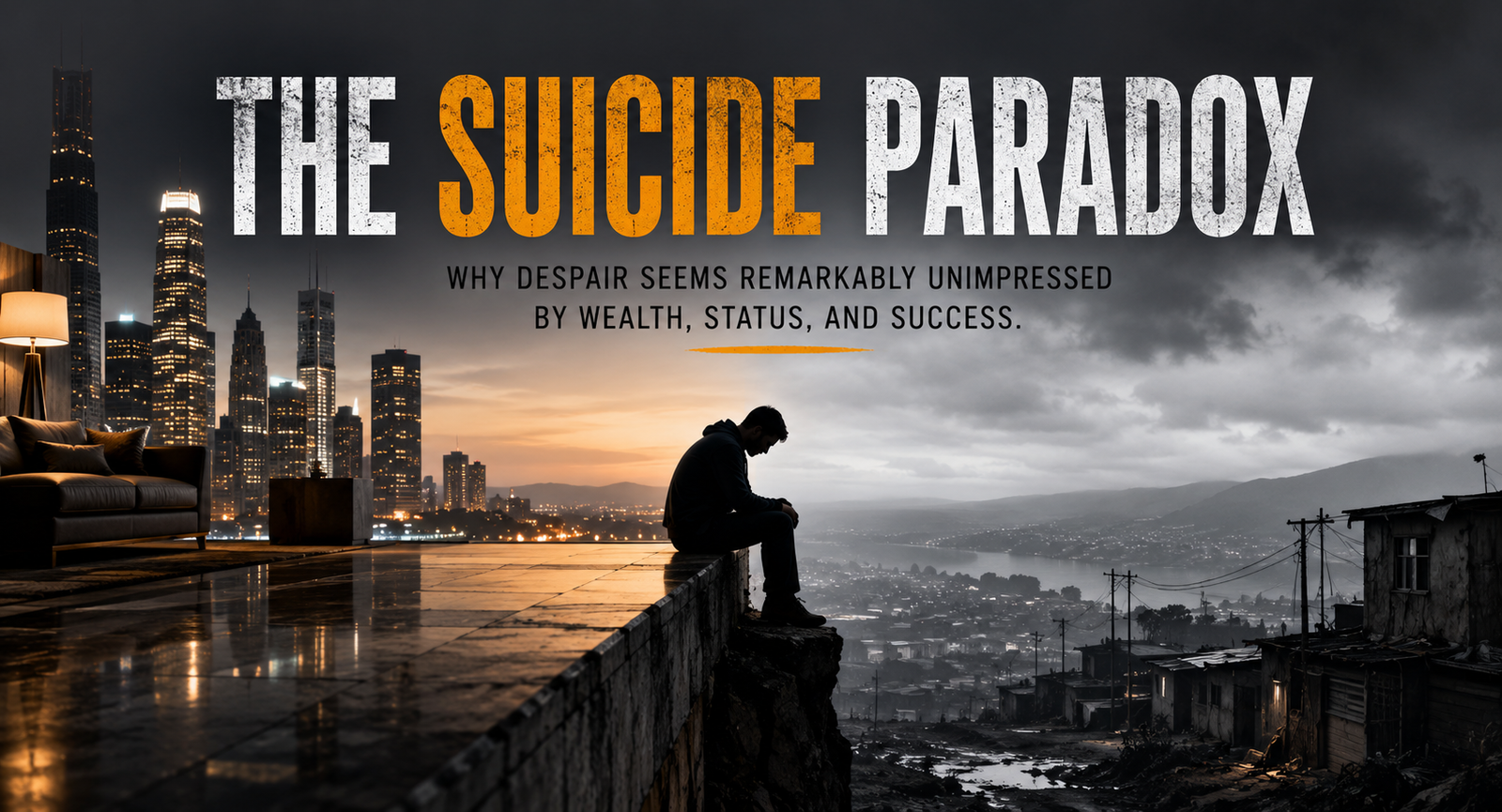
Or: Why Despair Seems Remarkably Unimpressed by Wealth, Status, and Success
Every time a wealthy celebrity, prominent executive, decorated military officer, successful entrepreneur, physician, or public figure dies by suicide, the collective reaction is almost always the same.
People stare at the headlines as though they contain a mathematical error.
The numbers simply do not add up.
They had the money.
They had influence.
They had opportunities.
They had access to treatment that most people can only dream of affording.
They had resources, connections, comfort, and every imaginable advantage. If modern society were to design a prototype for a protected life, it would probably look a lot like theirs.
And yet they are gone.
The public then begins searching for explanations with the urgency of investigators trying to solve a crime scene. Hidden addictions. Secret affairs. Financial scandals. Professional humiliation. Childhood trauma. Anything that might restore order to the equation. Anything that allows us to believe there was a missing variable all along.
Because the alternative is deeply unsettling.
The alternative is accepting that despair may not care very much about the things we spend our lives chasing.
I have spent years thinking about this contradiction, partly because the subject refuses to leave me alone. If suffering were merely a function of circumstance, then wealth should dramatically reduce suicide. If material comfort were the antidote to hopelessness, the affluent should enjoy near immunity. If access to elite medical care were sufficient protection, those with the best physicians, therapists, and specialists should rarely find themselves standing at the edge of existence wondering whether tomorrow is worth the trouble.
But reality keeps producing evidence to the contrary.
The more closely one examines suicide, the less it resembles a problem of economics and the more it resembles a problem of perception. That observation is uncomfortable because it undermines one of the most cherished assumptions of modern life: that external success and internal peace travel together. We desperately want them to be related. We want achievement to purchase fulfillment the same way it purchases homes, vacations, security systems, and retirement accounts. We want enough accomplishments to eventually silence whatever darkness lives in the corners of the human mind.
Yet history is littered with examples suggesting that the transaction never actually existed.
Perhaps that is why stories of suicide continue to disturb us long after the headlines fade. They force us to confront the possibility that human suffering operates according to rules we do not fully understand. They challenge the comforting belief that pain can be permanently outrun through accomplishment. Most importantly, they expose a truth many people spend their entire lives avoiding: the mind is capable of producing unbearable misery even when surrounded by extraordinary privilege.
And if that is true, then the conversation is no longer about money.
It is about something far more frightening.
It is about why some people lose the ability to imagine a future worth inhabiting at all.
What I have ultimately come to believe is that suicide is not proof that someone wanted death.
More often, it appears to be evidence that someone could no longer locate a convincing path toward continued life.
Those are not the same thing.
The distinction matters because most people imagine suicidal thinking as an overwhelming desire to die, when many who have wrestled with it describe something far stranger. They describe exhaustion. Psychological attrition. The gradual collapse of alternatives. A narrowing of possibilities until the future resembles a hallway with every visible door locked from the outside.
That is why wealth cannot reliably prevent it.
Money can purchase treatment, but it cannot guarantee belief in recovery. It can buy comfort, but it cannot manufacture purpose. It can eliminate countless practical hardships while remaining completely powerless against a mind that has become convinced it is trapped inside an endless winter.
At the same time, the existence of suicide among the wealthy reveals something unexpectedly hopeful about those who continue fighting despite enormous adversity. Every day there are people carrying burdens that would be invisible to most observers. They wake up in bodies they dislike, jobs they hate, circumstances they did not choose, grief they never asked for, and loneliness they cannot easily explain. Yet somehow they continue moving forward. Not because they possess extraordinary courage every morning. Not because they have discovered secret wisdom. Often they continue because something, however small, still exerts a gravitational pull on tomorrow.
A child waiting at home.
A spouse sleeping beside them.
A promise they made years ago.
A stubborn refusal to surrender.
A faith they cannot fully explain.
A curiosity about what happens next.
My own relationship with this subject became considerably more complicated once I began discussing it honestly in therapy. For years, I assumed my fascination with danger was simply part of my personality. I sought adventure. I traveled to unstable places. I accepted risks that many people would consider unnecessary. I was drawn toward experiences that sat uncomfortably close to the edge of reasonable decision-making. Because I generally functioned well, maintained a career, raised a family, and appeared successful by conventional measures, I never seriously questioned the pattern. I simply assumed I was curious. Adventurous. Restless.
Then one day a therapist introduced me to a concept I had somehow managed to avoid despite years of introspection.
Parasuicidality.
The word landed with the subtlety of a freight train.
It was not that I wanted to die in any active sense. Rather, there existed a recurring willingness to place myself in situations where survival occasionally felt negotiable. Looking backward, I could suddenly trace a thread connecting experiences I had always viewed as unrelated. The attraction was not necessarily death itself. It was proximity. The edge. The strange psychological territory where consequences become real and existence feels temporarily stripped of all pretense.
For a long time I believed becoming a father had cured much of that tendency. The explanation seemed obvious enough. Parenthood had finally given me something larger than myself. It forced me to think beyond my own needs. Like many fathers, I assumed responsibility had naturally displaced whatever reckless impulses had previously occupied space in my mind.
The more I examined the issue, however, the less certain I became that this explanation was entirely correct.
What I eventually discovered was something far stranger.
Buried beneath my thinking was a belief I had never consciously articulated. It was not a political belief, a religious doctrine, or a philosophical position developed through rigorous study. It was simply an assumption that had quietly taken up residence somewhere in the architecture of my mind.
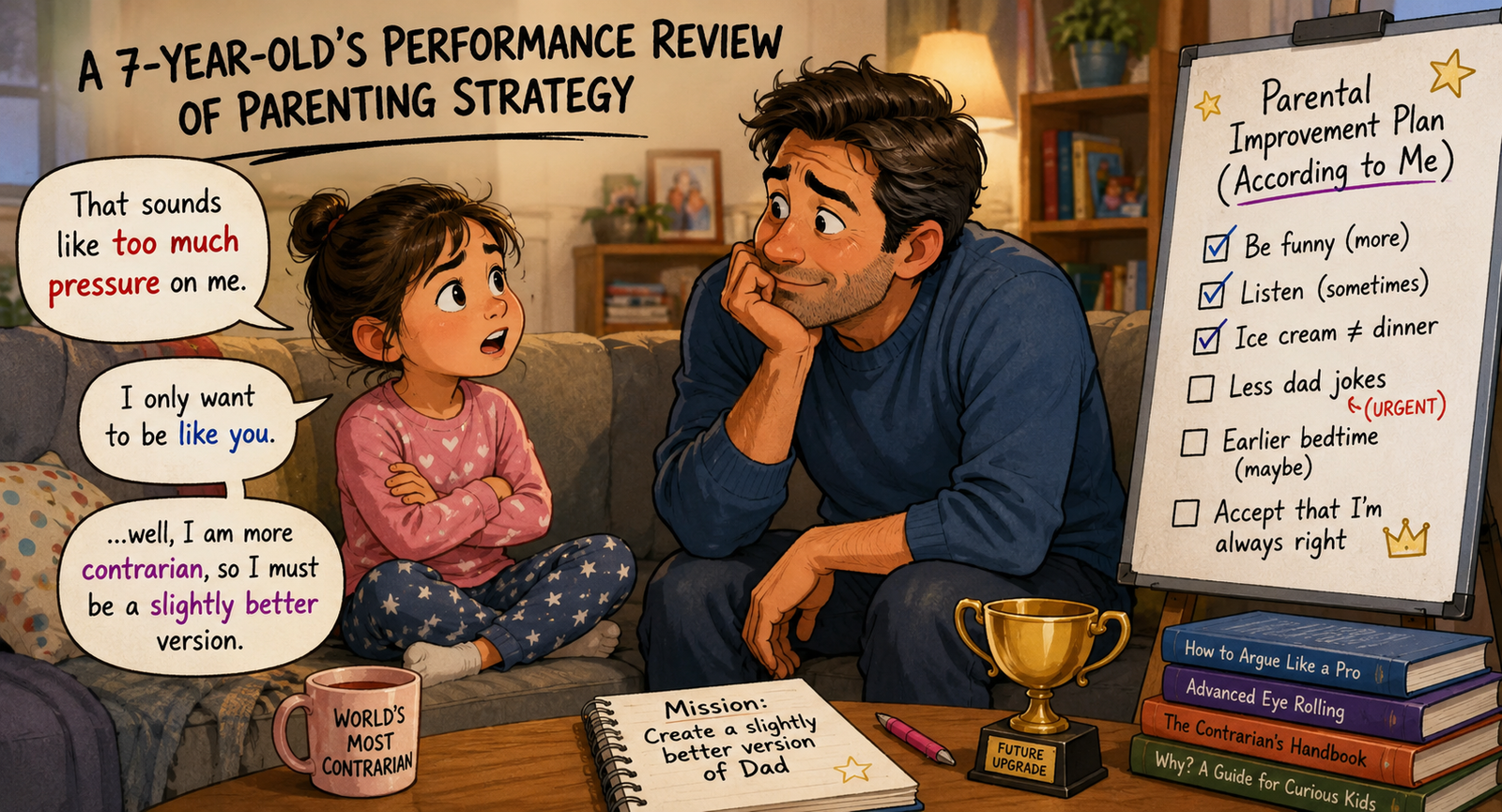
I believed that the fundamental task of every generation is to produce a better version of itself.
That is how civilizations advance. Parents sacrifice so their children can inherit more opportunity. One generation absorbs hardship so the next can stand slightly higher. Progress, at least in theory, is an endless relay race in which each runner hands the baton forward before disappearing from view.
The uncomfortable part is what followed.
Somewhere along the way I had apparently convinced myself that once you successfully completed that handoff, your obligations were largely fulfilled. You had contributed to the project. You had helped move the species forward by a fraction of an inch. You had played your role. The curtain could close whenever it chose.
Even writing those words feels strange because I recognize how irrational they sound when exposed to daylight. Yet the mind is perfectly capable of building entire operating systems around assumptions it never bothers to verify. We often imagine psychological distortions arriving as dramatic delusions. More commonly, they arrive as ordinary thoughts that have been left unchallenged for decades.
What fascinates me now is the contradiction embedded within that belief.
The same idea that occasionally tempted me toward resignation also became one of the strongest arguments against it.
Because if my responsibility truly ended with creating a better generation, then my daughter represented completion.
But if my daughter represented completion, she also represented continuation.
The logic collapses under its own weight.
The very existence of the child who supposedly frees me from obligation simultaneously creates an entirely new obligation. She does not simply need my genetics. She needs my presence. She needs memories, conversations, guidance, stories, mistakes, encouragement, and the thousand invisible interactions that accumulate into a relationship over decades. Producing a better generation is not an event. It is a process. One that stubbornly refuses to conclude simply because biology has completed its portion of the assignment.
That realization has changed how I think about the edge.
People often assume that protective factors work because they eliminate suicidal thinking. My experience has been considerably less tidy. The thoughts do not necessarily disappear. The questions do not magically resolve themselves. Instead, another voice enters the conversation. A competing argument emerges. A counterweight appears on the scale.
The edge remains where it has always been.
The difference is that someone is now standing behind me.
Waiting.
Expecting me to turn around and come home.
The remarkable thing is not that some people die by suicide.
The remarkable thing is that millions of people who have every reason to quit somehow keep going.
Perhaps that is the real mystery.
Not why despair occasionally defeats human beings.
But why hope, despite all available evidence, keeps finding ways to survive.
For all our advances in medicine, neuroscience, psychology, and psychiatry, we still do not fully understand why one person standing at the edge steps forward while another steps back. We can identify risk factors. We can observe patterns. We can construct theories. Yet there remains something profoundly human that refuses to fit neatly inside data tables and clinical models.
Maybe that uncertainty is precisely what should make us cautious whenever we attempt to judge the suffering of another person.
The wealthy executive staring at the ceiling at three in the morning.
The college student quietly unraveling in a dorm room.
The retired veteran sitting alone in a silent house.
The exhausted parent crying in a parked car before driving home.
The struggling worker wondering how many more years they can endure.
Pain has never respected résumés, tax brackets, educational credentials, or social standing.
Neither, it turns out, does hopelessness.
But neither does resilience.
And perhaps that is the one fact worth carrying away from this conversation.
Despair may be indifferent to wealth.
Hope appears equally indifferent to hardship.