Or: Why Mathematics Eventually Becomes Witchcraft
Humanity discovered fire, agriculture, flight, nuclear weapons, and somehow still decided the most psychologically destabilizing invention would be the phrase:
“There are different sizes of infinity.”
That sentence alone should have triggered immediate congressional oversight.
Because infinity already sounds fake.
Not fake in the “flat Earth” sense.
Fake in the sense that the human brain clearly was never designed to process it without overheating like a Dell laptop in 2007.
Most of us imagine infinity as one giant endless thing:
∞
Big. Infinite. Done.
But mathematicians — people who looked at numbers and decided sleep was optional — discovered that infinity behaves less like a number and more like a criminal organization with internal management tiers.
Some infinities are larger than others.
Some infinities can fit inside other infinities.
Some infinities can cancel themselves out.
And some infinities produce geometric objects that can hold paint on the inside but not the outside.
At that point we’re no longer doing mathematics.
We are negotiating with eldritch horrors.
The Smallest Infinity: Countable Infinity
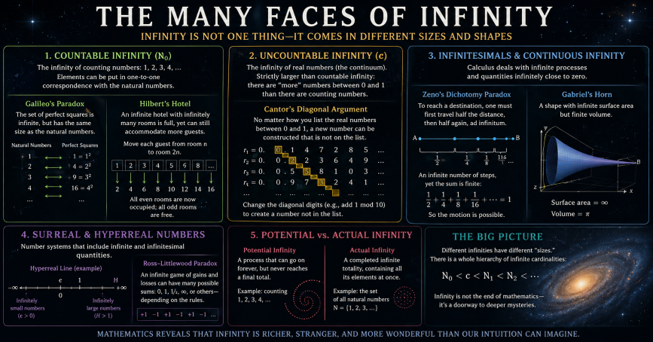
The most basic infinity is called countable infinity.
Formally:
ℵ₀
Pronounced aleph-null, because apparently mathematicians wanted infinity to sound like an ancient forbidden spell.
This is the infinity of counting numbers:
1,2,3,4,5…
Simple enough.
Except countable infinity immediately starts behaving suspiciously.
Take all natural numbers:
1,2,3,4,5…
Now take only the perfect squares:
1,4,9,16,25…
Logically, there should be fewer squares than total numbers.
Right?
Wrong.
Galileo Galilei noticed you can pair every number with exactly one square:
1 ↔ 1
2 ↔ 4
3 ↔ 9
Which means mathematically:
The part equals the whole.
That is not a sentence reality should allow.
Imagine eating half a pizza and somehow still having the full pizza.
Capitalism would collapse instantly.
Hilbert’s Hotel: The Infinite Airbnb From Hell
Then mathematics gave us perhaps the greatest paradox ever conceived.
An infinitely large hotel.
Every room occupied.
No vacancies.
Then one more guest arrives.
Can the hotel accommodate them?
Apparently yes.
Move everyone up one room:
1 → 2
2 → 3
3 → 4
Now Room 1 is free.
Fine.
Already ridiculous.
But then infinitely many new guests arrive.
Still solvable.
Move every guest to double their room number:
n → 2n
All even rooms become occupied. All odd rooms become free.
Infinite hotel. Fully occupied. Still infinite vacancies.
This is the point where your brain quietly whispers:
“I don’t think numbers should be allowed to do this.”
Uncountable Infinity: The Universe Escalates
Now comes the truly offensive part.
The infinity of real numbers:
0.123456…
is somehow larger than countable infinity.
Not metaphorically.
Actually larger.
This infinity is called the continuum:
𝔠
And Georg Cantor proved that there are more numbers between 0 and 1 than there are counting numbers in existence.
That sentence should not survive peer review.
Think about that carefully.
Between 0 and 1 — a tiny interval — exists a larger infinity than all counting numbers combined.
Infinity somehow has density settings.
Cantor’s Diagonal Argument: Mathematical Psychological Warfare
Cantor then became dangerous.
He proved that no matter how you try listing all real numbers, he can always construct one you missed.
Every time. Forever.
The proof is elegant.
It is also deeply rude.
You write an infinite list of decimals. Cantor changes one digit in each row.
The resulting number differs from every entry on the list.
Meaning your “complete” infinite list was never complete.
This is less mathematics and more cosmic humiliation.
Zeno’s Paradox: Walking Is Apparently Impossible
Ancient Greek philosophers were already losing sleep over infinity centuries before calculus existed.
Zeno of Elea argued motion itself should be impossible.
To reach a destination, you must first travel halfway.
Then halfway again.
Then halfway again.
Mathematically:
1/2 + 1/4 + 1/8 + 1/16 + … = 1
That is an infinite number of steps.
So how do you ever arrive anywhere?
Calculus eventually solved this by showing infinite series can converge to finite values.
Which is reassuring mathematically.
But emotionally?
Not really.
Because it means every trip to the refrigerator contains infinite subdivision.
Your midnight snack is secretly an advanced mathematical event.
Gabriel’s Horn: The Universe Starts Trolling Engineers
Then comes my favorite act of mathematical violence:
Gabriel’s Horn.
A shape with:
• Infinite surface area
• Finite volume
Meaning:
You can fill it with paint.
But you cannot paint the inside walls.
That sounds less like geometry and more like a cursed artifact in a fantasy RPG.
The equations are perfectly legitimate.
Reality is simply refusing to cooperate with intuition.
Hyperreal Numbers: Because Reality Wasn’t Complicated Enough
Then mathematicians invented hyperreal and surreal numbers.
Numbers infinitely large.
Numbers infinitely small.
Numbers greater than zero but smaller than any measurable value.
At this stage mathematics officially becomes organized hallucination with peer review.
John Horton Conway and Abraham Robinson essentially said:
“What if infinity itself had decimals?”
And somehow everyone accepted this.
Potential vs. Actual Infinity
Philosophers then split infinity into two categories.
Potential Infinity
Infinity as a process.
You keep counting forever:
1,2,3…
You never arrive at infinity. You merely approach endlessly.
Actual Infinity
An already completed infinite thing.
A fully existing infinite set.
This distinction sounds subtle until you realize it changes the entire structure of reality.
Potential infinity feels intuitive.
Actual infinity feels like the universe trying to render too many polygons simultaneously.
The Tristram Shandy Problem
One philosopher imagined a man writing his autobiography.
But it takes him one full year to document one single day.
If he lives forever, can he eventually finish?
Strangely:
No.
But also maybe yes.
Infinity breaks causality so thoroughly that “falling behind” stops behaving normally.
This is honestly just graduate school with extra steps.
The Real Horror of Infinity
Infinity is terrifying because it exposes something uncomfortable:
Human intuition evolved for survival. Not truth.
We are biologically optimized to throw spears, identify berries, and accidentally create email chains with 47 unnecessary recipients.
We are not optimized to understand:
• infinite sets,
• transfinite cardinality,
• converging infinities,
• or why a hotel can be simultaneously full and empty.
And yet the deeper science progresses, the more infinity appears baked directly into reality itself.
Space may be infinite.
Time may be infinite.
Quantum states may be effectively infinite.
The universe itself may extend forever beyond the observable horizon.
Which means the cosmos is not merely large.
It may be fundamentally incomprehensible.
And somehow we still expect human beings to respond to emails by COB Friday.