There are moments in adulthood when you reread parts of the Bible and realize nobody involved behaved with the level of institutional caution modern organizations demand.
Take Jesus’ first miracle.
Not raising the dead.
Not walking on water.
Not healing the sick.
No. According to the Gospel of John, the opening public demonstration of divinity was essentially: this wedding reception is underperforming operationally.
That is objectively hilarious if you think about it for more than seven seconds.
A wedding is underway. Somewhere in the background people are dancing badly. Relatives are pretending to enjoy each other. Somebody’s uncle is explaining politics too loudly near a plate of lamb. Then suddenly the wine runs out.
In modern terms, this is a catastrophic social failure.
And Jesus — who may or may not have even been formally invited depending on how you read the passage — looks around and decides this situation requires immediate supernatural intervention.
No committee meeting.
No risk assessment.
No consultation with the bride and groom.
No “have we considered the optics?”
Just quiet, decisive escalation.
“Fill those jars with water.”
And moments later the waitstaff accidentally become part of the greatest catering upgrade in human history.
Imagine being the wedding planner.
You spend twelve stressful months organizing seating charts, arguing with cousins, negotiating floral arrangements, and trying to stop somebody from bringing children under five to a black-tie reception.
Then a carpenter from Nazareth freelances a miracle in the middle of your event and permanently alters human civilization.
Honestly? Legendary behavior.
And it got me thinking about something deeply unserious:
What does heavenly downtime even look like?
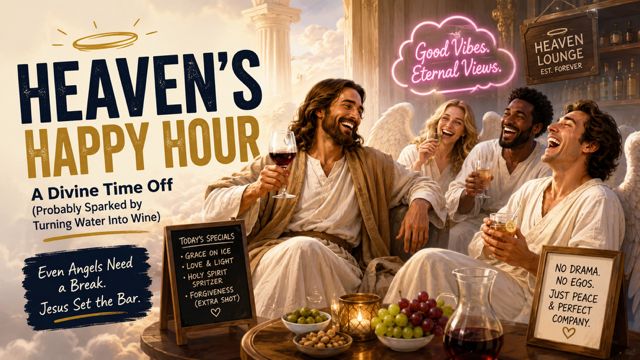
Because if Jesus’ first miracle set the tone, then Heaven probably has the most confusing happy hour policy imaginable.
I refuse to believe eternity is all harps and endless glowing whiteness.
There has to be some kind of celestial decompression process.
At minimum, the angels need breaks.
You cannot spend thousands of years announcing prophecies, monitoring humanity, and stopping people from driving into telephone poles without occasionally needing a beverage and thirty uninterrupted minutes.
Picture it.
Friday evening in Heaven.
Shift change just ended.
Gabriel walks into the celestial lounge looking exhausted because humans spent the entire week interpreting obvious signs incorrectly.
Again.
Michael is still in armor because he takes everything too seriously.
Raphael is trying to organize a wellness retreat nobody asked for.
Somewhere in the corner there’s one angel whose entire assignment is protecting toddlers and he looks absolutely finished.
Not burned out.
Not emotionally drained.
Finished.
Then Jesus walks in.
Not dramatic.
Not glowing excessively.
Just calm, observant, slightly amused.
And immediately everyone relaxes because historically speaking, if Jesus shows up to a gathering, things tend to become significantly more interesting.
Now here’s where I imagine Heaven differs from Earth.
No fake networking.
No pretending to enjoy IPAs that taste like carbonated tree bark.
No guy explaining cryptocurrency beside a charcuterie board.
No “circle back” conversations.
Just peace.
Real peace.
The kind humans accidentally spend their entire lives searching for in promotions, productivity apps, overpriced vacations, and motivational podcasts hosted by men named Chad.
But I also think celestial happy hour would involve a shocking amount of laughter.
Because despite how serious we make religion feel sometimes, Scripture contains an astonishing number of moments where human beings are lovingly ridiculous.
The disciples routinely misunderstand direct instructions.
Jonah literally tries to outrun omniscience.
Peter cuts off someone’s ear during an arrest and probably thought he was helping.
Humanity’s spiritual résumé is honestly chaotic.
Which means Heaven likely has the energy of a long-running family group chat where everybody is aware humans are trying their best but also deeply unserious creatures.
I imagine Jesus hearing modern prayers the same way a patient parent watches toddlers explain advanced engineering concepts.
“Lord, give me strength.”
“You argued with someone on Facebook for three hours.”
“I know, Lord. It was spiritual warfare.”
“No, that was the comments section.”
And if angels get recreational time, I suspect they spend a shocking amount of it reviewing near misses.
Like replay footage of moments where humans almost ruined their lives over avoidable decisions.
“Here’s the one where he texted his ex after two margaritas.”
“Oof.”
“Yeah, Michael had to intervene twice.”
“Strong save.”
“Thank you.”
There’s probably an angel assigned exclusively to stopping people from replying-all to company emails.
A senior angel too.
That’s not an entry-level responsibility.
And somewhere — somewhere — there has to be one exhausted heavenly administrator responsible for answering prayers that begin with:
“Now Lord… technically…”
Those are dangerous prayers.
Nothing good has ever followed “technically.”
But the older I get, the more I appreciate the symbolism behind that first miracle.
Not because of the wine itself.
But because the setting mattered.
A wedding.
A celebration.
A community gathering.
The first miracle was not performed in a palace or battlefield.
It happened where people laughed.
Where families gathered.
Where joy mattered enough that preserving it became sacred.
That feels important.
Maybe divinity was never meant to exist only in suffering, solemnity, and catastrophe.
Maybe God also shows up in crowded tables, loud conversations, embarrassing dance moves, and moments where people briefly forget how hard life is.
And honestly, that is comforting.
Especially now.
Because the world currently feels like everybody is one unanswered email away from becoming a medieval peasant emotionally.
So perhaps there’s something reassuring about imagining Heaven not as endless rigidity, but as perfect peace with room for joy.
Room for rest.
Room for laughter.
And possibly — if Jesus’ track record is any indication — exceptionally good drinks.
Which, when you think about it, would make sense.
The man’s opening act permanently raised expectations for hospitality.