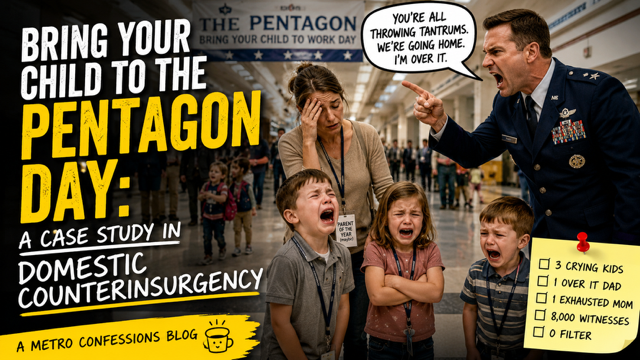
There are days when the Pentagon feels like a functioning workplace, and there are days when it feels like someone gave a security clearance to a Chuck E. Cheese.
Today was the latter.
It was Bring Your Child to Work Day, which sounds charming in theory, until you remember the Pentagon already contains enough adults pretending to understand acronyms to power a small republic. On a normal day, the building has thousands of people moving through it with badges, coffee, repressed anxiety, and shoes that sound like federal budget cuts on polished floors.
Then someone said, “You know what this needs? Eight thousand children.”
Eight thousand bright-eyed visitors. Eight thousand tiny observers. Eight thousand potential future leaders, taxpayers, whistleblowers, defense contractors, or children who will one day tell a therapist, “My first memory of government was a windowless hallway and my dad yelling near a food court.”
I tried to be mature about it.
I failed immediately.
There is something uniquely humbling about watching children enter the Pentagon with more joy than most of the adults who work there. They were excited. They were curious. They had snacks. They still believed buildings were fun.
The rest of us were walking around like unpaid extras in a leadership seminar titled Resilience Through Forced Cheerfulness.
So, naturally, I did what any serious professional does when morale collapses: I took a break from my very important schedule and went people-watching from behind a glass wall.
This was not idleness. This was field research.
Anthropology, really.
And that is when I saw them.
A family.
Mom. Dad. Three kids.
At first, they looked like a perfectly normal Pentagon family unit. Dad was in uniform, carrying that particular military-parent posture that says, “I have briefed generals, survived deployments, and yet this child with a granola bar has defeated me.” Mom had the look of a woman who had packed the snacks, remembered the water bottles, coordinated the outfits, located the bathrooms, answered 500 questions, and was still somehow about to be blamed for the collapse of civilization.
The kids looked like kids. Which is to say, they looked like small emotional weather systems.
One of them was already crying.
Not lightly crying. Not the polite little sniffle of a child denied a sticker.
No.
This was full-body litigation.
He was wailing with the conviction of someone who had been wronged by NATO. I do not know what happened. Maybe he was hungry. Maybe he was tired. Maybe he learned the Pentagon has five sides and felt betrayed by geometry. Children are mysterious organisms. One moment they are fine, the next they are screaming because their sock has become “too socky.”
But then, as always happens in families, the crying became contagious.
The second child joined in.
Then the third.
Now we had a trio.
A tiny, underfunded opera.
Three children performing Les Misérables: Federal Corridor Edition.
Mom looked exhausted. Dad looked cornered. The family system had entered what I will call the “Costco Parking Lot Phase,” which is when every member of the household knows the day is over, but no one has the courage to formally declare it.
And then Dad stepped forward.
This was his moment.
This was his Gettysburg.
This was his TED Talk.
He took one look at his crying children, his visibly depleted wife, the public setting, the innocent bystanders, the glass walls, the echoes, the badge-wearing adults pretending not to listen, and decided:
“Yes. This is where I become the villain.”
And he launched.
“That’s it. You’re throwing a tantrum. Your mom is throwing a tantrum. Your siblings are throwing tantrums. We’re going home. Get up. I’m over it.”
Sir.
Sir.
This is the Pentagon.
There are entire offices in this building dedicated to managing escalation. There are policy papers on proportional response. There are people here who can describe deterrence ladders in their sleep. And yet here you are, conducting domestic shock-and-awe on your own family next to a glass wall.
I wanted to tap the partition and whisper, “De-escalate, Colonel Feelings. De-escalate.”
Now, let me be fair. Parenting is hard. I do not have three crying children in a public building shaped like a bureaucratic pentagram. I understand that children can humble even the strongest among us. A toddler can break a person faster than an IG complaint.
But still.
There is losing your patience, and then there is convening a family court-martial in public.
This man did not simply say, “Okay, everyone, we need to go.”
No.
He produced an incident report.
He identified all offenders.
He named the emotional infractions.
He included the mother in the charge sheet.
“You’re throwing a tantrum. Your mom is throwing a tantrum. Your siblings are throwing tantrums.”
That was not parenting.
That was a PowerPoint bullet.
Slide 1: Family Breakdown
Slide 2: Contributing Factors
Slide 3: Everyone But Me Is the Problem
And this is where my spirit left my body.
Because there is a special kind of man who, when surrounded by three crying children and one exhausted woman, concludes that the real victim is himself.
“I’m over it.”
Over what, sir?
The consequences of reproduction?
The event you voluntarily attended?
The children you helped manufacture?
The wife who is visibly running the entire emotional logistics chain while you stand there like the angry spokesperson for a failed theme park?
This is where the whole thing became less about Bring Your Child to Work Day and more about Bring Your Unprocessed Family Dynamics to Work Day.
Because what I saw was not just a dad losing his temper.
I saw a family operating system.
And baby, the software needs an update.
In that one little hallway performance, you could see the whole domestic hierarchy.
The children were overwhelmed, because of course they were. The Pentagon is not exactly a sensory-friendly environment. It is a maze with fluorescent lighting, security theater, long corridors, and adults who all look like they are late to disappoint someone.
Mom was probably carrying the invisible load. Snacks, bathroom breaks, emotional interpretation, the quiet calculus of who is hungry, who is tired, who needs a distraction, who is about to detonate.
Dad, meanwhile, appeared to have reached his leadership limit the moment the children stopped behaving like decorative accessories.
That is the thing about some family systems. They are peaceful only when everyone is performing correctly.
The children must be cute.
The wife must be composed.
The father must be admired.
The public must witness competence.
And when reality fails to honor the script, someone must be punished.
Usually the person with the least power.
Sometimes all of them.
Now, again, I do not know this family. Maybe he is wonderful at home. Maybe he makes pancakes. Maybe he reads bedtime stories in funny voices. Maybe this was just a bad moment.
But public bad moments are revealing because people rarely invent new personalities under stress. They default.
And his default setting was: Command presence, but make it emotionally uninsured.
The tragedy is that he probably thought he was restoring order.
Men like this often do.
They mistake volume for authority. They confuse embarrassment with discipline. They believe if everyone gets quiet afterward, they have succeeded.
But silence is not respect.
Sometimes silence is just people waiting for the storm to pass.
And children learn from storms.
They learn who gets to be angry. They learn who has to absorb it. They learn whether love stays gentle when things get inconvenient. They learn whether public dignity is something everyone deserves or only the person doing the yelling.
That is the part that sticks.
Not the crying. Kids cry. That is their job. Their whole operating model is snacks, naps, and emotional terrorism.
But adults are supposed to have upgraded firmware.
At minimum, we should be able to avoid publicly narrating our family’s collapse like a losing football coach at halftime.
Imagine being one of those kids years from now.
“What was your Bring Your Child to Work Day like?”
“Oh, educational. I learned the Pentagon has five sides, my dad has one tone, and my mother apparently committed tantrum by association.”
Or imagine being the wife.
You dressed everyone, got them there, managed the snacks, soothed the kids, stood through the tours, smiled through the chaos, and then your husband announces to nearby strangers that you, too, are throwing a tantrum.
That is when marriage becomes a hostage situation with matching visitor badges.
And let us discuss the wife for a second, because women in these scenarios always have to perform Olympic-level composure. If she reacts, she proves his point. If she stays quiet, she swallows the insult. If she defends the kids, now she is “undermining” him. If she walks away, she is dramatic.
There is no winning.
Only damage control in sensible shoes.
Meanwhile, Dad gets to be “over it.”
Must be nice.
I, too, would like to be “over it” at random intervals and have society call it leadership.
Unfortunately, when I am over it, I still have to answer emails.
This is what made the whole thing so memorable. Not because it was the worst thing anyone has ever said. It wasn’t. Families have said worse things in Target checkout lines over throw pillows.
But this was the Pentagon. A building obsessed with command climate, professionalism, strategic messaging, and optics.
And there, in the middle of all that national-security choreography, was a man demonstrating that some people can brief deterrence abroad and still run a dictatorship at home.
That is the cautionary tale.
A family is not a unit you command into harmony.
It is not a staff meeting with smaller shoes.
You cannot yell people into emotional regulation. You cannot shame children into maturity. You cannot publicly diminish your spouse and call it “taking charge.”
That is not leadership.
That is a man outsourcing his embarrassment to the nearest available dependents.
The smarter move would have been simple.
Kneel down. Lower the voice. Give the kids food, water, a bathroom break, or a clean exit. Tell your wife, “Let’s call it. We tried.” Leave with dignity. Preserve the brand.
But no.
He chose the live demonstration package.
And I, unfortunately, was there to receive the training.
So yes, Bring Your Child to Work Day taught me something after all.
It taught me that some families are not built around love so much as performance. Everyone has a role. The children must behave. The mother must manage. The father must appear in control. And when the performance fails, the person at the top does not ask what the system needs.
He finds someone to blame.
Preferably three crying children and a woman too tired to argue.
And perhaps that is the real lesson.
The Pentagon can survive many things. Budget fights. Acronym overload. Fluorescent lighting. Adults saying “circle back” as though language has done something wrong.
But even the most secure building in America cannot protect a family from a father who thinks authority means making everyone smaller.
So to the man who turned a children’s event into a domestic command climate survey: congratulations.
Your kids came to see where you work.
And for one unforgettable hallway moment, we all got to see how.