On my metro ride last week, a rider sat next to me at the moment, I decided to correctly wind my watch. Not sure what he saw but he started asking me how they work. Typically, I’d be annoyed someone was infringing on my sacred metro ride – but then I thought, what a godsend. I get to nerd out on a poor unsuspecting soul and also hopefully make him a watch enthusiast who goes home and tells his parents, I want to be a watch collector. So below is what I believe I had time to poor into his impressionable brain. Good luck, parents!
Mechanical watches are one of the few everyday objects where 17th-century physics, precision metallurgy, miniature engineering, and controlled energy transfer still quietly outperform modern intuition.
At a fundamental level, an analog mechanical watch is not “smart.” It does not know time.
It measures the controlled release of stored energy.
That is the entire trick.
The reason that trick becomes extraordinary is because it does it with springs, gears, friction management, harmonic oscillation, and gravity compensation—sometimes for decades—inside a machine small enough to fit on your wrist.
Here’s the architecture.
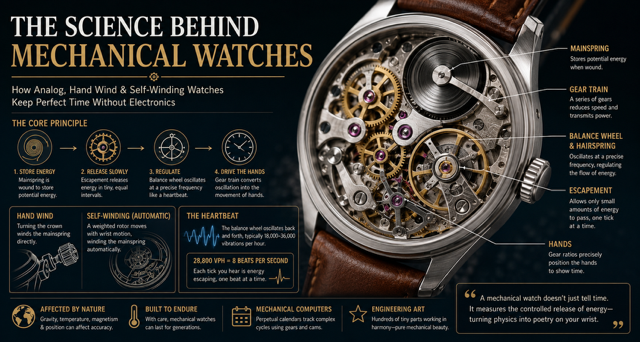
The Core Principle
A mechanical watch works by:
- Storing energy in a spring
- Releasing that energy very slowly
- Regulating the release into equal intervals
- Translating those intervals into hand movement
The “equal intervals” part is the entire science of watchmaking.
Without regulation, the spring would simply unwind instantly.
The watch would spin like a toy and die in seconds.
So the entire watch exists to solve one problem:
“How do we force energy to leave at a perfectly controlled rate?”
The Energy Source — The Mainspring
Inside the watch is a tightly wound ribbon of metal called the mainspring.
When you wind the crown:
- You are physically tightening this spring
- The spring stores potential energy
This is essentially classical mechanics.
Like compressing a bow.
Or stretching a rubber band.
The spring wants to return to equilibrium.
That stored energy becomes rotational torque.
Manual Wind vs Self-Winding
Manual Wind
In a hand-wound watch:
- You turn the crown
- The crown winds the mainspring directly
- The spring slowly unwinds over time
Most manual watches store between 40–80 hours of power.
Some modern ones exceed 8–10 days.
Self-Winding / Automatic Watches
An automatic watch adds a rotor:
- A weighted semicircular metal disc
- It swings freely with wrist movement
- Motion winds the mainspring automatically
The rotor converts kinetic energy into spring tension.
Essentially:
Human motion → rotational energy → stored mechanical energy.
The physics resembles inertial energy harvesting systems.
A rotor spins because gravity continuously reorients the weighted mass during movement.
Tiny reversing gears ensure winding occurs efficiently regardless of direction.
Some luxury movements achieve astonishing efficiency with ceramic bearings and low-friction pivots.
So How Does the Watch “Know” Time?
This is the real magic.
The answer is:
It doesn’t know time.
It creates an artificial heartbeat.
That heartbeat is the oscillator.
The Balance Wheel — The Mechanical Heart
The balance wheel oscillates back and forth at a fixed frequency.
Think of it as a tiny harmonic oscillator.
The same physics governing:
- Pendulums
- Metronomes
- Vibrating atoms
- Quartz crystals
applies here.
The wheel is attached to an ultra-thin spiral spring called the hairspring.
Together they form a resonant system.
Like this:
Wheel rotates → spring pulls it back → inertia carries it past center → spring reverses again.
Over and over.
Thousands of times per hour.
This is governed by harmonic motion:
T = 2\pi\sqrt{\frac{I}{k}}
Where:
- T = oscillation period
- I = rotational inertia of the balance wheel
- k = spring stiffness
That equation determines how fast the balance oscillates.
The watchmaker manipulates:
- wheel mass
- spring geometry
- material elasticity
- temperature stability
to achieve stable oscillation.
This is precision physics at miniature scale.
The Escapement — Controlled Leakage of Time
Now comes the genius mechanism.
The escapement.
The escapement:
- Prevents the mainspring from unwinding instantly
- Releases energy in tiny discrete packets
- Keeps the balance wheel oscillating
This is why you hear ticking.
Each tick is energy escaping.
Hence the name.
The escapement converts continuous rotational force into quantized impulses.
In essence:
Potential energy becomes digitally metered mechanical motion.
Long before electronics existed.
The Tick Rate
Most watches beat at:
- 18,000 vibrations/hour
- 21,600 vibrations/hour
- 28,800 vibrations/hour
- Some exceed 36,000
A 28,800 vph movement means:
8 oscillations per second.
That means the second hand is not actually moving continuously.
It is making microscopic jumps.
Your eye just smooths it out.
Gear Ratios — Translating Oscillation into Time
Now we get into pure engineering.
The escapement drives a gear train.
The gears reduce rotational speed through carefully calculated ratios.
Example:
- Escape wheel spins rapidly
- Intermediate gears reduce speed
- Final ratios produce:
- 1 minute rotation
- 1 hour rotation
- 12 hour rotation
The watch hands move because gear ratios mathematically enforce those intervals.
This is effectively an analog mechanical computer.
The hands “know” where to go because the gear train physically constrains them.
No software.
No processor.
Pure geometry and ratio mathematics.
Why Mechanical Watches Drift
Mechanical watches are constantly fighting physics.
Tiny disturbances affect timing:
- Gravity
- Temperature
- Lubricant viscosity
- Shock
- Magnetic fields
- Position of the wrist
- Material expansion
Even Earth’s gravity changes timing slightly depending on orientation.
A watch resting crown-up behaves differently than dial-flat.
This is why luxury movements obsess over positional regulation.
The Tourbillon — Fighting Gravity
Invented by Abraham-Louis Breguet in 1801.
The tourbillon rotates the entire escapement assembly continuously.
Why?
To average out gravitational timing errors.
Originally useful in pocket watches which sat vertically most of the day.
Today:
Mostly engineering art.
But extraordinarily beautiful engineering art.
Perpetual Calendars — Mechanical Computation
Now things become absurdly impressive.
A perpetual calendar mechanically tracks:
- Month lengths
- Leap years
- Date changes
without electronics.
Some can remain accurate until 2100.
This is achieved through:
- cams
- levers
- stacked program wheels
- mechanical memory encoding
The watch literally contains a programmed logic system made of metal geometry.
It is a physical algorithm.
Why Quartz Destroyed Mechanical Accuracy
Quartz watches use crystal oscillation instead.
A quartz crystal vibrates electrically at:
32,768 Hz.
Far more stable than mechanical oscillation.
Mechanical watches drift:
- ±5 seconds/day for excellent watches
Quartz:
- ±15 seconds/month
Atomic clocks:
- lose seconds over millions of years
So mechanically, quartz won.
Completely.
So Why Do Mechanical Watches Still Exist?
Because they are emotionally irrational engineering.
A mechanical watch is a visible argument against disposability.
It is kinetic sculpture.
A civilization-level flex.
It says:
“We became so advanced that we could miniaturize celestial regularity into springs and brass.”
The deeper irony?
The watch is fundamentally imitating astronomy.
Early clocks emerged because humans wanted to model recurring cosmic motion:
- sunrise
- planetary cycles
- seasons
A mechanical watch is essentially a tiny artificial universe running on controlled entropy.
Which is why watch enthusiasts speak about movements almost spiritually.
You are literally wearing regulated decay on your wrist.
And somehow turning it into order.