Parenthood occasionally provides moments of profound insight.
Most of those moments arrive disguised as insults from small people who still need help opening yogurt containers.
Last night was one of those moments.
My daughter and I were talking about absolutely nothing of consequence, which is usually when the best conversations happen. Adults schedule important discussions. Children ambush you with them between brushing teeth and arguing about bedtime.
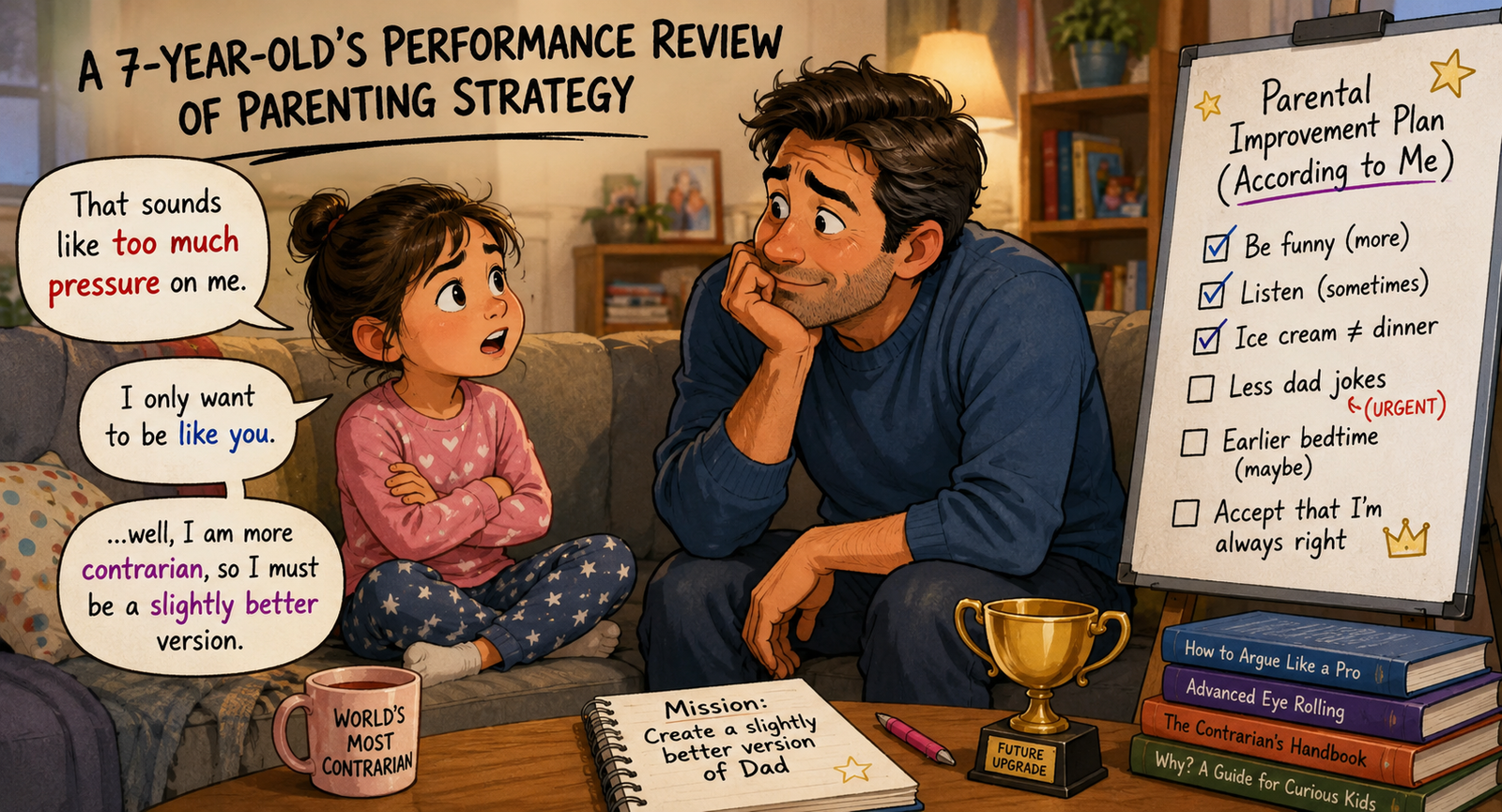
Somewhere in the conversation, I casually mentioned a belief I have carried around for years. I told her that I think the job of a parent is to create a slightly better version of themselves through their children.
In my head, this sounded wise.
Maybe even profound.
The kind of statement that should be engraved onto a mountain somewhere.
My daughter stared at me the way an exhausted project manager stares at an executive who has just volunteered everyone for additional work.
Then she said, “That sounds like too much pressure on me.”
No hesitation.
No reflection.
No diplomatic softening of the blow.
Just an immediate rejection of my entire strategic vision for humanity.
The more I thought about it, the more I realized she was probably hearing something very different from what I intended.
I heard: “Each generation should build upon the successes and failures of the last.”
She heard: “Congratulations. You are now responsible for fixing everything I didn’t get around to.”
From her perspective, she had been having a perfectly normal evening. Then her father suddenly informed her that she was apparently a long-term improvement initiative.
A seven-year-old should not have to sit through a performance review of civilization.
I imagine her internal monologue sounded something like this:
“Sir, with all due respect, I have only recently mastered tying my shoes. I feel grossly underqualified for this assignment.”
The more we talked, the more I began to appreciate how children view adults.
Adults are always trying to outsource things.
We outsource chores.
We outsource errands.
We outsource customer service.
Apparently we are now attempting to outsource self-improvement.
I could almost see her doing the math.
“So let me understand this correctly. You had forty years to become the best version of yourself, and your plan is for me to finish the project?”
Honestly, when framed that way, it sounds less like parenting and more like generational tax fraud.
Eventually she softened her position.
She informed me that she did want to be like me.
Which was nice to hear.
Then she immediately clarified that she did not want to be exactly like me.
Which felt significantly less nice.
Children have an extraordinary ability to hand you a compliment and a correction in the same sentence.
It is like receiving a participation trophy from someone who cannot legally ride in the front seat of a car.
Then came the negotiation.
She explained that she is more contrarian than I am and therefore might already qualify as a slightly better version.
This statement was delivered with the confidence of someone presenting peer-reviewed research.
I considered objecting, but the evidence was difficult to ignore.
This is a child who can debate bedtime with the intensity of a constitutional lawyer arguing before the Supreme Court.
She has questioned instructions, challenged assumptions, and requested clarification on parental decisions that frankly did not deserve that level of scrutiny.
Most children ask “why” repeatedly.
My daughter sometimes follows up with what can only be described as a request for supporting documentation.
If I tell her something, there is a decent chance she will ask for examples.
If I provide examples, she may ask for additional examples.
At some point I begin to suspect I am being cross-examined by a very small attorney whose payment structure involves fruit snacks.
So perhaps she has a point.
Every generation improves on the previous one partly by refusing to accept everything they are told.
My parents raised me.
I questioned some of their ideas.
My daughter is now questioning mine.
At this rate, her future children will probably fact-check her in real time.
There is something reassuring about the whole thing.
Parents often imagine themselves as sculptors carefully shaping the next generation.
The reality is much messier.
We hand our children a collection of strengths, flaws, habits, stories, and questionable life philosophies.
Then they sort through the pile like customers at a yard sale.
They keep what they like.
They leave behind what they don’t.
And occasionally they point at something you were particularly proud of and ask, “Why would anyone want this?”
By the end of the conversation, I realized that my original theory needed revision.
Maybe the goal is not to create a better version of ourselves.
Maybe the goal is to raise someone confident enough to disagree with us.
Someone capable of taking the useful parts, improving the weak parts, and building something entirely their own.
Someone who can hear a grand parental vision and immediately identify the hidden workload.
Which means my daughter may already be succeeding.
After all, I told her that children are supposed to become slightly better versions of their parents.
She challenged the premise.
Negotiated the terms.
Improved the argument.
And somehow managed to avoid accepting the assignment.
That is either a parenting success story or the beginning of a very successful career in management consulting.