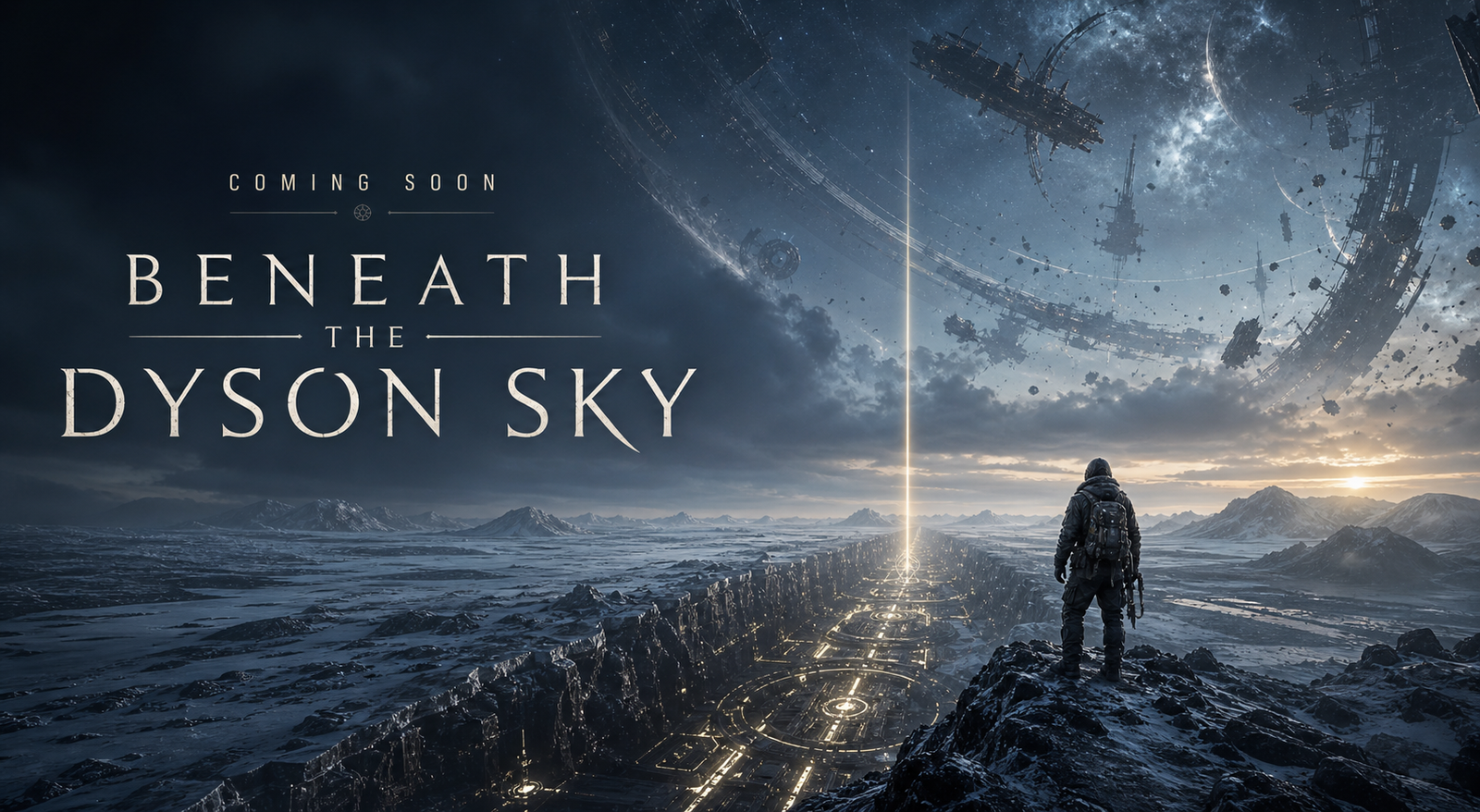
Somewhere beneath a frozen trench on a failing frontier world, something ancient wakes up.
That is the problem.
Beneath the Dyson Sky begins on Nydra, a hard-edged salvage world where survival depends on luck, timing, and knowing which risks are worth the cold. Kael Vey is not looking for destiny. He is looking for a score. One good find. One piece of buried machinery or outlawed salvage valuable enough to buy a little breathing room in a life that does not hand out much of it.
Instead, he finds a hidden machine system that should have stayed dead.
The moment it wakes, Nydra changes. Buried infrastructure begins to move. Dead orbital wrecks start answering signals they were never supposed to hear again. Offworld powers close in. And Kael, who should have remained just another scavenger trying to make it home in one piece, becomes the point of contact for forces much older and far more dangerous than anyone on his world understands.
That is where Beneath the Dyson Sky begins to open up.
This is a science-fantasy novel built on buried cities, ruined orbital graveyards, dead transit corridors, hostile machine intelligence, and the unnerving possibility that the universe is still held together by systems no one fully controls anymore. It is a story about salvage and secrecy, but also about power, memory, survival, and what happens when ordinary people stumble into the machinery that history forgot to turn off.
At the center of the story is Kael: practical, stubborn, unimportant in all the ways that usually keep a person alive. He is not a chosen one. He is not a prince, a pilot ace, or a polished revolutionary with a speech ready. He is a young man from the margins of a difficult world, and that matters. Because when the hidden architecture of the galaxy begins to wake, it does not do so in a throne room or a war chamber. It starts in the cold, in the dark, with people trying to survive.
Kael does not face that alone.
There is Tovan Rhee, sharp-tongued, loyal, skeptical, and deeply committed to pointing out when every new development is a terrible idea. He is exactly the kind of friend a story like this needs: practical enough to question everything, stubborn enough to keep showing up anyway. There is also Liora Sen, disciplined, dangerous, and tied to institutions that know just enough about the old machine systems to make her both an asset and a threat. Together, they are pulled into a widening chain of buried archives, forbidden routes, and old structures that do not merely contain history. They still enforce it.
What I wanted from this novel was scale with pressure.
I wanted the world to feel large, but never vague. Ancient, but still tactile. The kind of universe where cold metal matters. Where failing lights matter. Where the politics of a place are written into its corridors, who controls them, and who gets shut out of them. Beneath the Dyson Sky reaches toward the grand and the cosmic, but it stays grounded in consequence. People still get tired. Systems still fail at the wrong moment. The wrong choice in the wrong room can still get you killed long before anyone has time to explain the mythology.
That balance matters to me.
There are buried empires here, but this is not a story built on exposition for its own sake. The mystery unfolds through motion. Through pursuit. Through discovery under pressure. Through the slow realization that what looks like ruin may actually be infrastructure, and what looks like history may still be active. Space in this book is not just empty distance between planets. It is patterned. Scarred. Routed. Full of dead roads, sleeping corridors, broken gates, and hidden thresholds waiting for the wrong hand to wake them.
And once they wake, they do not care whether anyone is ready.
That is part of what excites me most about this book. It begins in a salvage trench and grows outward into something much larger, but it never leaves behind the human stakes that gave it energy in the first place. At its core, this is still a story about people trying to hold onto themselves while the ground beneath them turns out to be part of a machine bigger than anything they were taught to imagine.
It is about friendship under pressure.
It is about institutions arriving too late and too armed.
It is about old systems that were never as dead as people hoped.
And it is about the cost of becoming visible to powers that prefer ordinary people remain small.
If you like frontier worlds, hidden architectures, dangerous old technologies, deep-space ruins, political tension, and stories where the future is uncovered rather than invented, this book is very much for you.
Beneath the Dyson Sky is coming soon.
There is a world called Nydra.
There is something buried under it.
And the moment it wakes, the sky is no longer empty.