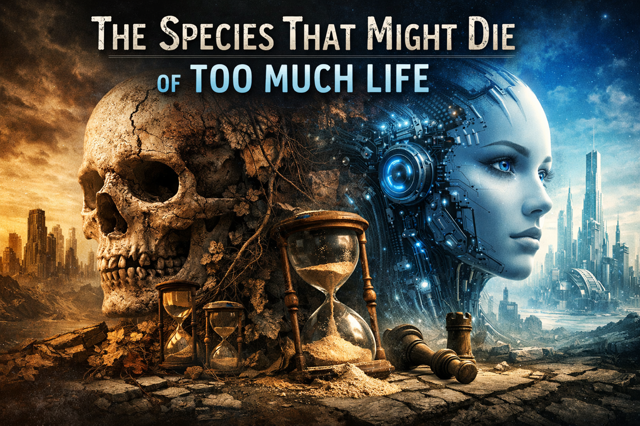
If death becomes optional, meaning may become unstable
Modern civilization has quietly decided that death is a technical defect. Not a metaphysical boundary. Not a civilizational constant. Not even an existential tutor. A defect. Something like bad code, weak hardware, or a very old design problem that biotechnology, AI, nanomedicine, and enough venture capital can eventually brute-force into submission.
That assumption now sits underneath longevity science, anti-aging medicine, brain-upload fantasies, cryonics, and the broader transhumanist sales pitch. The branding changes, but the doctrine stays the same: aging is damage, damage can be repaired, and if repair becomes comprehensive enough, death becomes negotiable.
It is an elegant theory. It is also the sort of theory a frightened species would invent. And it may be wrong in the one place that matters most: the human mind.
Biology already tells us that aging is not one neat failure point. The current “hallmarks of aging” framework describes aging as an interacting systems breakdown involving genomic instability, telomere attrition, epigenetic alterations, mitochondrial dysfunction, cellular senescence, stem-cell exhaustion, chronic inflammation, and related processes. In other words, aging is not a loose screw. It is a network cascade. Extending healthy life is therefore a real scientific project, but it is not remotely the same thing as flipping a switch labeled “immortality.”
Still, let us assume the engineers eventually win far more than they should. Let us assume disease is radically suppressed, senescence is delayed to the margins, organs are replaced on demand, cognition is stabilized, and humans become functionally long-lived in ways previous generations would have called absurd. Even then, the hard problem would remain untouched. Not the cellular one. The psychological one.
Because death does not merely terminate life. It structures it.
Human beings did not evolve for endless duration. We evolved under scarcity, risk, reproductive windows, bodily fragility, social turnover, and finite time horizons. Our motivational architecture was shaped inside those constraints, not outside them. The result is that many of the things we call “human depth” may actually be side effects of limitation: urgency, commitment, sacrifice, legacy, and the sudden realization that because time is short, not everything can matter equally.
This is where the immortality fantasy begins to wobble. It assumes that because death feels cruel, its removal must feel liberating. That does not follow. A mind calibrated for finitude may not become wiser when given endless time. It may become less decisive, less anchored, and less capable of distinguishing desire from drift.
Psychology has been unusually clear on one part of this. Socioemotional Selectivity Theory argues that perceived time horizon changes human motivation. When people feel they have expansive time ahead, they tend to prioritize exploration, novelty, and future-oriented goals. When time feels limited, they shift toward emotionally meaningful pursuits and closer relationships. That is a quietly devastating finding for the immortality crowd, because it suggests that the nearness of endings helps generate depth. Finitude does not merely sadden us. It clarifies us.
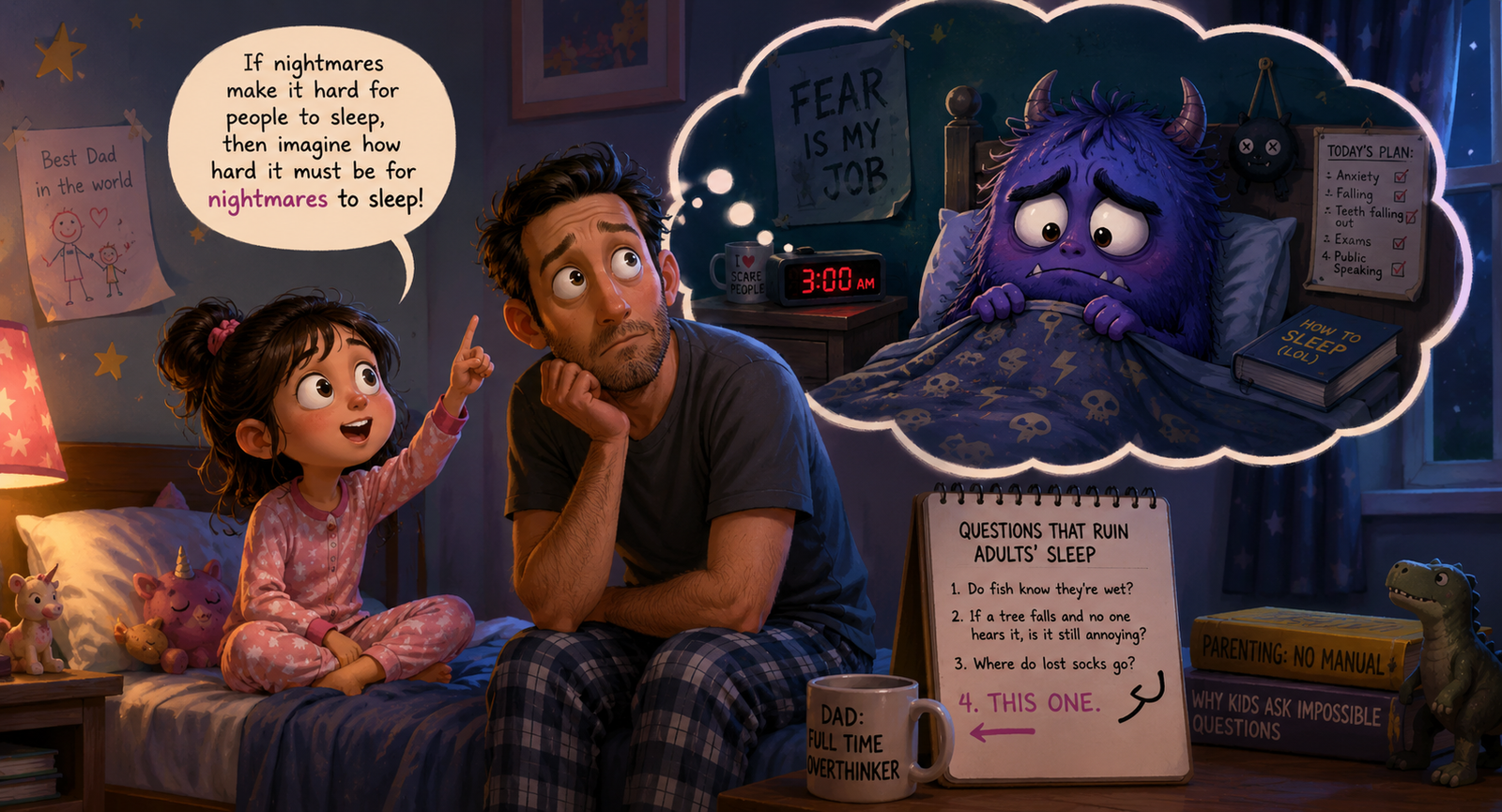
Put more bluntly: if time becomes endless, meaning may become optional.
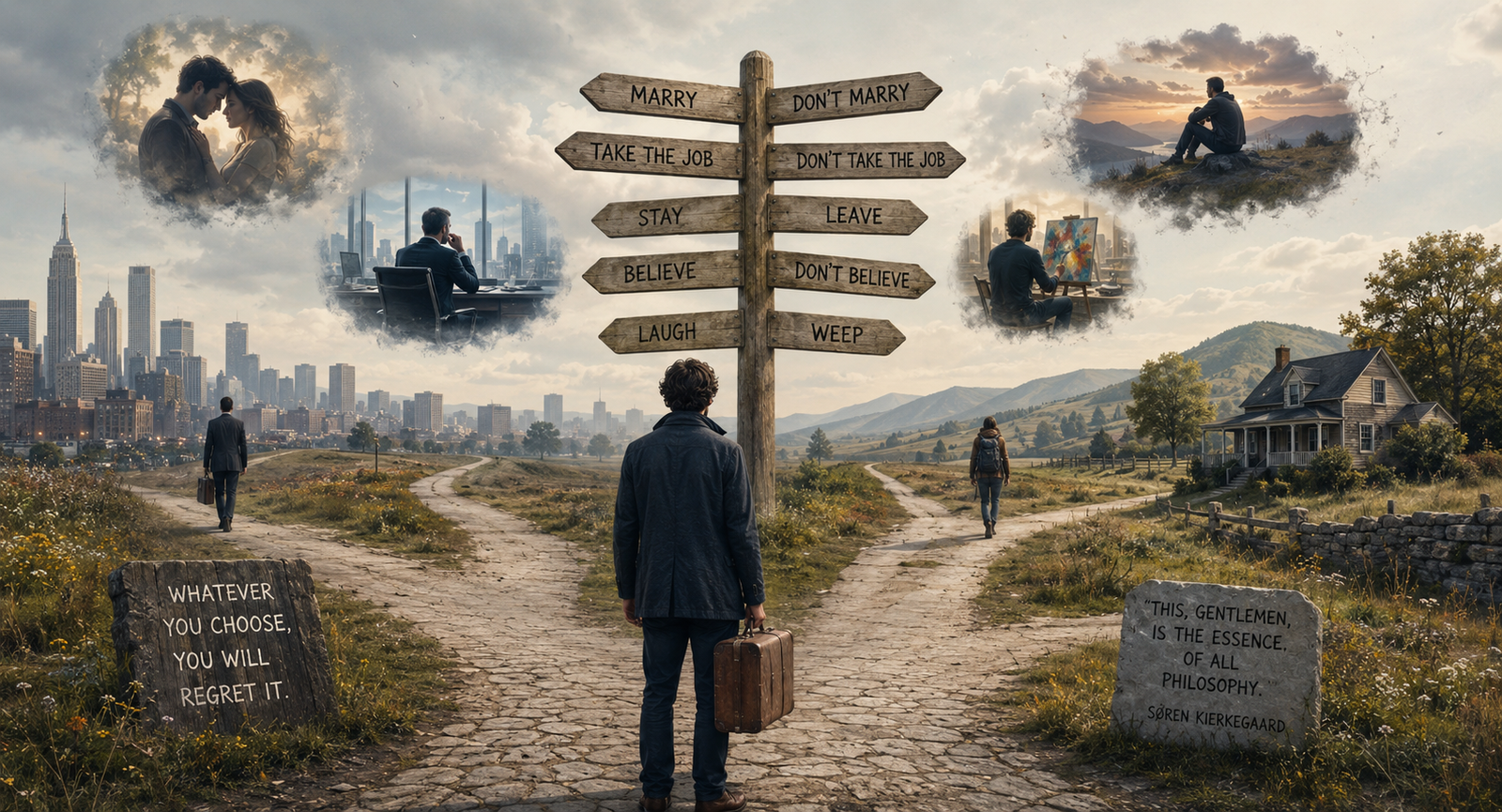
That matters because freedom is not simply the possession of more time. Freedom is also the necessity of choosing under constraint. A being with effectively infinite tomorrows may have more duration but less agency. Why reconcile now? Why commit now? Why build now? Why risk now? Why become anyone in particular if reinvention can always be deferred another decade, century, or millennium? Endless life may not expand freedom so much as liquefy it.
Then there is desire, which modern futurism treats with the naive optimism of people who have clearly never watched human beings get everything they said they wanted and remain dissatisfied anyway. Research on purpose and wellbeing consistently suggests that flourishing is tied not to indefinite extension but to structure, direction, and meaningful organization of one’s life. Studies have repeatedly found that stronger purpose in life is associated with lower mortality risk, including in older adults and across adulthood more broadly. The point is not that “purpose makes you immortal.” The point is that human wellbeing appears linked to directedness, not mere duration.
That distinction is fatal to the immortality narrative.
A long life is not automatically a meaningful one. In fact, one reason meaning may emerge at all is because a life cannot contain everything. Scarcity forces ranking. Ranking forces identity. Identity forces a person to say yes here and no elsewhere. That is how a life acquires contour. Endless duration threatens that contour by keeping every possibility artificially open.
And the human organism is already bad enough at handling abundance.
If longevity science ever hands indefinite life to a species with hedonic adaptation, status anxiety, social comparison, tribal grievance, and institutional inequality still intact, it will not have created paradise. It will have created backlog. Power may calcify. Grievances may become intergenerational without the mercy of generations ending. Inequality may cease to be temporary and become quasi-permanent. Mortality is vicious, but it is also one of history’s reset mechanisms. People die. Elites age out. Institutions turn over. New cohorts arrive with different priorities. Remove that turnover, and conflict may not diminish. It may harden.
This is where boredom enters the room like an undertaker in expensive shoes.
Boredom is not a trivial complaint of spoiled people with too many screens. It is increasingly treated as a meaningful psychological signal, often associated with low engagement, under-stimulation, and a mismatch between attention and purposeful activity. In normal human life, boredom can push reorientation. In endless life, it may become chronic civilizational corrosion. Infinite duration does not guarantee infinite significance. It may simply industrialize distraction.
And before anyone dismisses this as philosophical melodrama, look at the species now. Global fertility has fallen from about 4.9 children per woman in the 1950s to 2.3 in 2023, according to Our World in Data using UN population data. That does not prove some grand “death of civilization” thesis by itself; fertility decline has many economic, social, and political drivers. But it does show that humanity is already struggling with continuity, reproduction, and future confidence under modern conditions. We are not exactly a species radiating unshakable conviction about tomorrow.
So are we meant to evolve beyond this feeble flesh state?
In one sense, yes. Healthy longevity is a serious and worthwhile goal. Reducing frailty, compressing morbidity, delaying disease, and extending years of functional life are legitimate scientific ambitions grounded in mainstream biomedical research. On that front, the project makes sense. Few sane people are romantics about dementia, organ failure, or needless suffering.
But that is not the same as saying mankind is meant for boundless continuation.
That leap is philosophical vanity disguised as science. It assumes that because we can reduce biological limitation, we should abolish existential limitation. It assumes that a mortal primate’s psyche will remain stable when stripped of the very boundary conditions under which it developed. It assumes that the engine of human meaning can survive the removal of urgency. None of that has been established. In fact, some of the best evidence points the other way. Time limits, mortality awareness, and purpose-linked striving appear deeply entangled with how humans organize value and significance.
The darker possibility is that mankind does not go extinct because it failed to conquer death.
It goes extinct because it succeeded too well.
Not necessarily by dramatic collapse. Not by asteroid, plague, or machine uprising. Something quieter. A slow civilizational thinning. Endless postponement. Endless appetite. Endless psychological congestion. Fewer compelling reasons to reproduce, sacrifice, build, or hand the world forward. A species so technologically competent that it defeats senescence, yet so existentially disordered that it cannot survive the victory.
That would be the final irony: death was never merely the executioner. It was also the editor.
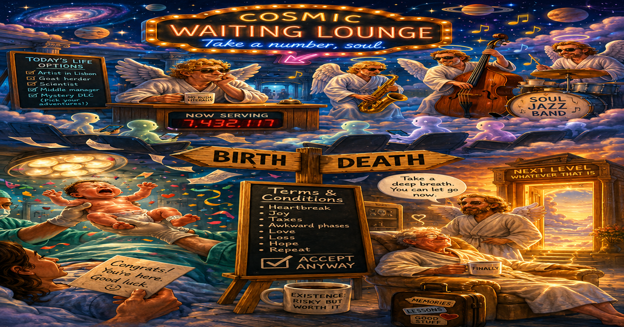
It made time scarce enough to matter. Love costly enough to wound. Choice narrow enough to mean something. Ambition urgent enough to become action. Remove it carelessly, and we may not become gods.
We may become aggrieved, bored, structurally unsatisfied beings with too much time, too little meaning, and no serious reason to continue.
A species does not need to be destroyed to vanish.
It can simply outlive the conditions that once made life worth choosing.