There are a few ways one imagines meeting a guardian angel.
You picture a soft glow. A calm voice. A face conveying ancient wisdom and premium customer service. Maybe some orchestral background music. Maybe a reassuring hand on the shoulder. Maybe the sort of divine bedside manner that says, “You have suffered, my child, and now I shall explain the mystery of pain with compassion and a tasteful amount of light.”
That is not what I got.
What I got was a celestial employee in visible distress over what was clearly an unfortunate scheduling conflict.
He appeared in front of me with the energy of a man who had double-booked a dental cleaning and a tax audit. No warm welcome. No serene smile. No wings unfurling in majestic slow motion. Just a hard stare, an exhale loaded with professional disappointment, and the unmistakable expression of someone who had opened an email marked urgent at 4:57 p.m. on a Friday.
“You have got to be kidding me,” he said.
Now, under the circumstances, this was not the response I had hoped for.
I blinked. “Are you… my guardian angel?”
He rubbed his forehead like I was the reason heaven needed new funding.
“Yes,” he said. “Regrettably.”
“Regrettably?”
He looked around, as though hoping another angel might step in and say this had all been a clerical mix-up.
“Yes. Regrettably. Deeply. Strategically. Administratively. Pick one.”
There is something uniquely humbling about discovering that your first supernatural encounter is with a divine functionary who already seems sick of you.
“I’m sorry,” I said, which felt appropriate, if a little reflexive.
“Of course you are,” he muttered. “Now.”
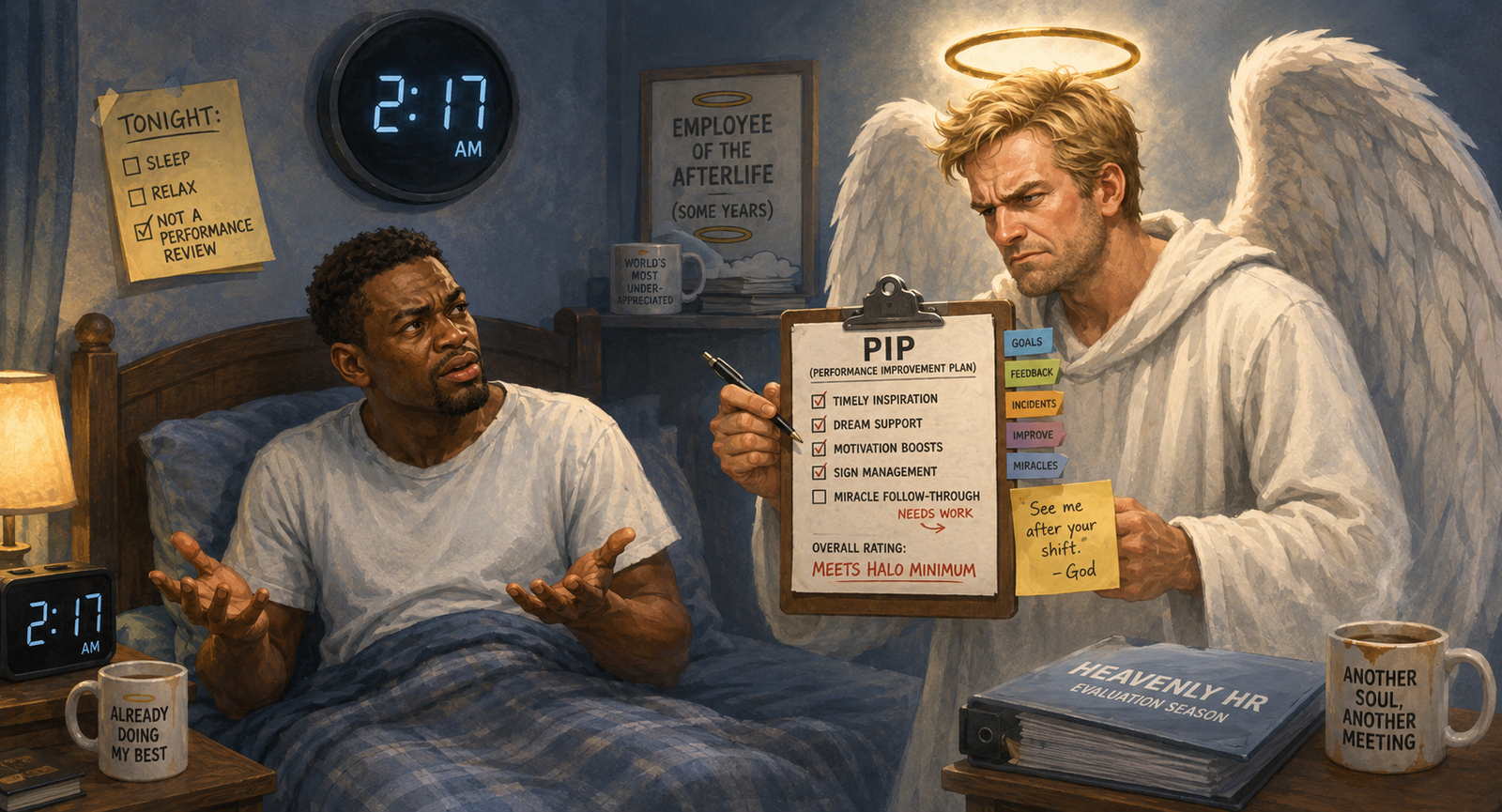
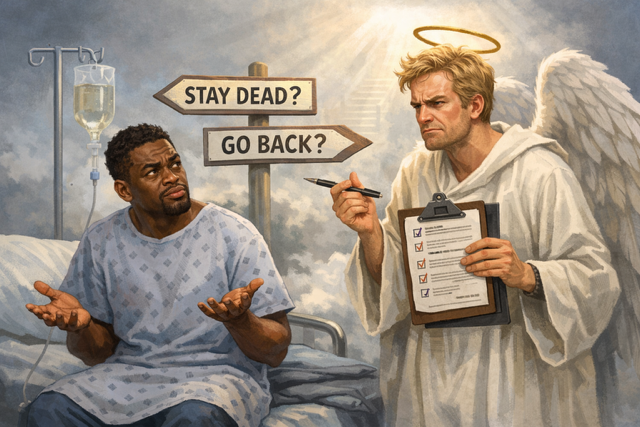
He snapped open a clipboard.
Yes, a clipboard.
Because apparently the afterlife, like every organization with too much power and too many subcommittees, runs on forms.
“You have a clipboard?” I asked.
“Everyone asks that as though eternity would be managed through vibes.”
“That feels unnecessarily hostile.”
“You attempted to escalate to a terminal outcome during my evaluation window,” he said. “I am past hostile. I am now in performance-impact territory.”
And that, more than anything else, is what set the tone.
Not my anguish. Not my existential collapse. Not the grand tragedy of human despair.
His review cycle.
“My evaluation is this week,” he said, tapping the clipboard with the tight fury of an employee who had already prepared a self-assessment. “I was on track for ‘meets expectations with strong promise.’ Do you understand what this does to my metrics?”
I stared at him.
“You have metrics?”
“Everything has metrics.”
“For guardian angels?”
“Especially for guardian angels. Intervention efficiency. Guidance receptivity. Crisis deflection. Longitudinal soul stewardship. Do you have any idea how hard it is to get a good score in novice celestial oversight?”
“Novice?”
He closed his eyes.
“Do not make this worse.”
I should have stopped there. I should have let the man—or being, or luminous compliance officer—continue his speech. But curiosity is a disease and I have always been extremely symptomatic.
“You’re new?”
He inhaled in the exhausted way of someone deciding whether the truth will only encourage more questions.
“You,” he said slowly, “are my first assignment.”
Now this was devastating on several levels.
First, because it meant that my entire life had effectively been overseen by a heavenly intern.
Second, because he clearly knew it too.
Third, because once you learn your guardian angel is new, every bad decision you’ve ever made starts to feel less like character failure and more like a weak onboarding process.
“Your first assignment?”
“Yes.”
“So nobody senior was available?”
“I did not say that.”
“But that is what it sounds like.”
He made a small note on his clipboard.
“What did you write?”
“‘Combative under correction.’”
“Can I see it?”
“No.”
This is when it became clear that heaven, like every bureaucracy on earth, becomes significantly less charming the moment you are part of the workflow.
He straightened himself, as if trying to recover what remained of the meeting.
“Here are your options,” he said.
“Wow,” I replied. “No small talk?”
“This is the small talk.”
He adjusted the clipboard again and read with the tone of a man reciting from a policy memo he personally disagreed with.
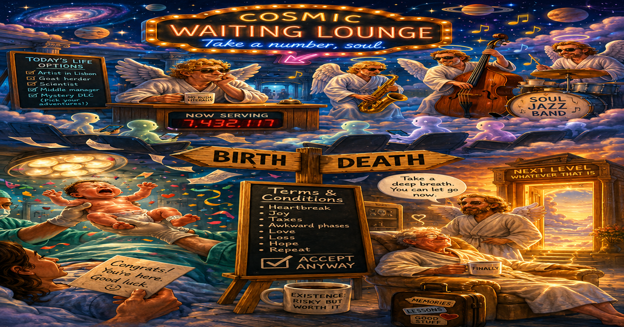
“Option one: you stay dead.”
Now, I would like to pause here and say that “stay dead” is an outrageous phrase.
It is crude. It is blunt. It lacks pastoral sensitivity. It sounds less like a metaphysical threshold and more like a customer service decision.
Like, “After careful review, we have decided to uphold your original expiration.”
I raised a hand.
“Can I just say, the wording there is appalling.”
“You may say whatever you like. It will not alter the framework.”
“You don’t have something more compassionate? Transition? Pass on? Enter the next phase?”
“We are trying to save time.”
He was clearly not interested in branding.
“If you stay dead,” he continued, “there is a fifty-fifty chance of one of several outcomes.”
I frowned. “One of several?”
“Yes. Reincarnation, purgatory, or re-entry into your current life through a procedural anomaly.”
I stared.
“That is not fifty-fifty.”
“It is internally categorized as fifty-fifty.”
“That’s at least three outcomes.”
He gave me a look that said celestial math was not a public-facing product.
“So let me understand this,” I said. “If I choose death, I could remain dead, come back as someone else, get spiritually warehoused, or wake up again in my same ridiculous life?”
“That is a simplified version, yes.”
“That sounds unstable.”
“It is a legacy system.”
I laughed. I could not help it.
Here I was at the edge of existence and even the heavens were running outdated infrastructure.
Of course they were.
Entire civilizations can split the atom, but no institution, terrestrial or divine, has ever mastered the basic dignity of clear process.
“And option two?” I asked.
He looked at me flatly.
“You go back.”
“That’s it?”
“That’s it.”
“With all my problems?”
“Yes.”
“With all my unresolved issues?”
“Yes.”
“With the same rent?”
“Yes.”
“With the same inbox?”
He checked the clipboard. “Likely worse.”
“Any compensatory package?”
“No.”
“A sign? A revelation? Some premium insight to offset the burden?”
He looked at me as if I had requested business class on a rescue flight.
“No. You may gain perspective.”
“Can I decline that and take cash?”
He ignored me.
I wish I could say I then became reflective and noble, full of reverent awareness. I did not. I became annoyingly practical.
“Can I ask,” I said, “what exactly do you do all day?”
He stared at me.
“This is what I do.”
“No, I mean before this.”
He blinked once, slowly. “Prevent this.”
“Right, but when I’m not falling apart?”
“Mitigation.”
“Mitigation?”
“Yes. Redirecting you from terrible decisions. Prompting instinctive unease. Nudging you away from dubious social invitations. Delaying messages that would have ruined your life. Encouraging naps. Soft-blocking your attachment to people with chaos in their aura. Standard scope.”
I looked at him with newfound respect.
“You were the reason I didn’t text that one person?”
He sighed. “Do not make me revisit the archives.”
“And when I missed that train?”
“Yes.”
“That was you?”
“Yes.”
“And the time I got a weird feeling and turned around?”
“Yes.”
“And that job I wanted that I didn’t get?”
“Yes.”
“Oh wow,” I said. “You’ve actually been busy.”
He looked personally offended that I found this surprising.
“I have been carrying this portfolio with minimal support and no appreciation.”
“Portfolio” is such a violent word for one’s soul.
“Do angels always talk like management consultants?”
“We adapt our vocabulary to the subject.”
“That’s offensive.”
“That is data-driven.”
Now, to be fair, he was right about one thing. This conversation was not a good use of anyone’s time.
Mine, because I was apparently in the middle of a cosmic decision tree with no appealing branches.
His, because he had nowhere else to be, strictly speaking, but still managed to radiate the annoyance of a man with three back-to-back meetings and no lunch.
Which is a remarkable achievement when you are immortal.
“You seem very stressed for someone eternal,” I said.
“I am being assessed on emotional steadiness under adverse mortal engagement.”
“That sounds fake.”
“It is extremely real. My reviewer uses a developmental rubric.”
“Who reviews a guardian angel?”
He hesitated.
“I am not at liberty to disclose names.”
“So there’s a senior angel.”
“There is always a senior angel.”
“And they’ll ask why this happened?”
He gave me a bitter laugh. “They will not ask why. They will ask what proactive interventions were attempted upstream and whether my stewardship model sufficiently accounted for subject volatility.”
I was silent for a moment.
“That is horrible.”
“Yes.”
“That sounds exactly like corporate America.”
He pointed the clipboard at me. “Every bureaucracy is an echo of something older.”
That line was so good I almost forgot I was in a crisis.
Almost.
He continued.
“Do you know what’s in your file?”
“I’m scared to ask.”
He began flipping pages.
“Oh, I should not do this,” he said. “This is definitely not best practice.”
And yet he did it anyway, which made him instantly more believable.
“Age seven,” he read, “attempted to eat chalk because another child said it looked like candy.”
“I was curious.”
“Age fourteen, nearly derailed long-term trajectory over a person who played acoustic guitar incorrectly.”
“In my defense, I was a teenager.”
“Age twenty-three, described a very obvious warning sign as ‘probably just a vibe.’”
“That’s still a valid framework.”
“It is not.”
“Sometimes it is.”
“It isn’t when the vibe is danger.”
He flipped another page and frowned. “Age twenty-nine. Considered deleting entire professional life because of one email.”
“That email was disrespectful.”
“It was mildly terse.”
“It had energy.”
“It had punctuation.”
He went on.
“Multiple episodes of catastrophizing based on insufficient evidence. Repeated tendency to confuse fatigue with destiny. Chronic overinvestment in closed loops. An unfortunate pattern of granting temporary emotions permanent authority.”
That one landed.
I hated him a little for how concise he was.
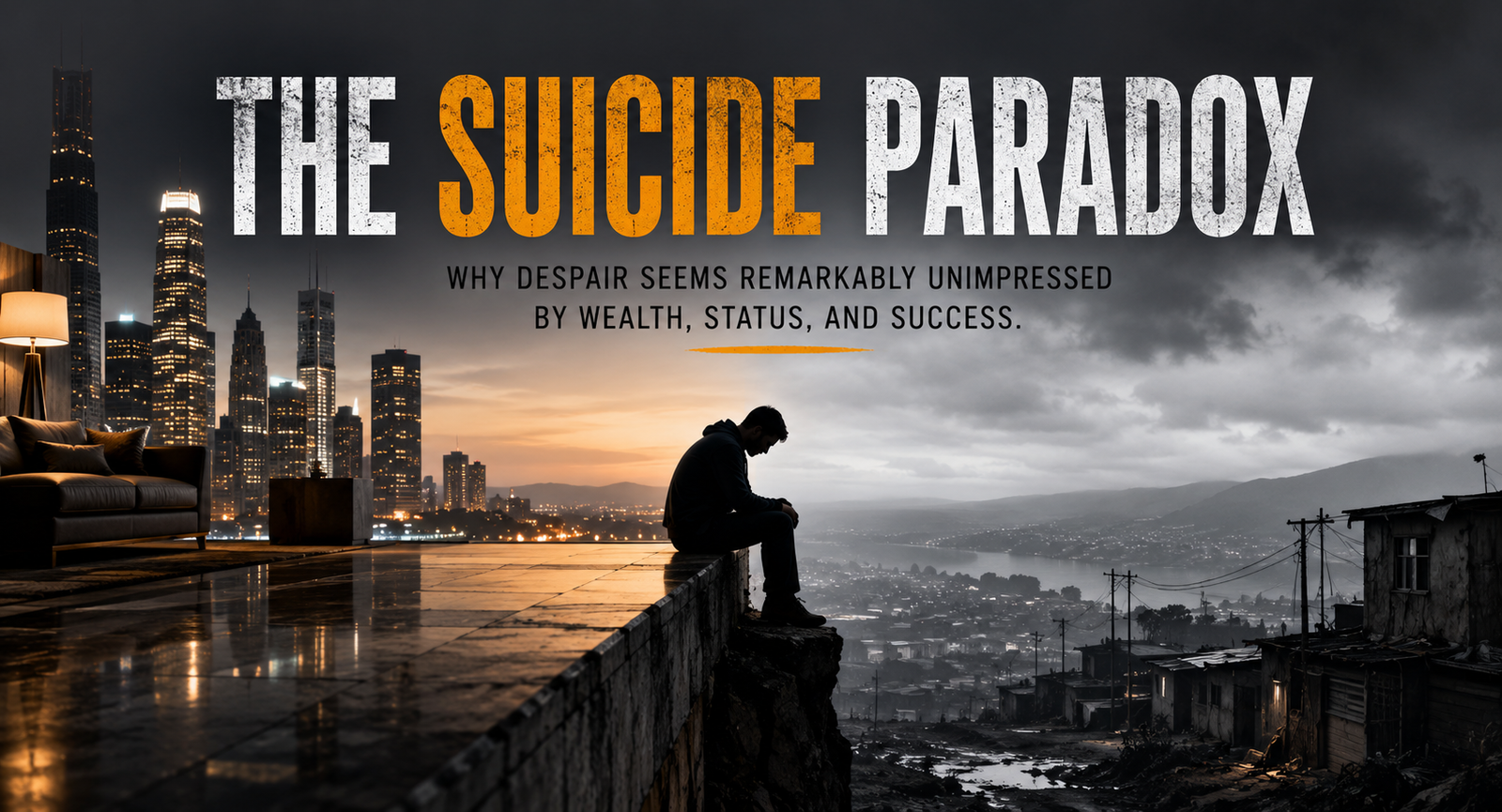
Because that, more than anything, is despair’s most arrogant move. It takes a bad hour and presents it as prophecy. It takes loneliness and sells it as identity. It takes exhaustion, dresses it up in philosophy, and suddenly your mind is doing keynote speeches on the futility of being alive.
Meanwhile you may, quite literally, be dehydrated and under-slept.
I do not say that to trivialize pain. I say it because pain is crafty. It knows how to masquerade as final truth. It knows how to make the temporary feel permanent and the unbearable feel objective.
Which is why, even in this absurd exchange, I understood why the angel was irritated.
Not because my suffering was fake.
But because my timing was terrible.
Because I had interrupted the quarter-end review with a dramatic escalation while he was apparently trying to demonstrate growth areas and initiative.
“This is not ideal,” he muttered, scanning the clipboard.
“For me too,” I said.
He looked up sharply. “Do not make this symmetrical.”
“Excuse me?”
“You mortals love false equivalence. This is a bad day for you. This is a measurable setback for me.”
I laughed again.
Because what else could I do?
I was having a performance management discussion with my guardian angel.
No one prepares you for that in church.
No sermon ever says, “One day your celestial protector may stand over you muttering about key performance indicators.”
But perhaps they should.
Perhaps the trouble with how we imagine spiritual encounters is that we make them too elegant.
Too polished.
Too full of revelation and not enough paperwork.
Because if there is one thing human life reliably teaches, it is that most major turning points do not arrive with cinematic dignity. They arrive messy. Annoyed. Half-coherent. With poor lighting and a body that has not emotionally caught up to the moment.
And that is where the humor lives.
Not in making light of pain.
In refusing to grant pain monopoly power over the scene.
Humor interrupts despair’s speech.
It clears its throat in the back row and says, “This is awful, yes, but it is also faintly ridiculous, and I refuse to let you have the room unchallenged.”
That is not cruelty. That is survival.
I asked the angel, “Have you done this before?”
He stared blankly.
“With a subject,” I clarified.
“You are my first subject.”
“Yes, but have you ever had this exact conversation?”
He shifted, which told me more than the answer.
“Not this exact one.”
“So I’m your first suicidal intervention?”
He looked deeply offended by how directly I had phrased it.
“I would not put it like that.”
“But that’s what it is.”
He grimaced. “You are determined to worsen the wording of everything.”
“And you are determined to act like we’re discussing delayed luggage.”
“We are discussing consequences.”
“Same tone.”
He sighed. “There was a simulation.”
“A simulation?”
“In training.”
“Did you pass?”
He paused too long.
“You failed the simulation?” I asked.
“It was a developmental exercise.”
“Oh my God.”
“It involved a nineteenth-century poet and a bridge. The variables were unusual.”
“You failed to stop a simulated poet?”
“I said the variables were unusual.”
That did it.
I laughed so hard I nearly forgot why we were there at all.
Because of course the heavens would entrust me to someone who once lost a practice round to an imaginary poet.
Of course.
The angel watched me laugh with grim patience.
“This is not funny.”
“It is a little funny.”
“It is not.”
“You lost a training scenario to a bridge poet.”
“There were weather complications.”
“Was the poet dramatic?”
“All poets are dramatic.”
“That’s fair.”
For the first time, his face shifted. Not into warmth exactly. More into reluctant humanity, which felt generous given the circumstances.
“You are not the only one,” he said.
That line sobered me.
He looked down at the clipboard, then away.
“You mortals think these thoughts make you uniquely broken,” he said. “They do not. They make you human. An inconveniently fragile, wildly improvisational, frequently contradictory species with no respect for maintenance cycles.”
Now that is an excellent description of humanity.
He continued. “You break under weight. You hide under performance. You call it logic when it is pain. You call it clarity when it is depletion. Then you become persuaded that because suffering is articulate, it must be correct.”
There it was again.
That irritating celestial accuracy.
Because suffering is articulate. Extremely articulate. It writes strong internal memos. It arrives with charts, examples, old evidence, and dramatic language. It can make one terrible week feel like a thesis on why your continued existence is strategically unsound.
And sometimes what saves you is not a grand argument back.
Sometimes it is interruption.
A friend calling.
A text arriving.
A song catching you off guard.
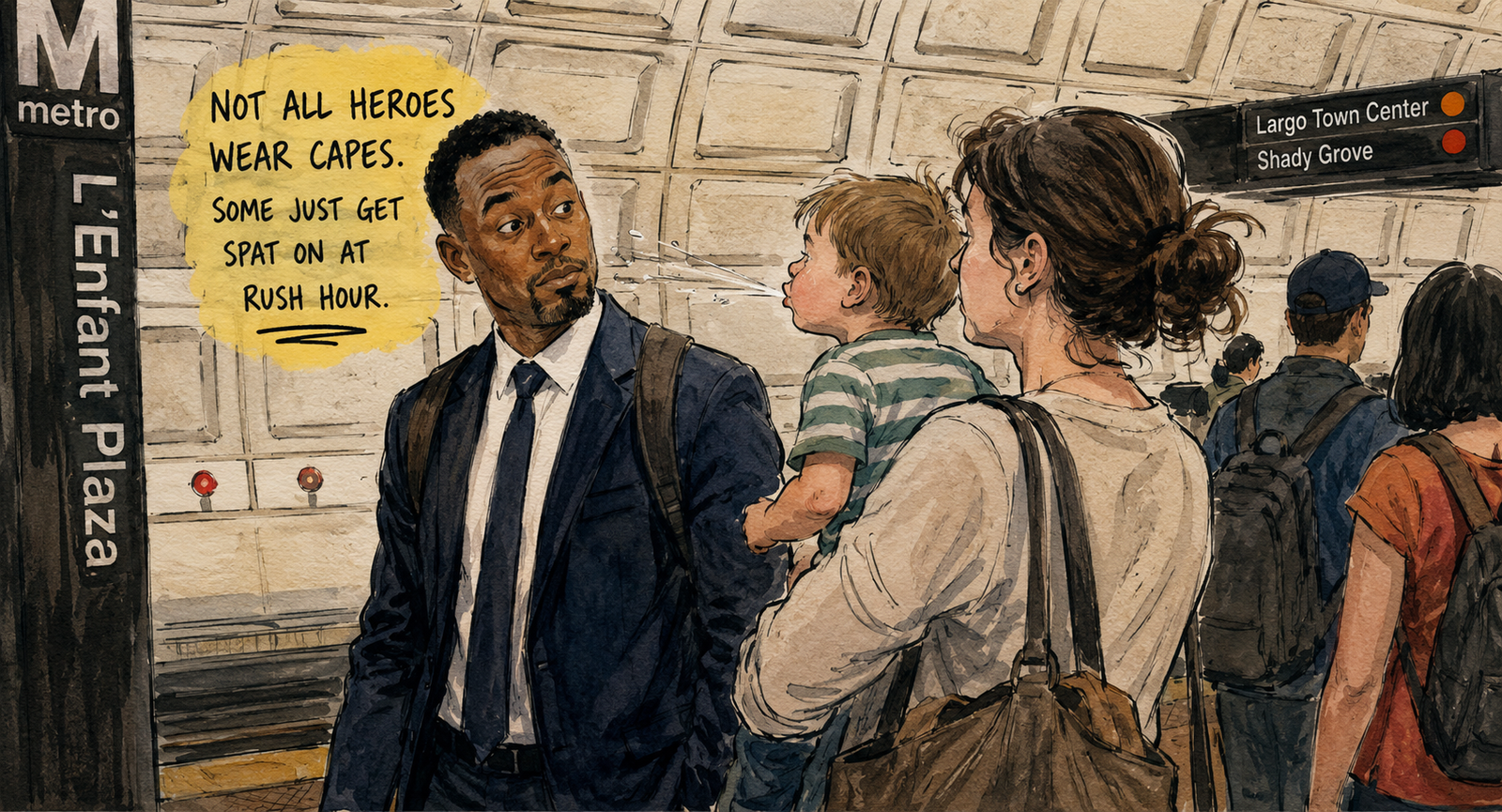
A stranger saying something absurdly human on public transit.
An exhausted guardian angel with review anxiety and poor interpersonal finesse.
He cleared his throat.
“We need to close this out.”
“Close this out?”
“Yes.”
“Are you resolving my life in corporate language?”
“I am advancing the matter to decision.”
“That is worse.”
He straightened. “Choose.”
“Can I ask one more question?”
His whole face twitched. “This is why my notes are not strong.”
“One more.”
He said nothing, which I took as consent.
“If I go back, what changes?”
He looked at me for a long moment.
“Nothing immediately,” he said. “That is what you dislike.”
That, unfortunately, was true.
We all want our major inner battles to produce a visible atmospheric shift. A sunrise. A revelation. A new jawline. Something. We want the breakthrough to feel worth the breakdown.
But usually life does not hand you a new plot. It hands you the old one again and asks whether you want to read it differently this time.
That is the rude part.
You return to the same dishes. The same body. The same bills. The same awkward messages from people who suddenly remember you exist when they need a favor. The same mind, though perhaps with slightly less authority than it claimed an hour ago.
You return not because everything is fixed.
You return because final conclusions should not be made in a storm.
You return because pain lies about permanence.
You return because tomorrow is sometimes just today with slightly better lighting and one less catastrophic thought.
You return because absurdity, while not healing, can still be evidence that the story has not closed.
The angel glanced again at the clipboard.
“You know,” he said, “from an outcomes perspective, I really need you to pick life.”
“That sounds self-serving.”
“It is.”
“Honesty. I appreciate that.”
“I am trying a new competency.”
“Which one?”
“Transparent engagement.”
“It’s not bad.”
“It is benchmarking well in practice environments.”
He was absolutely insufferable.
And yet.
There was something comforting in his irritation. In his refusal to romanticize my pain. In his annoyance at being dragged into a moment that, for me, felt absolute but for him was still clearly interruptible.
That, perhaps, is the gift of being interrupted. Someone else seeing finality where you saw none. Someone else insisting, however grumpily, that the scene is not over.
I looked at him.
“So if I choose life,” I said, “I get no applause, no revelation, no upgraded circumstances, and no guarantee tomorrow won’t still be nonsense?”
“Correct.”
“And if I choose death, I may still end up back here?”
“Also correct.”
“That is offensively inefficient.”
He nodded. “The cosmos is not optimized around your preferences.”
I took a breath.
Which felt symbolic, but mostly was functional.
And I understood then that surviving is rarely one dramatic yes.
It is usually a pile of small, annoyed yesses.
Yes, I will stay.
Yes, I will keep going.
Yes, I will allow for the possibility that my current despair is not the final authority on my life.
Yes, I will endure one more morning, one more text, one more attempt to eat something with nutritional value, one more awkward conversation, one more chance for the world to surprise me with something decent or at least absurd.
So I picked life.
Not heroically.
Not because I was flooded with hope.
Not because the heavens opened and explained the purpose of suffering in clean bullet points.
I picked life the way many people do.
Reluctantly.
Suspiciously.
With notes.
The angel closed the clipboard so hard it sounded personal.
“Fine,” he said.
“Fine?”
“Yes. Fine. Acceptable. We are proceeding with life.”
“That’s it?”
“What did you want, a certificate?”
“A little warmth would be nice.”
He looked at me with ancient intern fatigue.
“Listen carefully,” he said. “The fact that you are still here means the conversation is not over. Do not confuse your worst moment with your final truth. And do not ever do this during review season again.”
“That last part feels oddly specific.”
“It is now in your file.”
“Can I appeal that?”
“No.”
Then he leaned in slightly, as if passing along a confidential note from a department that only functions under duress.
“When you wake up, tell someone the truth immediately. Not the polished truth. Not the impressive truth. The real truth. The one that makes you sound inconvenient. Especially that one.”
That was the closest he came to tenderness.
Then, as if remembering himself, he added, “And seek professional help. We are a celestial backstop, not a primary treatment model.”
“Wow,” I said. “That’s actually responsible.”
“We had a training update.”
And then he was gone.
No music.
No glow.
No sense of transcendence.
Just absence.
Then waking.
Then the old world again.
The same absurd life. The same unfinished business. The same bills. The same unhelpful inbox. The same mind, still capable of theater. The same body, still insisting on maintenance.
But something had shifted.
Not everything.
Just enough.
Enough to know that humor had made a small opening where despair wanted a sealed room.
Enough to know that interruption is sometimes grace in bad packaging.
Enough to know that even my most convincing darkness had not been the whole story.
Enough to know that if heaven really does assign guardian angels, mine is under-supported, lightly embittered, and one mediocre evaluation away from needing his own intervention.
And honestly?
That explains a lot.
If you are contemplating suicide, seek help immediately. Call or text 988 in the U.S. and Canada, contact emergency services if you are in immediate danger, or go to the nearest emergency room. Tell someone the unpolished truth right now. Your guardian angel might be in a grumpy mood just when you need it.