I have a standing question every time I enter a Metro station and see the station manager sitting in that little glass booth like the final boss in a bureaucracy-themed video game:
What exactly is the job?
Not theoretically. I know there is probably a real job description somewhere with words like customer assistance, station oversight, fare support, operational coordination, and public safety interface. I mean in practice. On the ground. In the wild. In the actual station, with actual humans, broken fare machines, and one escalator that has been “temporarily out of service” since the Obama administration.
Because from my lived commuter research, the station manager role seems less like a job and more like a mood.
Their natural habitat is the booth. Their facial expression says: I have seen too much. Their body language says: whatever happened, I did not do it. And their energy says: before you ask, the answer is already no, unclear, or spiritually unavailable.
But over time, I have developed a theory.
The station manager is not uninterested in helping people.
The station manager is selectively activated.
That is the part nobody tells you.
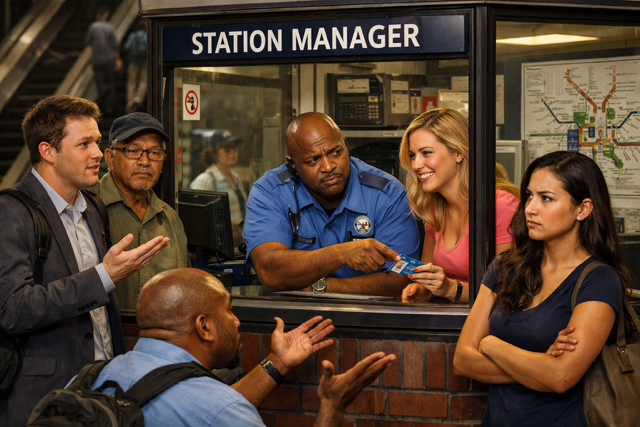
If a visibly confused man in work shoes, holding a laptop bag, approaches the booth and says, “Excuse me, my card isn’t reading,” what follows is usually a philosophical exchange. Not help. A seminar.
The station manager will look at him through the glass with the calm detachment of a professor who has no intention of giving partial credit.
“Did you tap correctly?”
Sir, I tapped it like I was entering heaven.
“Did it beep?”
If it had beeped, I would not be standing here looking like a rejected extra from a transit safety poster.
Then begins the Metro Socratic method.
“Did you add money?”
“Did you use the right gate?”
“Did you try the other machine?”
“Did you maybe not tap long enough?”
“Did you see what the screen said?”
At this point, I am no longer seeking assistance. I am defending a dissertation.
But let a beautiful woman walk up.
Everything changes.
Suddenly the station manager is out of the booth like this is an emergency deployment. The posture improves. The voice softens. The entire station experiences a customer-service awakening.
“Oh no, let me take a look.”
“Try this gate right here.”
“Sometimes this machine acts up.”
“You’re going the other direction? Let me show you.”
Show you?
Show you?
Minutes ago, a grown man with a government badge and the dead eyes of someone commuting from the end of the line was being challenged to prove he understood the concept of stored fare value. But now we have white-glove concierge service. Suddenly Metro has a hospitality division.
I am not saying this happens every time.
I am saying it happens often enough that if the Department of Transportation funded a field study, I would volunteer as principal investigator.
My working theory is that the station manager booth operates under a triage model not publicly disclosed to riders. Not based on urgency. Not based on need. Based on a mysterious and highly subjective formula involving appearance, charm, tone of voice, and whether helping you would feel like a burden or an opportunity.
There are categories.
There is The Pretty Privilege Response, which triggers immediate operational support, facial animation, and sometimes walking assistance.
There is The Regular Civilian Response, where you are met with vague gestures, partial eye contact, and an answer that sounds like it came from an oracle who resents being consulted.
Then there is The Burdened Male Commuter Tier, where your problem becomes your character test. This is where the station manager does not solve the issue so much as invite you to grow from it.
You say, “My card isn’t working.”
They hear, “Guide me, wise one, through this valley of malfunction so that I may become worthy of transit.”
And to be fair, maybe I get it.
Maybe after years in that booth, after the ten thousandth question about train delays they did not personally cause, after fare evaders have vaulted the gates right in front of everyone, after tourists ask whether this train goes to places it plainly does not go, after someone has once again confused the map, the signs, the announcements, and reality itself, maybe the station manager has earned the right to be selective.
Maybe they are rationing their spirit.
Maybe they wake up every morning and say, “Today I have enough emotional bandwidth to fully help six people. The rest will receive riddles.”
That would honestly explain a lot.
Because there is always that look on their face. Not anger exactly. Not even annoyance in the ordinary sense. More like a deep administrative fatigue. The look of someone who has spent years standing at the intersection of public confusion and institutional limitation.
They are customer-facing, but only in the same way gargoyles face outward. They are there. They are visible. They are technically part of the structure. Whether they are there to comfort you is another matter.
And yet, I respect them.
Because nobody in Washington has mastered the art of saying “that’s not really my problem” without actually saying it quite like a station manager. It is a subtle craft. A performance discipline. A level of bureaucratic minimalism that deserves study.
The station manager can communicate, with one sigh and a half-turn of the head, that your problem is real, unfortunate, and absolutely headed toward becoming your own personal project.
That is talent.
So no, I still do not fully know what the station manager job is.
But I do know what it feels like.
It feels like approaching the booth to ask for help and realizing you are about to find out whether you are one of the chosen.
If you are, congratulations. You will receive personalized service, practical guidance, and perhaps even a sympathetic nod.
If you are not, enjoy your pop quiz.
That’s Metro, baby. Public transit for all. Assistance for some. Character development for the rest.