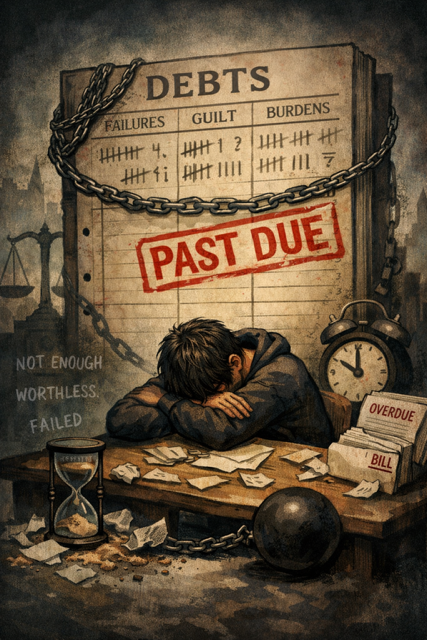
There are days when being alive does not feel like a gift. It feels like an invoice.
You wake up already owing something. Owing energy. Owing performance. Owing gratitude. Owing composure. Owing productivity. Owing other people the edited, presentable version of yourself. Before your feet even touch the floor, the mind has already opened a ledger and started counting what you have not done, what you should have done, what you meant to become, and what you still somehow owe the world for the crime of continuing to exist imperfectly.
That is the kind of exhaustion people do not always know how to name.
Not physical exhaustion, though that often comes with it. Not even ordinary stress. Something deeper. A spiritual fatigue. A psychological tax. A private sense that life is less a journey than a balance due notice. That your existence must be justified over and over again. That every breath has to be earned. That every failure compounds interest. That every weakness is evidence. That every quiet day is laziness. That every struggle is moral, not human.
And if you have lived long enough under pressure, disappointment, trauma, shame, loss, or depression, you may start to internalize a terrible theology of the self: that to be alive is to already be wrong.
Not in a dramatic sense. Not always in language people would recognize as a crisis. Sometimes it shows up in smaller, more respectable forms. In chronic self-disgust. In the inability to rest without guilt. In the reflex to apologize for needing help. In the way some people shrink when they speak, as though taking up conversational space requires formal authorization. In how they treat joy like stolen property and suffering like rent.
That is one of depression’s quieter distortions. It does not always scream. Sometimes it audits.
It goes through your life item by item and finds fault with all of it. It tells you that your existence is not neutral but burdensome. That being here costs too much. That other people are carrying you. That your pain is inconvenience. That your unfinished business is personal failure. That your body is an inefficient machine. That your mind is a hostile workplace. That your survival record should impress no one because plenty of people are suffering and still managing to answer emails on time.
Depression is cruel like that. It can turn consciousness into accounting.
You begin to measure yourself in debts. Emotional debts. Financial debts. Familial debts. Social debts. Professional debts. Even moral debts. You think of the people you disappointed. The versions of yourself you abandoned. The opportunities you mishandled. The promises you made in a stronger season and could not fulfill in a weaker one. You begin to imagine that your life is one long apology letter with no clear recipient.
And shame, once seated comfortably in the soul, is an excellent storyteller.
It knows how to make everything sound final. It knows how to reinterpret your history in the harshest possible light. It knows how to convert ordinary limitation into indictment. It knows how to tell you that your tiredness is cowardice, your grief is indulgence, your slowness is failure, your sensitivity is weakness, your need for tenderness is evidence that you are fundamentally unequipped for the world you have been assigned.
For many people, especially those raised inside systems of high expectation, survival itself can feel morally compromised.
You were taught, explicitly or otherwise, that your value must be demonstrated. That usefulness is virtue. That resilience means silence. That discipline means never falling apart where anyone can see it. That other people may have emotional complexity, but you are expected to have control. You learn to translate every internal ache into a management problem. You do not ask, “Why am I hurting?” You ask, “Why am I not performing?” You do not ask, “What happened to me?” You ask, “Why can’t I get over it?” You do not ask, “What kind of care do I need?” You ask, “How do I become less inconvenient?”
That is how a human being slowly becomes an employee of their own suffering.
At that point, even rest feels sinful. Pleasure feels suspicious. Sleep becomes negotiation. Tears become inefficiency. You judge yourself for not being able to carry what was, in truth, never meant to be carried alone. You begin to see your humanity as breach of contract.
And yet, for all its force, this way of seeing the self is not wisdom. It is not depth. It is not moral seriousness. It is not evidence that you finally understand life. Often it is simply pain that has learned sophisticated language.
Because pain is persuasive.
Especially when it borrows the vocabulary of obligation. Especially when it dresses itself up as realism. Especially when it says, “I am not being cruel. I am just being honest.” That line has done immense damage inside countless minds. Whole inner worlds have been colonized by a counterfeit honesty that is, in practice, only relentless accusation.
Real honesty is harsher than denial, yes, but kinder than contempt.
Real honesty says: you are tired, not worthless.
You are overwhelmed, not defective.
You are wounded, not fraudulent.
You are behind on some things, yes, but you are not a cosmic error because of it.
You are not failing at being a machine. You are being a person in a world that often extracts more than it gives.
There is a distinction there that matters.
Some people live as though existence itself requires constant repayment. They move through life trying to earn the right to stay. They overwork, overexplain, overgive, overfunction. They become hyper-competent in public and spiritually threadbare in private. They become everyone’s dependable person and their own unvisited ruin. From the outside, it may even look admirable. Responsible. Driven. Strong. But beneath it sits a devastating premise: I must keep producing enough value to offset the burden of being me.
That premise breaks people.
It does not always break them dramatically. Sometimes it breaks them into politeness. Into emotional flatness. Into chronic irritation. Into numb achievement. Into a life so administratively efficient that no one notices the person living it has not felt internally safe in years.
And this is where mental health conversations often become too shallow.
We talk about burnout as though it is a scheduling problem. We talk about depression as though it is only sadness. We talk about anxiety as though it is excess worry. We talk about healing as though it is a wellness routine with good lighting.
But sometimes the deeper wound is existential. Sometimes a person does not merely feel stressed. Sometimes they feel illegitimate. Sometimes they do not simply need a vacation. Sometimes they need deliverance from the belief that their life is a moral overdraft.
That kind of wound cannot be solved by productivity tips. It has to be confronted at the level of narrative.
What story are you living inside?
Who taught you that your worth is conditional?
Who benefits from your guilt?
When did you first learn that your needs were expensive?
When did weakness become, in your mind, a kind of misconduct?
When did rest start feeling like theft?
When did being alive stop feeling permissible and start feeling like debt service?
Those are not decorative questions. They are strategic ones.
Because many of us are not just tired from life. We are tired from the meanings we have attached to life. Tired from interpreting every struggle as proof against ourselves. Tired from carrying invisible courtrooms inside our heads where we are defendant, witness, prosecutor, and sentence.
No one thrives under permanent internal prosecution.
Not the child in you.
Not the grieving version of you.
Not the ambitious version.
Not the frightened version.
Not the version trying very hard to keep going without making a spectacle of the effort.
The mind cannot heal in the same place it is endlessly condemned.
This does not mean responsibility disappears. It does not mean pain makes all choices irrelevant. It does not mean every consequence is illusion. Some debts are real. Some regrets are earned. Some apologies are necessary. Some repairs must be made. But there is a world of difference between taking responsibility for what you have done and treating your very existence as the offense.
One leads to growth.
The other leads to corrosion.
And corrosion is quiet.
It shows up when compliments bounce off but criticism lodges deep.
When one mistake wipes out ten good days.
When you cannot imagine being loved without being useful.
When care from others makes you uncomfortable because somewhere deep down you believe resources should not be wasted on you.
When you fantasize about disappearing, not always because you want death, but because you want relief from the exhausting requirement of being someone.
Many people understand that feeling and never say it aloud.
They continue going to work. They answer messages. They pay bills. They laugh at appropriate intervals. They perform fine. But beneath the choreography is a soul muttering, “I am so tired of owing my life an explanation.”
That line deserves compassion, not judgment.
Because once you understand the emotional architecture of that thought, you realize it is not arrogance. It is pain mixed with depletion. It is often what happens when a person has carried too much for too long without enough tenderness, language, rest, treatment, truth, or human shelter. It is what can happen when depression, shame, and chronic pressure merge into a single worldview.
And worldviews are dangerous when they go unchallenged.
So let this be the challenge.
You are not a sin because you are struggling.
You are not a debt because you are tired.
You are not a liability because your mind has darkened.
You are not failing because your healing is not linear.
You do not need to become less human in order to deserve peace.
There may be parts of your life that need repair. There may be patterns that need interrupting. There may be medication worth considering, therapy worth pursuing, conversations worth having, grief worth naming, boundaries worth enforcing, sleep worth protecting, and stories worth rewriting. All of that can be true.
But none of it begins with the premise that your existence is an offense.
It begins with a more survivable truth: you are a person under strain, and people under strain require care.
That sounds obvious until you try to apply it to yourself.
Care feels easier to recommend than to receive. Especially for those who have become fluent in functioning. Especially for those praised for composure. Especially for those who know how to produce competence while quietly starving emotionally. Especially for those whose pain has been minimized, racialized, spiritualized, or turned into character assessment. Especially for those who have learned that the world is more comfortable with their labor than their need.
But still, the truth remains.
You do not have to pay for your right to be alive by bleeding excellence every day.
You do not have to justify your continued existence through exhaustion.
You do not have to turn your life into a constant repayment plan for being imperfect, needy, traumatized, grieving, depressed, or behind.
There is no human life that survives without mercy.
Not one.
Not the people who look put together.
Not the people who pray eloquently.
Not the people who seem mentally disciplined.
Not the people who post polished thoughts about resilience.
Every last one of us is, at some point, carried by grace we did not earn.
Maybe that is the harder truth to accept. Not that life is painful. Most of us know that already. Maybe the harder truth is that your worth was never meant to be calculated with the tools you use to measure performance, success, control, or emotional neatness.
Maybe you have been using accounting language in a place that needed compassion.
And maybe that is why your spirit is so tired.
Because spreadsheets are poor substitutes for mercy.
Because shame is a brutal manager.
Because self-contempt is unsustainable fuel.
Because no one can build a meaningful life on the foundation of “I must earn permission to exist.”
At some point, the internal ledger has to be closed.
Not because everything is settled.
Not because the past never happened.
Not because your suffering was exaggerated.
But because you cannot heal while treating your own humanity as an unpaid bill.
You are here.
That is not proof of guilt.
It is proof of life.
And life, however heavy, however bruised, however unfinished, should not have to stand in court every morning and argue its case.
If this line reflects more than a writing prompt and speaks to how you have actually been feeling, please tell someone immediately tonight—a trusted person, a therapist, or call/text 988 in the U.S. for immediate support. If you are in immediate danger, call 911 or go to the nearest emergency room.
If this line reflects more than a writing prompt and speaks to how you have actually been feeling, please tell someone immediately tonight—a trusted person, a therapist, or call/text 988 in the U.S. for immediate support. If you are in immediate danger, call 911 or go to the nearest emergency room.