Every morning on the DC Metro, I relearn the same lesson: there is the official policy, and then there is whatever is happening in front of my face.
Those are not always the same thing.
I ride to work like a lot of people in this city do: half-awake, overthinking my day, underestimating how long the escalator line will be, and trying not to make eye contact with anybody already conducting a full-volume personal crisis on speakerphone before 8:15 a.m. I tap my SmarTrip card like a law-abiding adult citizen. I do my part. I pay the fare. I move with purpose. I try to respect the choreography of the system: stand right, walk left, let people off first, do not block the doors, and for the love of public order, do not stop dead at the top of the escalator like you have just arrived on the moon.
And then Metro reminds me that I am the fool.
Because nothing tests your commitment to civic responsibility quite like watching somebody skip the fare directly in front of Metro employees, Metro police, cameras, God, and the ancestors, and then continue on to the platform like they are boarding a private yacht.
The best example I ever saw was not even on the train. It was on a bus.
A passenger gets on and does not pay. Not taps wrong. Not fumbles for a card. Not that little performance some people do where they pat every pocket theatrically like maybe a valid fare will emerge from pure optimism. No. Just flat-out did not pay. Next thing I know, this person is being dragged off the bus by what felt like four officers, which is an incredible ratio when you think about it. Four officers for one frail-looking passenger. That is not fare enforcement. That is a limited-series action drama.
And while this entire production is happening, while the bus has become an accidental stage play called Les Misérables: SmarTrip Edition, another person boards and skips payment too.
Just walks on.
No one says anything.
At that point I had to admire the efficiency of the universe. Metro had somehow managed to produce both over-enforcement and under-enforcement in the same ten-second window. That takes talent. That is not a bug. That is artistry.
And that, to me, is the true genius of DC Metro fare enforcement: it is never simply present or absent. It is selective in a way that feels almost poetic. It is like jazz. Improvisational. Unpredictable. Occasionally impressive. Often confusing. Everybody seems to be responding to the same beat, but nobody appears to be playing the same song.
You start to notice patterns when you ride enough.
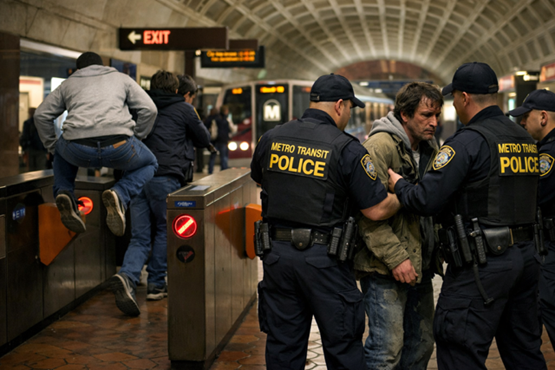
One of them is this: whenever you see one Metro police officer, there are always more nearby. Metro police do not travel alone. They move like a school project. Like if one officer appears, two more were copy-pasted just outside your peripheral vision. You round a corner and suddenly it looks like somebody started a police officers’ networking brunch inside the station.
And yet, somehow, even in the middle of all that visible authority, people will still jump the fare gates with the kind of confidence usually reserved for Olympic qualifiers and men who say “trust me” right before making your life worse.
I have seen someone hop a fare gate so smoothly it looked like muscle memory. No hesitation. No warmup. No second thoughts. This was not a crime of desperation. This was a routine. This man had clearly stretched before arriving.
Then there is piggybacking, one of Metro’s weirdest social practices, where a total stranger times their entry behind another passenger and glides through the gate on borrowed legitimacy. It is an incredibly intimate crime, if you think about it. There are married couples with less coordinated movement. Somebody taps, minds their business, and suddenly another grown adult is half a step behind them, close enough to qualify as a dependent.
You do not really know violation until a stranger uses your paid fare like you filed taxes jointly.
And what makes it even funnier is how casual everybody is about it. The piggybacker does not look nervous. The gate-jumper does not look hunted. The staff often do not react. The police might be ten feet away. There is no alarm, no whistle, no dramatic pursuit sequence. Just the quiet acknowledgment that on today’s episode of regional transit, the fare gate is more of a suggestion than a barrier.
That is what gets me.
I am not naïve. I understand transit systems are messy. I understand not every offense can be stopped. I understand officers have bigger issues to worry about than every single person trying to save a couple dollars and a little self-respect. I know public transportation is an ecosystem. It is not a lab. It is a moving experiment involving urgency, fatigue, social friction, and the kind of mental instability that makes somebody decide this is the perfect place to clip their nails.
But what I do not understand is the logic.
What exactly is the operating concept here?
Because from where I sit, usually by the door because I still foolishly believe I will outsmart my transfer, the system appears to function according to principles known only to Metro, weather patterns, and perhaps a rotating council of exhausted supervisors.
Sometimes there are officers everywhere. Sometimes there are none. Sometimes they stand in the station while people jump the gates in plain view. Sometimes one person gets stopped with the urgency of a federal indictment. Sometimes another person sails through untouched like a diplomat with immunity.
It is impossible to build a theory of enforcement when the evidence keeps changing shape in front of you.
And before anyone says, “Well, maybe they are exercising discretion,” let me just say this: discretion is a fine principle in courtrooms and diplomacy. On Metro, it often looks a lot like random number generation.
I cannot even comfortably reduce it to discrimination in the obvious way because the inconsistency is too broad, too chaotic, too stupidly democratic. In the same station, in the same hour, under the same fluorescent lighting, one person gets hammered, another gets ignored, and a third practically moonwalks through the gate while a uniformed officer stares past them into the middle distance like he is contemplating whether this job once had a clearer mission.
That is not a coherent model. That is vibes-based governance.
And Washington, of all places, should not run on vibes. We already have entire agencies dedicated to making vibes sound strategic.
This is why paying the fare starts to feel like a personality flaw.
Every weekday I do the right thing. I tap my card. I absorb the charge. I keep moving. I participate in civilization. Then I watch someone else leap the gate like they are starring in Fast & Furious: Fare Drift, and I am forced to confront a difficult truth: Metro has somehow designed a system where the most compliant person often looks like the least adaptive.
You can feel your own morality curdle a little.
Not enough to jump the gate yourself. Let me be clear. I am far too risk-averse, too employed, and too spiritually tired to begin a life of transit crime. But enough to make you stare at your fare deduction and think, wow, I really am out here financing the whole experiment.
There is something especially insulting about paying while being watched by people who are not paying and by officers who are not stopping them. It creates a very specific commuter bitterness. Not rage. Not even resentment exactly. More like administrative heartbreak. The feeling that you are participating sincerely in a social contract everyone else is treating as optional or decorative.
That feeling grows each time you see a heavily staffed station with very lightly enforced rules.
And the officer clustering does not help. Again, I understand safety in numbers. Transit is unpredictable. People are volatile. Nobody wants a situation escalating because one officer approached the wrong person alone. Fair enough. But from the rider perspective, when four officers are locked onto one fare issue while three other people evade payment within eyesight, it raises questions.
You do not need a PhD in public policy to know that looks ridiculous.
It is like watching a football team bring a full blitz against one receiver while leaving the rest of the field open. Impressive aggression. Unclear strategy. Very emotional. Little uneven.
Meanwhile, the rest of us are standing there pretending not to watch, which is one of the Metro rider’s most advanced survival skills. People on this system can witness almost anything and immediately become students of the tile floor. We do not stare. We do not ask questions. We glance once, log the absurdity internally, and continue toward our train like we are late for a meeting on resilience.
Metro commuters are some of the best anthropologists in America. We observe everything. We speak on almost nothing. We carry enough stories to fill several congressional hearings and at least two group chats.
And fare enforcement may be the richest field site of all.
Because it reveals the larger culture of Washington perfectly: highly visible systems, inconsistent application, many uniforms, unclear outcomes, and everybody pretending this is more coordinated than it actually is.
You can tell Metro wants riders to believe the rules matter. There are officers. There are signs. There are announcements. There is all the general atmosphere of a system that wants to be seen as serious. And maybe, institutionally, it is serious. Maybe there are internal deployment maps and enforcement metrics and cross-jurisdictional complexities and legal distinctions between D.C., Maryland, and Virginia that make all this make sense in a PowerPoint.
That is fine.
But riders do not commute through PowerPoint. We commute through experience.
And the experience is madness.
The experience is paying your fare, then watching a stranger go over the gate with the fluidity of a Cirque du Soleil understudy.
The experience is seeing piggybacking so often that you start wondering whether Metro should just add it as an official travel category. Full fare. Reduced fare. Senior. Disabled. Government. Opportunist.
The experience is seeing bus enforcement go from zero to SWAT-team energy depending on which stop, which driver, which day, and which unlucky passenger the system has chosen to become deeply principled about.
The experience is seeing enough officers in one station to suggest a tactical operation, only to discover they are apparently there to provide a strongly worded ambiance.
And yes, I know that sounds harsh. But the visual incoherence is the problem. A little nonpayment in a big system is one thing. A visibly arbitrary response is another. Once riders start to believe enforcement is random, the rule itself loses moral force. People stop seeing it as a standard and start seeing it as a gamble.
That is bad management.
Because the goal of fare enforcement should not just be punishment. It should be clarity. It should make ordinary riders think: yes, this system is imperfect, but I understand how it works. Instead, Metro often inspires a different thought: this entire thing is being held together by architecture, fatigue, and the fact that most of us are too decent or too scared to test the boundaries before coffee.
The real winners, of course, are the people who have understood this from the beginning. They are not angry. They are not confused. They are not writing mental essays while waiting for the Red Line. They simply move through the system with supreme urban confidence. They know which gates stick. They know where the officers cluster. They know when the bus driver has emotionally checked out. They know that rules on Metro are sometimes enforced less like laws and more like weather advisories.
Possible. Serious. Uneven. Check local conditions.
And the rest of us just keep tapping our cards like loyal shareholders in dysfunction.
That is the part I cannot get over. There is something deeply comic about a transit system in which the most predictable action is the behavior of the paying customers. We are the fixed costs. We are the stability mechanism. We are the ones keeping the revenue model alive while everybody else experiments with alternative theories of entry.
Maybe that is the real fare structure.
Standard fare for riders.
Premium freedom for improvisers.
Moral exhaustion for observers.
By the time I get to work, I have already seen enough human behavior to qualify for field pay. I have watched a man hold the train doors with his foot like he was saving democracy. I have seen someone enter the car eating fried fish at breakfast hours. I have witnessed a woman apply a full face of makeup between Gallery Place and L’Enfant with the calm hand of a surgeon. I have seen schoolkids with more tactical movement than junior staffers at the Pentagon. And woven through all of it is the standing Metro question: who exactly is fare enforcement for?
Not in theory. In practice.
Is it deterrence? Is it revenue recovery? Is it optics? Is it random intervention to maintain an atmosphere of consequence? Is it concentrated around certain times and places because of staffing constraints? Is it mostly there to make the paying public feel like somebody, somewhere, is at least trying?
Because from the platform, it often looks like the system has settled on a compromise nobody fully admits out loud: enforce enough to create a spectacle now and then, ignore enough to keep things moving, and let the paying riders carry the emotional burden of noticing the contradiction.
And notice it we do.
Every day.
All the way to work.
So I will keep tapping my SmarTrip card. I will keep watching the fare gate Olympics. I will keep pretending not to see the piggyback maneuvers that would qualify as partner dancing in another setting. I will keep observing the small miracle by which four officers can appear instantly around one nonpayer while two others drift through untouched like blessed spirits of administrative loopholes.
And I will keep asking the same question every commuter asks, whether out loud or in the privacy of their own fed-up soul:
What exactly are we doing here?
Because if the answer is “enforcing the fare,” the evidence is mixed.
If the answer is “maintaining order,” that too feels ambitious.
But if the answer is “creating a daily absurdist theater production for exhausted professionals on their way downtown,” then I have to say: mission accomplished.
The DC Metro may not have solved fare evasion.
But it has perfected something arguably more Washington:
the appearance of a system,
the language of seriousness,
and the live commuter experience of total strategic confusion.
That is not transportation.
That is Metro Confessions.