Boredom has a PR problem.
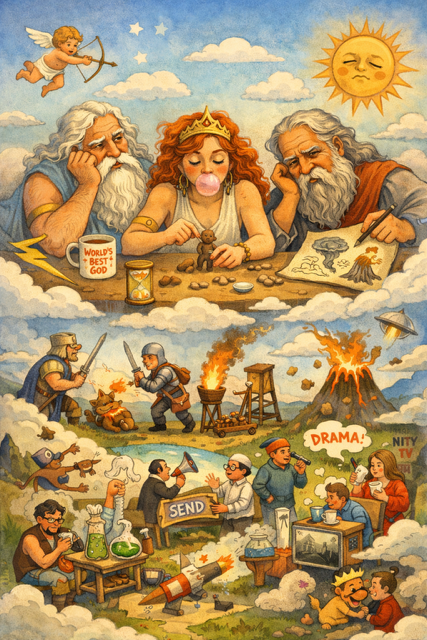
We treat it like the harmless cousin of exhaustion—soft, beige, and mildly inconvenient. We talk about boredom the way we talk about plain toast: not ideal, but not dangerous. Yet Kierkegaard shows up like the world’s most philosophical coworker and says, basically, “Actually… boredom is the root of all evil. Also, the gods were bored, so they made you.”
That’s a wild origin story.
Not “dust and breath and destiny,” but: “We were bored. Let’s start a species.”
And honestly? It tracks.
Because if you’ve ever watched a person with five free minutes and an internet connection, you’ve seen the beginning of evil in real time.
Boredom: the quiet executive sponsor of bad decisions
Boredom doesn’t kick the door down. It doesn’t arrive with dramatic music. It just slides into the room like a mid-level manager with “quick question” energy and says:
- “So… what are we doing?”
- And if the answer is “nothing,” boredom immediately opens a new tab inside your soul.
- That tab is titled: Unnecessary Chaos.
This is how it starts:
- You’re bored, so you “just check” your phone.
- The phone feeds you a video of a guy pressure-washing a driveway in 4K.
- You feel calm for twelve seconds.
- Then boredom returns, louder, because now you’ve awakened your brain’s appetite for novelty.
- Suddenly you’re ordering a grapefruit spoon, researching Viking ship-building techniques, and drafting a resignation letter you won’t send.
All before lunch.
Boredom isn’t laziness. It’s restlessness with ambition and no plan.
Boredom is the reason you reorganize your entire kitchen at 11:47 p.m. and wake up the next morning unable to find the peanut butter—because your house is now optimized according to a system only boredom understands.
“The world goes backwards” is just boredom with a platform
Kierkegaard’s line hits harder when you consider modern life. We have eliminated so much boredom with technology… and yet boredom is thriving like it has a marketing budget.
Because we didn’t eliminate boredom. We just gave it better tools.
Boredom used to be:
- staring out a window
- rolling a stick in the dirt
- making a small, dramatic sigh
- inventing a game with a rock
Now boredom is:
- refreshing the same apps like you’re expecting a miracle
- doomscrolling through tragedies at the speed of your thumb
- starting fights in comment sections about things you don’t even care about
- watching a 22-part series on a celebrity’s breakup like it’s required training
Boredom is no longer a lack of stimulation. It’s an oversupply of stimulation that somehow doesn’t satisfy.
You’re not under-entertained; you’re under-nourished.
And this is where Kierkegaard’s “evil spreads” starts to look less like an insult and more like a systems analysis.
When people are bored, they don’t just seek joy. They seek motion.
Any motion.
Even destructive motion.
Even petty motion.
Even “let me say something incendiary and see what happens” motion.
Boredom doesn’t need a cause. It just needs time.
The gods were bored, so they created humans — and humans got bored, so they created everything else
If the gods created humans out of boredom, then humans turned around and created the entire modern world out of… boredom plus caffeine.
Boredom created reality television.
Boredom created office drama.
Boredom created “I wonder if I can cook an entire dinner using only an air fryer and spite.”
Boredom created the phrase “Let’s circle back,” which is arguably proof of original sin.
And boredom definitely created the concept of “Reply All.”
There’s a reason the first thing a bored person does is initiate an interaction they cannot control. That’s the dopamine play.
Boredom says: “I need a reaction.”
Not a solution. Not a vision. Not an outcome.
A reaction.
So you text your ex.
You buy the thing.
You start the argument.
You propose the reorg.
You “just ask” the question in the group chat that you know will split the room into factions.
Boredom loves factions.
Boredom loves chaos.
Boredom loves a meeting that could’ve been an email.
The holy difference between boredom and stillness
Here’s the catch: boredom is not the same as stillness.
Stillness is calm. Stillness is grounded. Stillness is the kind of quiet that lets your nervous system unclench and your brain finally process what it’s been avoiding.
Boredom is stillness without permission.
Boredom is quiet that feels like failure.
Stillness says, “Be here.”
Boredom says, “Escape.”
So we avoid boredom like it’s a moral defect, when the reality is: boredom is a signal. A dashboard light. A little internal alert that says:
- Your life is trying to tell you something, and you’re trying to drown it out with stimulation.
- Sometimes boredom is your mind asking for meaning.
- Sometimes boredom is your body asking for rest.
- Sometimes boredom is your soul saying, “Please stop living like a device that needs constant input.”
And sometimes boredom is simply your brain detoxing from an overstimulated world and trying to remember how to be a human being again.
Which is inconvenient, because the world does not reward “remembering how to be human.” It rewards “being online.”
The corporate version of boredom is “strategic mischief”
Let’s talk workplace boredom, because that’s where boredom becomes a full-blown operational risk.
Work boredom doesn’t look like lying on the floor staring at the ceiling (though respect to anyone bold enough to try). Workplace boredom looks like:
creating a spreadsheet for something that doesn’t need tracking
scheduling “alignment” meetings to generate the illusion of progress
rewriting an email seven times to feel powerful
“following up” just to feel alive
turning minor issues into strategic initiatives because you need a mission
Workplace boredom is the birthplace of unnecessary complexity.
It’s how organizations end up with:
five approval layers for ordering pens
a governance board for a policy nobody reads
a 60-slide deck that exists solely to justify the existence of decks
Boredom loves bureaucracy because bureaucracy creates activity without meaning.
Which is exactly what boredom wants: motion without risk of real transformation.
Real transformation is scary. Boredom isn’t trying to evolve. It’s trying to feel something.
What if boredom isn’t evil — but unmanaged boredom is?
Kierkegaard calls boredom the root of evil, but maybe it’s more precise to say:
- Boredom is the root of impulsivity.
- And impulsivity, when scaled, becomes the kind of collective nonsense we later call “history.”
- Because an individual bored person makes a questionable purchase.
A bored society makes questionable decisions.
A bored empire starts romanticizing conflict.
A bored organization starts measuring productivity by busyness.
A bored person starts scanning for enemies in their own home, their workplace, their community—because boredom needs a storyline, and conflict is the easiest one.
Boredom doesn’t ask, “What matters?”
It asks, “What’s happening?”
And if nothing is happening, it will manufacture something.
Including trouble.
A practical boredom protocol (aka: how to stop boredom from running the show)
You don’t need to “beat” boredom. You need to route it.
Think of boredom as raw energy looking for direction. If you don’t give it a runway, it will take over the control tower.
Here’s a simple, real-world boredom playbook:
- Name it out loud.
- “I’m bored” is more powerful than you think. It pulls boredom out of the shadows where it becomes compulsion.
- Ask the diagnostic question.
- Am I bored because I need rest or because I need meaning?
- Rest boredom: you’re depleted, and your brain is refusing more input.
- Meaning boredom: you’re under-challenged, under-connected, under-inspired.
- Choose one “clean” stimulus.
- Not five tabs. Not infinite scroll. One thing: a walk, a book, music, journaling, a task you can finish.
- Do the smallest useful thing.
- Boredom hates completion because completion ends the drama.
- Send the email. Fold one pile. Write one paragraph. Wash five dishes. Make one decision.
- Create on purpose.
- The gods made humans out of boredom.
- You can make something smaller: a page, a meal, a sketch, a plan, a conversation that matters.
Creation is boredom’s cleanest outlet.
The punchline Kierkegaard didn’t write
If the gods created humans because they were bored, then we are, in a cosmic sense, the universe’s first boredom project.
Which means boredom is older than you.
It’s not a personal failure. It’s part of the design.
But you don’t have to let it drive.
Because boredom becomes dangerous when it has no direction—when it’s untreated energy that starts looking for cheap excitement, cheap outrage, cheap meaning.
And yes, sometimes that’s evil.
Other times it’s just you at 1:00 a.m. trying to convince yourself that buying a third throw pillow is “self-care.”
The solution isn’t to eliminate boredom.
It’s to stop outsourcing your life to it.
So the next time boredom shows up with its little clipboard and says, “So… what are we doing?” you can say:
“We’re not manufacturing chaos today.”
“We’re not doomscrolling our way into despair.”
“We’re not starting an unnecessary fire just to feel warm.”
We’re going to create something. Even something small.
Because if boredom is the root of evil, then intentionality is the root of sanity.
And if the gods started this whole thing because they were bored…
the least we can do is not make it worse in the comments section.