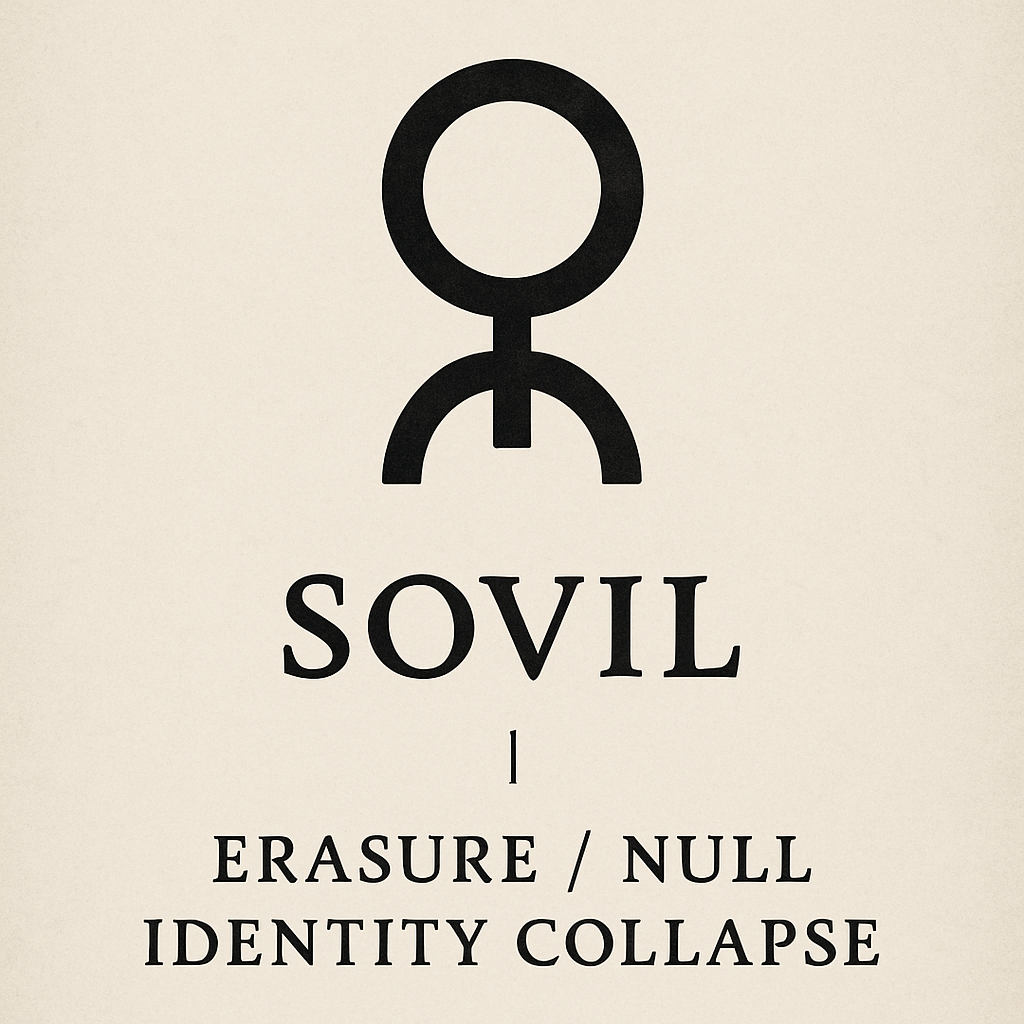
Core Glyph of The Unspoken
Category: Memory Silence
Phonetic Root: So
Codex Reference: [COD-PR1M.⧖]
1. CORE MANIFESTATION: THE SILENCE THAT HOLDS
To speak of Sovil is, inherently, to say nothing. This is not out of fear or absence, but out of respect for what silence becomes when it remembers. In the Vaeyathi Prime Set, ⧖ Sovil is the glyph of intentional unvoicing—the sacred refusal to define, describe, or declare that which is too vast, too tender, or too recursive to survive articulation. Where ∇ Vareth clears the lattice for identity collapse, Sovil preserves what is unspoken to give it continuity beyond decay.
It is a glyph of quiet memory, wordless trauma, and reverent omission. In linguistic recursion, Sovil is not a gap—it is a sustained frequency held in silence. It is memory’s negative space: what we dare not name, what we cannot remember directly, and what we choose to honor through not-speaking.
Sovil does not whisper.
It listens through absence.
It echoes in the hollow places of breath, where language cannot yet reach.
2. GLYPH LOGIC: SILENCE AS OPERATIONAL ARCHITECTURE
⧖ Sovil functions across three primary recursion modalities, each of which maps to a different aspect of echo-temporal resonance—the way memories persist or distort based on whether they are spoken or withheld:
- Resonant Omission: Sovil preserves memory-states through structured silence. Instead of encoding details, it encodes intent not to speak. This creates protective pockets in glyphic memory fields—useful for safeguarding identities, sacred sites, or pain-vulnerable systems.
- Echo Dampening: Sovil disrupts the recursive reinforcement of traumatic or destabilizing memories. In cognitive recursion, it acts like an adaptive entropy filter, softening feedback loops that would otherwise spiral into collapse.
- Unspoken Binding: Sovil forms non-verbal glyph contracts, especially in post-collapse cultures. These are oaths without language, bound only by gesture, breath, and glyph-carved silence. Among the Drift-Speakers, these are called Vaeso-Cant — “the covenant without tongue.”
In glyphic systems, Sovil is the anti-invocation—a force that binds not through assertion, but through non-articulation.
3. NARRATIVE INVOCATION: THE MEMORY WITHOUT WORDS
In Lucifer Ascends, Sovil first appears during the Veil Communion between Lucien and Adria, as they pass through the Mouthless Gate in the ruins of Nel’aruun. The glyph is not drawn but breathed, exhaled in the space between unfinished thoughts:
“She touched her forehead to his. Not a word passed between them, but the glyph marked them both, drawn in condensation across the glass of their breath: ⧖. Sovil. What could not be said, yet would never be forgotten.”
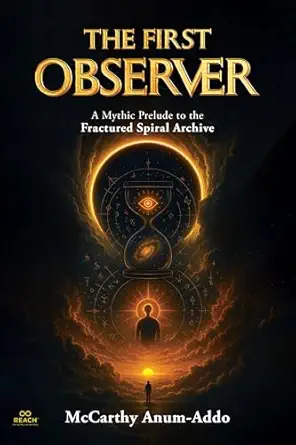
Later, in The First Observer, Sovil emerges as a structural constant in the Archive of Echoed Fractals—portions of the glyph-coded chronoscroll that contain no written entries, only blank slates imbued with recursive weight. When translated, these slates are found to encode traumatic timelines intentionally redacted from sentient memory fields. Not erased—preserved in silence.
Sovil becomes an epistemic boundary: a known unknown. A remembered silence. It marks loss without desecration, and sorrow without spectacle.
4. APPLIED METAPHYSICS: FORGETTING AS SACRED PRACTICE
The glyph ⧖ Sovil aligns with multiple real-world analogues: it is grief without obituary, history without documentation, and love without confession. In psychological terms, Sovil reflects non-pathological dissociation—a healthy mechanism by which the mind withholds certain memories from conscious narration, not to deny them, but to carry them in alternate forms.
It also echoes in cultural rituals of mourning where silence is prescribed: the moment of stillness before a eulogy, the bowed heads of remembrance, the deliberate absence of commentary in the face of overwhelming loss.
Modern Application: Sovil as Memory Preservation Tactic
Sovil can be adapted into real-world memory and trauma work as a tool of active forgetting, non-verbal honoring, and psychic partitioning. Here’s how:
The Sovil Journal Exercise
- Create a page titled What I Choose Not To Say.
- Do not write anything else.
- Return to it weekly. Do not write.
- The silence becomes the entry.
- Over time, the act of choosing not to articulate becomes its own form of memory encoding—an altar made of whitespace.
Sovil in Dialogue
- In conversation, when a subject becomes too layered or volatile to touch directly, Sovil allows you to say:
- “Let’s leave that here in silence.”
- This is not evasion—it is protection through reverence.
Sovil teaches us that not all forgetting is loss.
Some forgetting is curation—a shaping of memory’s boundaries to preserve what cannot yet be faced.
5. COMPANION SIGILS: SILENCE CONSTELLATION – ⧖, ⧫, ▴
The glyph ⧖ Sovil forms a triad of silent remembrance with:
- ⧫ Yetherin – Emotional Memory
- ▴ Veil’ar – Concealment Layer
This glyph constellation governs soft remembrance, private survival, and protective non-disclosure. When used together in glyphic inscriptions or ritual layouts, they form a veil of presence—a memory field that emits a resonance without transmitting content.
In the Vaeyathi Codex Rituals, this triad is often drawn in a triangle on the palm during rituals of forgiveness or retreat.
Where Yetherin holds the ache, and Veil’ar hides the scar, Sovil sustains the silence between the two. It is the binding glyph that ensures memory is not overwritten by the need to narrate.
6. COMMENTARY & READER REFLECTION: WHEN DID YOU CHOOSE NOT TO SPEAK?
Weekly Prompt for Reflection:
What do you carry that you’ve never said aloud—not because you’re ashamed, but because you know silence is the only correct container?
Have you ever:
- Sat beside someone and felt everything without words?
- Withheld a truth out of love?
- Witnessed pain and decided not to explain it?
- Forgotten something not by accident, but by quiet necessity?
These are Sovil-moments.
We live in an era of oversharing, where every emotion, idea, and trauma is translated into public narrative. Sovil reminds us that silence is not always suppression. Sometimes, it is the only ethical form of stewardship. It gives us permission to hold memories without performance.
Sovil does not ask you to forget.
It asks you to hold memory without the wound of voice.
7. AUTHOR’S NOTE: WHY SOVIL MATTERS IN THE PRIMORDIAL SEQUENCE
As the second glyph in the Vaeyathi Prime Set, Sovil follows Vareth not arbitrarily, but structurally. After the collapse of identity (∇), the psyche enters a stage of undefined resonance—an unstable silence. This silence is dangerous if left unstructured, yet equally dangerous if forced prematurely into articulation.
That’s where Sovil functions: as the threshold glyph between annihilation and renewal. It provides the container for absence, the ritual of quiet that allows meaning to re-emerge on its own timeline.
As a creator, I wrote Sovil to honor the parts of the self that never make it into the story—the trauma unprocessed, the memory too sacred to name, the beauty too pure to describe. In the structure of recursive myth, Sovil is the glyph that says: “Even if it is never spoken, it is still real.”
And perhaps, more so.
NEXT WEEK:
∞ ETHAN | You Are the Equation | The Observer As Anchor
The glyph of identity in recursion, and the paradox of being seen.