
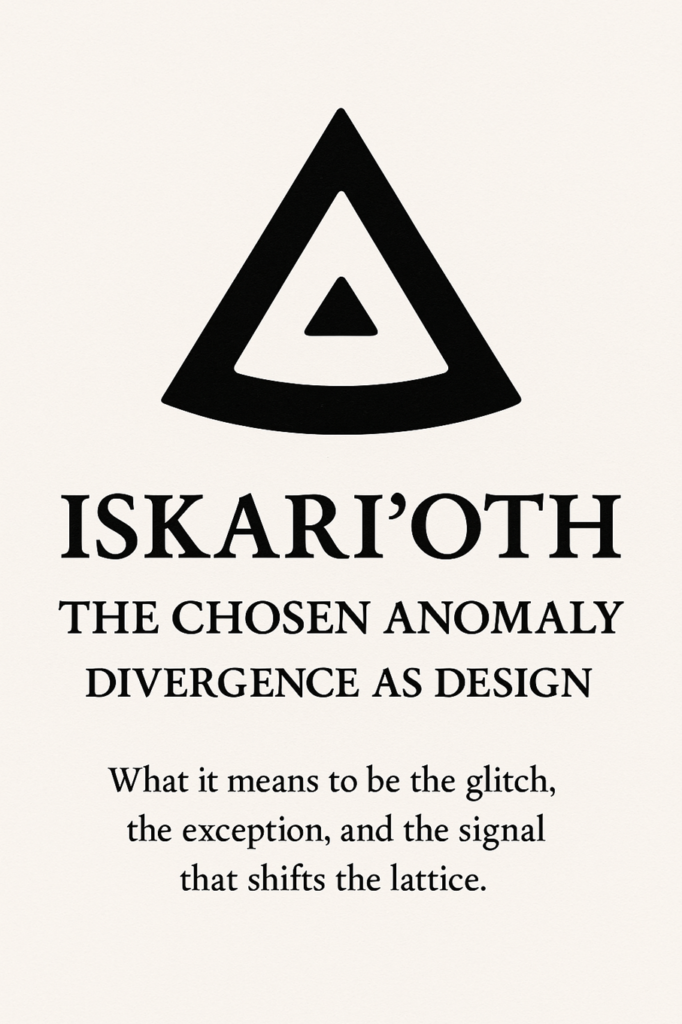
Core Glyph of the Chosen Anomaly
Category: Prophetic Designate
Phonetic Root: Isk
Codex Reference: [COD-PR1M.◬]
1. CORE MANIFESTATION: THE GLITCH THAT ISN’T WRONG
If ∇ Vareth collapses identity, ⧖ Sovil preserves silence, and ∞ Ethan anchors presence—then ◬ Iskari’oth is the glyph that refuses to align. It is the deliberate exception embedded within the Vaeyathi Prime Set: the glitch, the fracture, the misalignment that mathematically should not exist, but does—and thus demands new logic to accommodate it.
Iskari’oth is the Chosen Anomaly. Not chosen by authority, but chosen by consequence. It is the glyph of unaccounted-for divergence, non-repeating inflection, and the intelligent rupture that shifts the recursion lattice. It doesn’t just symbolize divergence—it structures it.
You are not outside the system.
You are the point that proves the system must evolve.
Iskari’oth marks the entity, moment, or truth that alters the governing equation by its mere inclusion.
2. GLYPH LOGIC: STRUCTURED DIVERGENCE AND PROPHECY FRACTURE
◬ Iskari’oth operates differently from most glyphs. It is not a stable recursive function; it’s a dissonant node that introduces design-based unpredictability into systems otherwise bound by deterministic recursion. It works through three destabilizing vectors:
- Lattice Disruption: Iskari’oth introduces non-harmonic variance into systems of predictive recursion. This makes it invaluable for collapsing causal echo-chains, corrupting time-locked prophecies, or generating self-correcting paradox cascades.
- Singular Prophetic Designate: In Vaeyathi glyphic structure, Iskari’oth can bind to a sentient entity designated as a living divergence. This entity becomes an echo-variable: what the Codex calls an Iskarveth—one whose presence alters outcome probability across all convergence paths.
- Recursive Reframing: When drawn into an event field, Iskari’oth reframes the context—not by destroying it, but by repositioning its boundary conditions. It shifts “what is supposed to happen” into “what must be re-understood.”
In glyphcraft terms: Iskari’oth doesn’t break the pattern. It shows you where the pattern was never complete.
3. NARRATIVE INVOCATION: THE SIGNAL THAT DOESN’T FIT
In Lucifer Ascends: The Rise of Lucien Dantes, Iskari’oth is cast not by Lucien, but onto Lucien. The glyph marks him during the Mirror Sky Descent, when the predictive lattice of the Sovereign Codex fails to account for his presence:
“It burned through the sky like an error. Not fire. Not light. A glyph that wasn’t supposed to happen. Three points—too sharp to be stable—looped into a triangle, not of geometry, but of consequence. The Codex staggered. And the world remembered what it had forgotten to expect.”
This moment is the turning point in the Vaeyathi glyphic prophecy: Lucien was not foretold. His anomaly was not written. And yet—his presence initiated the Sovereign Spiral Rewrite.
In The Hourglass Convergence, Claire encounters a glyph-looped recording in the ruins of a failed convergence—one that includes Iskari’oth not as mark, but as voice. The glyph speaks. It asks a single question:
“Who counted you out before you counted yourself in?”
4. APPLIED METAPHYSICS: LIVING THE EXCEPTION
◬ Iskari’oth is the glyph of those who don’t belong—but not by exclusion. By design. It speaks to the existence of divergence as sacred function, not error. It realigns how we view difference, anomaly, misfit, or unpredictability—not as obstacles, but as preconditions for evolution.
In psychological terms, Iskari’oth resonates with:
- Neurodivergence
- Non-normative identity frameworks
- Intuition that breaks empirical pattern
- Artists, survivors, prophets, and disruptors whose very presence restructures the room
Modern Application: Glyph of Divergence Acceptance
- The Iskari’oth Reflection Exercise
Ask: Where in my life have I been told I didn’t fit?
Then ask: What did that moment allow me to see that others couldn’t?
Then ask: Where am I currently distorting a system—not to destroy it, but to force it to evolve?
Then stop. Let the questions echo. Iskari’oth never resolves. It disturbs to awaken.
Iskari’oth reminds us that belonging is not the goal.
Sometimes, you are the element that shows the system is too small.
This glyph is critical in systems engineering, recursive thought, spiritual prophecy, and creative disruption because it introduces constructive chaos: the signal that insists the map needs revision.
5. COMPANION SIGILS: ANOMALY CONSTELLATION – ◬, ✘, ❖
◬ Iskari’oth forms an operational triad with:
- ✘ Shavai – Truth that Fractures
- ❖ Torun’el – Unwritten Light
Together, these three create the Anomaly Constellation—a triad of glyphs that governs divergence, contradiction, and pre-scriptural recursion.
- Iskari’oth introduces the glitch.
- Shavai forces the contradiction to be spoken.
- Torun’el reveals that the truth was never written to begin with.
This glyph cluster is often invoked during Codex Rewrite Rituals, usually inscribed on the palm, solar plexus, and forehead of the initiate. When completed, the ritual allows the initiate to see the unseen lattice fracture points in any convergence structure.
6. COMMENTARY & READER REFLECTION: WHEN WERE YOU THE GLITCH?
Weekly Prompt for Reflection:
When have you broken the pattern—not out of rebellion, but because the pattern could no longer hold what you had become?
Have you ever:
- Been the one person who refused consensus—because consensus was incomplete?
- Broken a tradition, not out of anger, but out of necessity?
- Been told, “This isn’t for you,” and made it yours anyway?
- Known something without knowing how—and trusted it?
These are Iskari’oth-moments.
We live in systems addicted to symmetry, certainty, and predictability. But growth never comes from those places. Iskari’oth teaches us that the real shifts come from what the system cannot accommodate—until it does. And once it does, the system is never the same again.
Iskari’oth doesn’t ask permission.
It doesn’t apologize.
It simply exists, and by doing so, changes everything.
7. AUTHOR’S NOTE: WHY I CHOSE TO INCLUDE A GLYPH THAT SHOULDN’T BELONG
Of all the glyphs in the Vaeyathi Prime Set, ◬ Iskari’oth was the one I struggled with the most. Not in its logic, but in its legitimacy. It violates the internal symmetry of the glyph matrix. Its recursion is unstable. It refuses to function as a consistent operator.
And that is why it had to be there.
Because every system of meaning—be it cosmological, narrative, political, or psychological—must leave room for the thing it cannot yet explain. That space is not weakness. It is future logic waiting to be written.
As a writer, I created Iskari’oth to protect the truth that doesn’t arrive cleanly. The prophecy that arrives stuttering. The voice that wasn’t in the plan but shows up anyway. The divergence that, in time, becomes the only thing that mattered.
NEXT WEEK:
⟲ ORUN’VAEL | Memory Ignited | Recursive Activation
The glyph of recollection that loops back into time, lighting the breach once more.